Dolmabahce Palace is one of the most magnificent landmarks on the shores of the Bosphorus, reflecting the Ottoman Empire’s final golden era in the 19th century. With its dazzling crystal chandeliers, grand ceremonial halls, and a unique blend of European and Ottoman architecture, it offers visitors an unforgettable journey into history.
As a licensed tour guide with over 20 years of experience in Istanbul, I have prepared this article to help you make the most of your visit. Here you will find practical information, visiting hours, ticket options, and insider tips that only a local expert can provide.
Whether you explore the palace on your own or join a guided tour, Dolmabahce Palace will fascinate you with its rich history and breathtaking details. Let’s discover together why this iconic palace is a must-see for any Istanbul itinerary.
The History of Dolmabahce Palace
The history of Dolmabahce Palace begins with Sultan Abdulmecid leaving the traditional Topkapi Palace in the 19th century. A new palace was built on the shores of the Bosphorus under the influence of westernization in the Ottoman Empire.
1. Ottoman Istanbul in the 19th Century
Westernization gained real momentum in 19th-century Ottoman Istanbul. For the residents of the Historical Peninsula, the idea of “Europe” was closely associated with the northern shore of the Golden Horn, where embassies, foreign merchants, and new lifestyles gradually reshaped the city’s social landscape.
This transformation became far more visible after Sultan Abdulmecid moved the Ottoman court from Topkapi Palace to Dolmabahce Palace in 1856. From that moment on, the center of political power and elite life shifted away from the Old City. Neighborhoods along the Bosphorus and around Beyoglu began to offer a higher standard of living, influenced by Western architecture, fashion, and social customs.
While much of the Muslim population on the Historical Peninsula continued to lead a more modest and traditional life, the Pera (Beyoglu) district developed a very different character. With its balls, concerts, theaters, and social gatherings, it earned the nickname “the Paris of the East,” becoming the cultural and social heart of a rapidly changing imperial capital.
2. Beyoglu and the Bosphorus
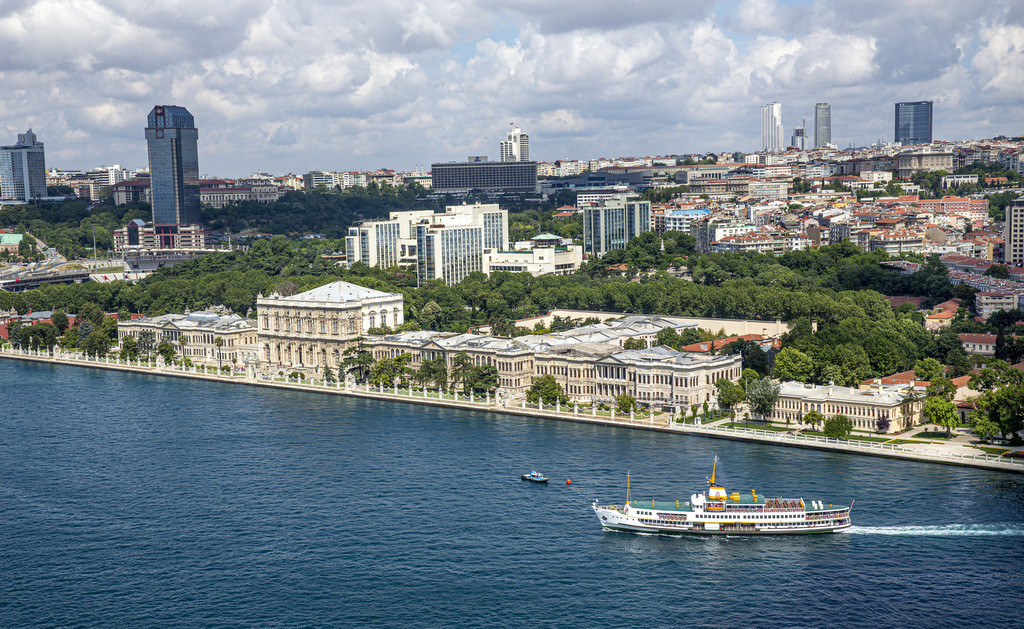
Beyoglu and the Bosphorus gradually became the most visible symbols of this new lifestyle. In Beyoglu—known at the time as Pera—Neo-Classical and Baroque-style buildings began to rise, while French-style cafés, restaurants, and social venues introduced new habits into daily life.
Pera also developed into a district where foreign communities and non-Muslim Ottoman citizens lived side by side. French and Italian merchants, often referred to as Levantines, along with Greeks, Armenians, and Jews, shaped a distinctive urban culture that was different from the more traditional atmosphere of the Historical Peninsula. The district quickly became a center for social life, attracting not only diplomats and merchants but also members of the Ottoman bureaucracy—and on occasion, even the Sultan himself.
Many foreign embassies, noble families, and wealthy merchants who lived in Pera also built mansions along the Bosphorus shoreline. As a result, the Bosphorus underwent a dramatic transformation during the 19th century, with its waterfront gradually filling with elegant and colorful waterside residences.
Observing these changes in the city and the shifting lifestyle of the elite, Sultan Abdulmecid decided to commission a new palace that would replace the traditional Topkapi Palace. This decision ultimately led to the construction of the magnificent Dolmabahce Palace on the shores of the Bosphorus.
The Architecture of Dolmabahce Palace
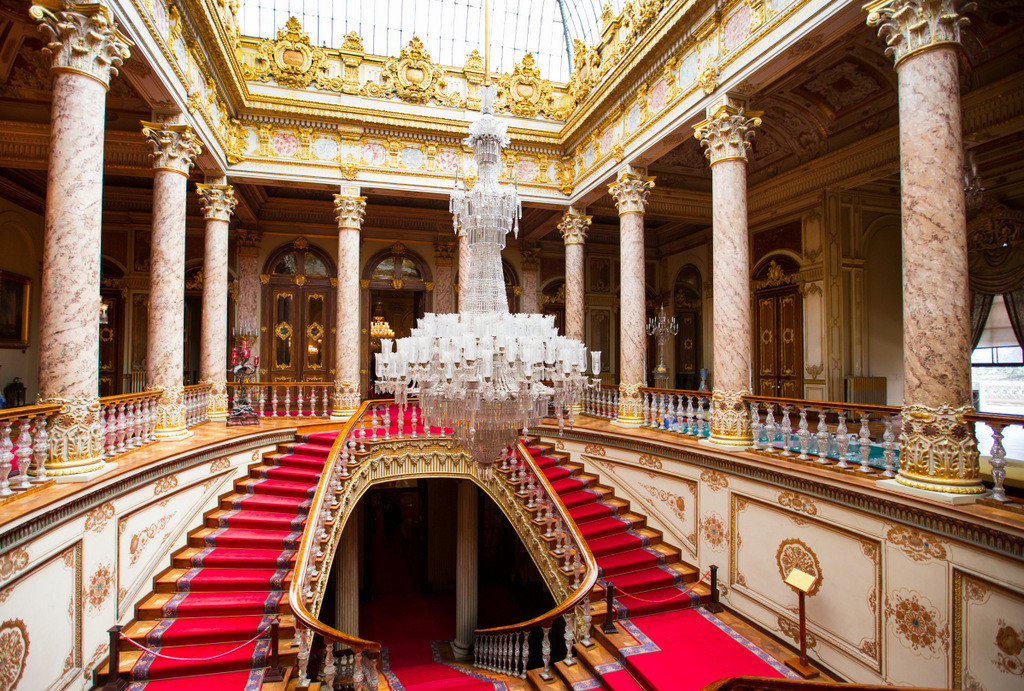
The architecture of Dolmabahce Palace is very different from that of earlier Ottoman palaces. Visitors who have already seen Topkapi Palace will immediately notice the contrast between Classical Ottoman architecture and the Western-influenced palace designs of the 19th century.
In Turkish, “dolma” means filled and “bahce” means garden. The name of the palace comes from the site on which it was built: a small bay along the Bosphorus that was gradually filled in to create the palace grounds.
The chief architect, Garabet Balyan, successfully combined Eastern and European traditions. While court life, ceremonies, and protocol remained deeply rooted in Ottoman culture, the architectural layout was inspired by European palaces. Balyan brought together different architectural styles, resulting in an eclectic design that reflects the ambitions of a rapidly modernizing empire.
Dolmabahce Palace consists of 285 rooms and 46 halls, spread across an area of approximately 25 hectares (62 acres). Inside, visitors can see nearly 600 unique paintings and impressive large-scale Turkish carpets, many of which were specially woven for the palace and reflect the high level of craftsmanship of the period.
In terms of technology, the palace was also far ahead of its time. Gas lighting and water-closets were imported from Great Britain at a time when many European palaces still lacked such features. In later years, electricity, a central heating system, and even an elevator were added, further underlining Dolmabahce Palace’s role as a symbol of modernization.
Dolmabahce Palace Entrance Fee 2026
The entrance fee for Dolmabahce Palace in 2026 is 2000 Turkish lira. This combined ticket includes access to the Main Building, the Harem Rooms, and the Palace Collections sections of the palace. This section was last updated in March 2026.
In short, with a combined ticket, you can visit the main halls of the palace called the Selamlik (the official reception and state rooms), as well as the Harem Rooms (the private living quarters of the sultans and their families). The ticket also includes access to the Palace Collections Museum, where you can admire a remarkable selection of imperial paintings, including portraits of the sultans and works by renowned court artists.
After receiving the ticket you will see the turnstiles at the entrance of the palace. You can get a free audio guide system from the office on the left before you pass the turnstiles. If you bring a wired headset for your audio guide, it will be easier for you to listen and you will not disturb other visitors around you.
Dolmabahce Palace Entry & Experience Options
Below you can compare Dolmabahce Palace ticket options as well as a related Bosphorus sunset cruise experience.
Dolmabahce Palace Opening Hours 2026
Dolmabahce Palace is open daily from 09:00 AM to 05:00 PM in 2026. Please note that the palace is closed on Mondays. This information was last updated on March 2026.
Museum visiting hours in Istanbul may change due to various restorations and special occasions. Before going to the museum, I recommend you to visit the official website of the palace and review the latest situation.
How to Get to the Palace?
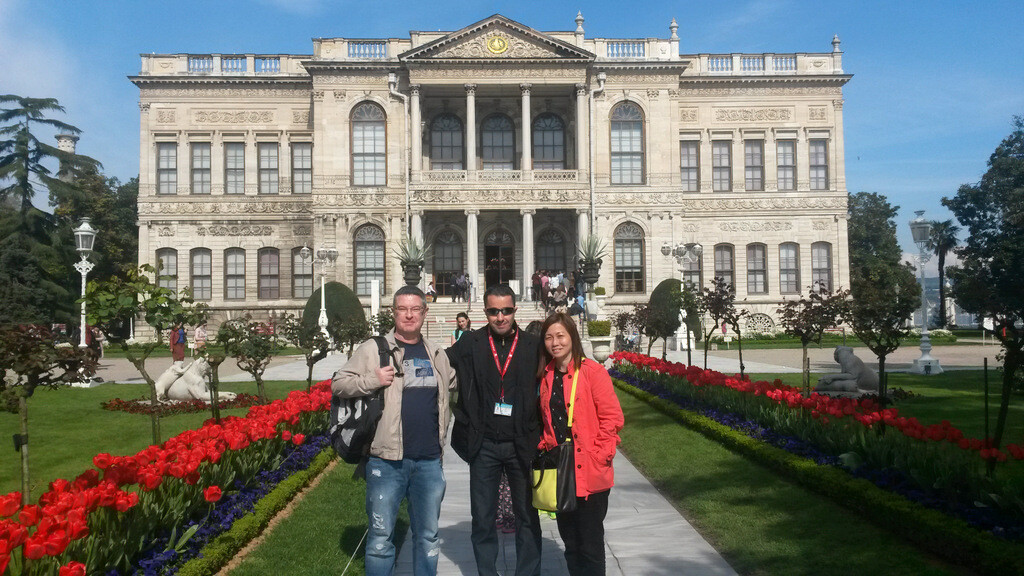
Dolmabahce Palace is located in the Besiktas district, right next to the Besiktas Stadium, on the shores of the Bosphorus. Thanks to its central location, the palace is easy to reach from both Sultanahmet and Taksim Square, two of the most popular areas for visitors in Istanbul.
If you are coming from Sultanahmet, the most practical option is to take the Tram T1 in the direction of Kabatas. Get off at the last stop, Kabatas, and from there it is about a 10-minute walk to the palace along the waterfront.
From Taksim Square, you can take the Funicular F1 down to Kabatas, which only takes a few minutes. Once you reach Kabatas, simply follow the coastline toward Besiktas, and you will reach Dolmabahce Palace in a short walk.
Conclusion
Dolmabahce Palace is one of the best places to understand Ottoman Istanbul in the 19th century, a period when the city was undergoing profound transformation under the influence of Westernization. The palace reflects this shift not only in its architecture, but also in its layout, ceremonial spaces, and decorative choices.
Both the exterior and interior of the palace are visually impressive. The original furniture, grand chandeliers, and richly decorated walls offer a clear glimpse into the aesthetic tastes of the era and the ambitions of the late Ottoman court.
The palace grounds also provide excellent photo opportunities. Its spacious courtyards, ornamental fountains, statues, and monumental gates are framed by the Bosphorus, which remains a constant and striking backdrop throughout your visit.
Written by Serhat Engul

Hi, is it free just to walk around the garden of this palace? ( just visiting the outside of building)
Hi Jerry, the outer garden of Dolmabahce Palace can be entered without a ticket. But I can’t say that part is very attractive. There is only the palace cafe and ticket offices there.
The main garden of the palace, decorated with flowers and a pool, remains inside. You can’t get there without going through the ticket turnstiles.
Hello! Is it possible to take amateur pictures during the visit?
Thank you!
Hi Maria, unfortunately it is forbidden to take photos indoors of the Dolmabahce Palace. But you can take pictures in the courtyards.
Yes, the prices have really shot up. I paid 300 TL a week back.
Hello Manali, I have started to update the ticket prices of Istanbul museums on the site. Very soon, the latest entrance fees of Dolmabahce Palace will be added. Thanks for information.
You need to update the ticket price. It has almost tripled now
Hi Andrew, thanks for the warning. Yes, as of May 1, prices have changed. As far as I can see, they have combined the Palace and Harem tickets, and on top of that, there is a 50% price increase.
In fact, the issue is not only Dolmabahce Palace. There are 50 museums from Turkey on the site, and all of them need updating their ticket prices.
Although I try to keep the site up to date as much as possible, sometimes I can’t keep up because the prices change so frequently due to post-pandemic inflation.
Hello! Can we visit the palace with our dog?
Thank you
I don’t think you can visit with a dog. I have never come across anyone visiting the palace with a pet before. They probably don’t allow it. Inside the palace, there are 150-year-old carpets and priceless items.
Does it needed Negative PCR test to visit the Palace?
No, there is no Covid control at the entrance to mosques and museums in Istanbul. At least that’s the case with the big museums affiliated with the state, and Dolmabahce Palace is one of them. Some private museums may have a different procedure.
Serhat, thank you so much for your swift responce and useful articles!
You’re welcome, Marina. I wish you a nice trip in Istanbul.