Over the past two decades, working as a licensed tour guide in Istanbul, my path has gradually led me deeper into one specific layer of the city: Byzantium.
What began as a general interest in history slowly evolved into a focused pursuit. Along the way, certain books shaped that journey—most notably the Byzantium trilogy by John Julius Norwich, which brought the empire to life not just as a sequence of events, but as a continuous human story.
Since then, I have spent years exploring the Byzantine heritage of Istanbul—through academic sources, on-site observation, and by guiding hundreds of visitors who shared the same curiosity.
This article is a reflection of that journey.
Byzantine Constantinople was one of the most remarkable cities in history: vast, complex, and constantly evolving. Founded by Constantine the Great in 330 as a “New Rome,” it became the capital of an empire that would endure for more than a thousand years.
Rather than presenting this history as a timeline alone, I have chosen a different approach.
In the following sections, you will explore the story of Constantinople through 25 sites—churches, palaces, walls, and monuments—that together reveal how the city was built, transformed, challenged, and ultimately reshaped.
What follows is not just a list of places.
It is the story of a city.
A Long Story Told Through 25 Places
Constantinople was not a static city.
It was a living system—shaped by emperors, rebuilt after fires, tested by sieges, and redefined by faith and power.
At its peak, it was the largest and most influential city of the medieval world, positioned at the crossroads of trade routes connecting Europe and Asia. Its harbors, markets, and institutions sustained a complex urban life that endured for centuries.
This article follows that transformation.
Rather than strictly adhering to a linear timeline, the narrative moves through key structures that represent decisive moments in the history of the city. Some belong to the same period, others were rebuilt multiple times, and a few gained importance long after their construction.
In certain cases, structures are intentionally placed outside strict chronology to highlight turning points—moments when individuals, beliefs, or events reshaped the direction of the empire.
You will also notice that not all sites are strictly Byzantine. A few later additions—such as Galata Tower and Rumeli Fortress—are included because they played a crucial role in the final chapters of the city’s history.
Taken together, these 25 places form a connected narrative.
They show how Constantinople was founded, how it reached its height, how it adapted to crisis, and how it eventually gave way to a new imperial era.
As you move from one site to the next, you are not simply changing locations.
You are moving through time.
1. Forum of Constantine
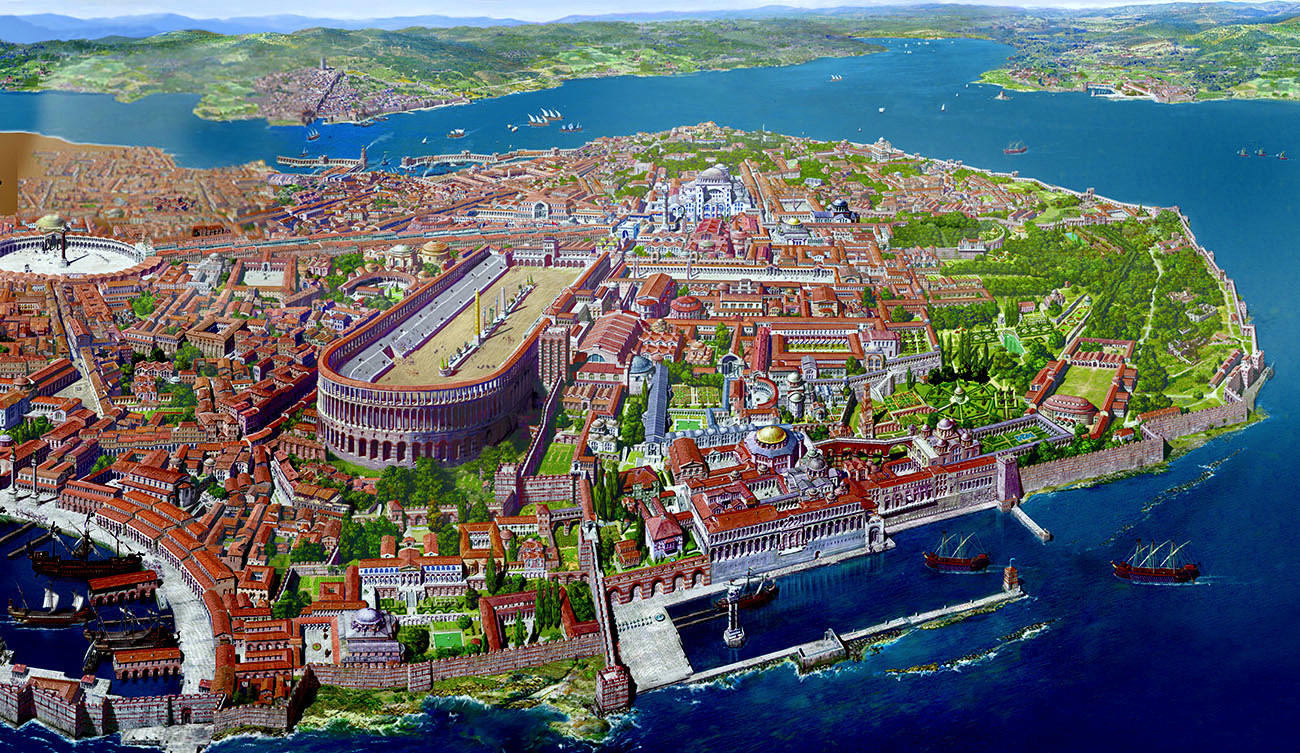
When Constantine the Great decided to rebuild Byzantium as a new imperial capital in the early 4th century, he was not simply founding a city. He was redefining the center of the Roman world.
The Forum of Constantine was one of the first monumental spaces created to give physical form to this idea. Built for the dedication ceremonies of the new capital in 330 AD, the forum stood just beyond the limits of the old city, signaling that this was no longer a provincial Greek town, but a new Rome rising in the East.
Unlike the rectangular forums of classical Rome, this one was laid out as an oval, surrounded by colonnaded porticoes and integrated into the city’s main ceremonial artery, the Mese. This was not just a public square—it was the stage upon which imperial power would be displayed, announced, and remembered.
At its center rose the Column of Constantine, assembled from massive drums of purple porphyry, a stone reserved exclusively for emperors. The column carried a statue of Constantine that puzzled even his contemporaries. He was depicted in the guise of a Roman sun god, reminiscent of Apollo, yet associated with the Christian ruler who had just begun to reshape the empire’s religious identity.
This ambiguity was not accidental. Constantine did not replace one belief system with another overnight. Instead, he carefully blended the old and the new, allowing the Roman world to transition gradually from pagan traditions to Christianity. In this sense, the forum itself became a symbol of that transformation.
According to later traditions, the foundation of the column concealed sacred relics—objects tied both to pagan Rome and Christian Jerusalem. Whether legend or truth, these stories reinforced the idea that Constantinople was not merely a political capital, but a city with a sacred destiny.
Standing here today in the district known as Çemberlitaş, it is difficult to imagine that this busy intersection was once the symbolic heart of an empire. People pass quickly toward the Grand Bazaar, rarely pausing to look up at the column. Yet this was the point from which Constantine’s vision began to unfold.
From this forum, the city stretched westward along the Mese, the great avenue that would bind together the monuments of Constantinople and shape the daily rhythm of the imperial capital.
2. The Great Palace
From the Forum of Constantine, where the idea of a new Rome was first proclaimed, the city unfolded toward the place where that idea was lived—the Great Palace.
Founded in the early 4th century under Constantine the Great, the Great Palace was not a single monumental structure like the imperial residences of later Europe. It was something far more complex: a vast, evolving imperial landscape stretching down the slopes between the Hippodrome and the Sea of Marmara.
Over the centuries, successive emperors expanded this residence into a labyrinth of courtyards, audience halls, private chambers, chapels, and gardens. It was, in every sense, a “city within the city”—a secluded world where imperial life unfolded behind walls, terraces, and ceremonial gates.
Its location was not accidental. The palace formed one corner of what might be called the power triangle of Constantinople. To one side stood Hagia Sophia, representing divine authority. To another lay the Hippodrome, where the voice of the people could erupt in both celebration and unrest. At the center of this triangle stood the emperor’s residence—the point where spiritual, political, and popular forces converged.
One of the most striking features of the palace was its direct connection to the Hippodrome. Through a private passage, the emperor could move unseen from the inner chambers of the palace to the Kathisma, the imperial lodge overlooking the arena. When he appeared before the crowds, it was never a casual moment. It was a carefully staged act of power, emerging from behind the invisible machinery of the palace.
Yet the Great Palace was not only a place of ceremony. It was also a space of everyday imperial life. The fragments that survive today—preserved in the Great Palace Mosaic Museum—offer a rare glimpse into this quieter world. Unlike the solemn religious mosaics of later Byzantine churches, these scenes are filled with movement and vitality: hunters chasing wild animals, children playing, mythological creatures woven into landscapes of surprising detail.
They remind us that the palace was not only a center of authority, but also a continuation of the classical Roman world, where art, nature, and daily life were still deeply intertwined.
Over time, however, the heart of imperial life shifted. From the 11th century onward, emperors increasingly preferred the Blachernae Palace near the Golden Horn. The Great Palace was gradually abandoned, damaged during the Latin occupation of 1204, and eventually disappeared beneath the layers of the Ottoman city.
Today, as visitors walk through Sultanahmet, it is almost impossible to perceive the scale of what once stood here. The courtyards, halls, and terraces have vanished. Only fragments remain—hidden beneath streets, or preserved in quiet museum spaces.
And yet, this was once the true center of imperial life in Constantinople—the place where decisions were made, ceremonies were prepared, and the emperor lived at the intersection of power, faith, and spectacle.
From the terraces of the palace, paths and colonnaded streets descended toward the main artery of the city—the Mese—where imperial life extended beyond the walls and into the wider fabric of Constantinople.
3. The Mese
Leaving behind the enclosed world of the Great Palace, one stepped into the artery that gave life to the entire city—the Mese.
More than a road, the Mese was the spine of Constantinople. Beginning near the Milion, just beside Hagia Sophia, it stretched across the city toward the Golden Gate, binding together its forums, monuments, and daily life into a single continuous flow.
To walk along the Mese was to move through the empire itself.
Unlike modern streets, this was not an open, exposed road. It was lined with colonnaded porticoes, creating long, shaded corridors filled with shops, statues, and gathering places. Merchants called out to passersby, officials moved between administrative buildings, and citizens lingered beneath the shelter of stone arcades. The city did not simply exist along the Mese—it unfolded through it.
The great forums of Constantinople were arranged along this route like a sequence of stages. From the Forum of Constantine to the Forum of Theodosius and beyond, each square marked a moment in the expansion of imperial power. Together, they formed a ceremonial landscape through which emperors moved in carefully orchestrated processions.
These processions gave the Mese its most dramatic role. Victorious emperors entered the city through the Golden Gate and advanced along this road, accompanied by soldiers, captives, and spoils of war. The crowds gathered along the porticoes, witnessing a spectacle that reaffirmed the order of the empire. The journey would end at the heart of the city, where political power and divine authority converged.
Yet the same road that celebrated triumph also witnessed final journeys. When emperors died, their bodies were carried along the Mese in solemn funeral processions, moving toward their burial place in the Church of the Holy Apostles. In this way, the road became both a path of glory and a path of farewell.
The Mese was never static. At the Philadelphion, it divided into branches, extending toward different gates of the city and connecting Constantinople to the wider Roman world. It was both a local artery and part of a vast imperial network reaching as far as Rome itself.
Even today, traces of this ancient route remain visible. Modern streets such as Divanyolu follow its course, and the tramlines that cut through the historic peninsula echo the same direction of movement. The stones have changed, the buildings have risen and fallen, but the line of the city—the rhythm of its circulation—remains almost unchanged after seventeen centuries.
As we follow this road westward, leaving behind the ceremonial squares and the noise of daily life, it leads us toward a place of silence and memory—the burial ground of emperors, where the story of Constantinople turns from power to legacy: the Church of the Holy Apostles.
4. Church of the Holy Apostles
Following the Mese westward, the movement of the city gradually gives way to a different kind of space—one defined not by crowds or ceremony, but by memory.
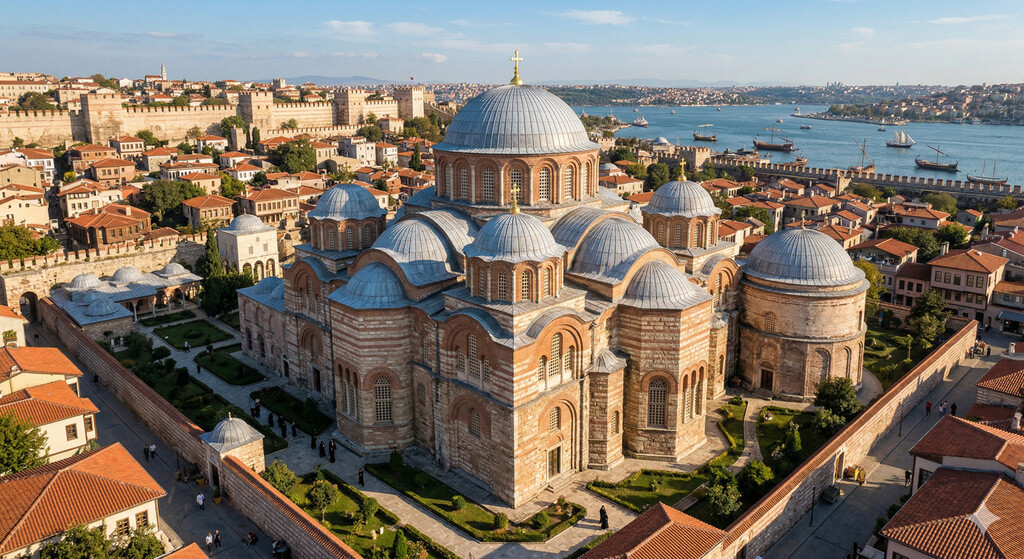
On one of the highest hills of Constantinople stood the Church of the Holy Apostles, a structure that embodied the imperial vision of a Christian Rome. Founded in the 4th century under Constantine the Great and later rebuilt on a grand scale by Justinian I, the church was among the most important monuments of the early Byzantine world.
But this was not simply a place of worship.
From the very beginning, it was conceived as the imperial mausoleum.
Constantine’s intention was both symbolic and personal. By bringing relics associated with the apostles into the church and placing his own tomb at its center, he aligned himself with the sacred foundations of Christianity. In doing so, he was not only establishing a new capital, but also redefining the relationship between imperial authority and divine legitimacy.
Over the centuries, the church became the final resting place of emperors who shaped the history of Constantinople—figures such as Constantine himself, Justinian, and Heraclius. Their massive porphyry sarcophagi filled the interior, transforming the building into a space where power, memory, and faith converged.
Architecturally, the structure also left a lasting imprint far beyond the city. The cross-shaped plan crowned with multiple domes influenced later monumental churches, most notably St. Mark’s Basilica in Venice. Although the original building no longer survives, its form continues to echo in the Mediterranean world.
Yet the fate of the church reflects the fragility of even the greatest monuments. During the Fourth Crusade in 1204, the building was looted and desecrated. Imperial tombs were opened, and treasures accumulated over centuries were carried away. What had once been the most sacred burial ground of Byzantine emperors was reduced to a shadow of its former self.
By the time of the Ottoman conquest in 1453, the structure was already in decline. A few years later, it was demolished, and the Fatih Mosque rose on its foundations—marking a new chapter in the history of the city, while preserving the symbolic importance of the site.
Today, nothing of the original church remains above ground. And yet, the meaning of this place has not disappeared. It was here that the journey along the Mese came to its quiet conclusion—where emperors who once entered the city in triumph returned for the final time, carried in silence to their resting place.
From this hill, overlooking both the land and the sea, Constantinople reveals another layer of its story—not of power in motion, but of the systems that sustained it. Beyond the ceremonial avenues and imperial monuments, the city depended on something far more essential: the steady flow of water that made life possible within its walls.
5. Valens Aqueduct
From the hill of the Holy Apostles, where emperors were laid to rest, the gaze naturally shifts to the structures that allowed the city itself to endure.
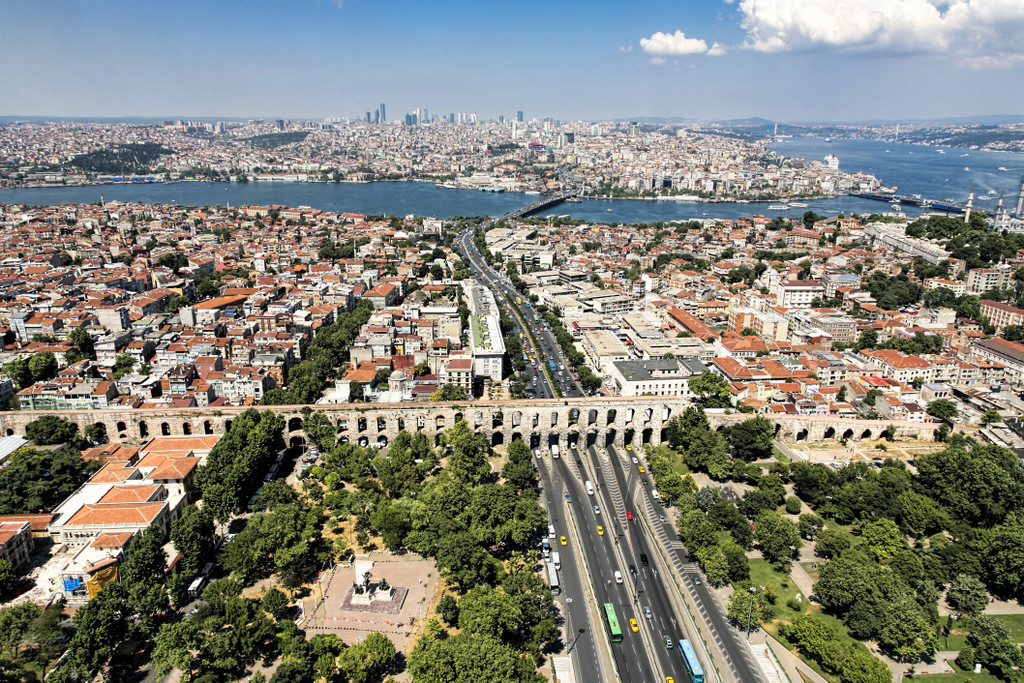
Among them, none was more essential than the aqueduct built under Valens in the late 4th century—a monumental bridge of stone that carried life into Constantinople.
At first glance, the need for such a structure may seem paradoxical. Surrounded on three sides by water, the city appears abundantly supplied. Yet Constantinople lacked one crucial resource: fresh water. Without it, no palace, no forum, no church could function.
The Valens Aqueduct was the visible heart of a vast hydraulic system that stretched far beyond the city. Channels and bridges carried water from distant springs in Thrace across valleys and hills, relying entirely on gravity. What we see today—rising above the modern streets—is only a fragment of one of the longest water supply systems of the ancient world.
Spanning the valley between two hills of the city, the aqueduct formed a monumental passage through which water flowed silently, sustaining baths, fountains, and reservoirs. It fed the great cisterns hidden beneath Constantinople—structures that would prove vital in times of siege, when the city had to rely on stored water to survive.
There is a quiet irony in its history. The emperor who completed this life-giving system met his end not in the city he helped sustain, but on the battlefield. In 378, Valens was killed during the Battle of Adrianople, a moment that signaled a profound crisis for the Roman world.
Yet the structure he left behind endured far beyond his lifetime.
Even after the fall of the Byzantine Empire, the aqueduct continued to serve the city under Ottoman rule, its arches repaired and reused for centuries. Like the Mese, its function survived the empires that controlled it.
Today, traffic flows beneath its towering arches, and few who pass below pause to consider the invisible system it once supported. But without this steady flow of water, Constantinople could never have grown into one of the largest and most resilient cities of the medieval world.
As the water carried by the aqueduct moved deeper into the city, it disappeared from view—descending into vast underground reservoirs that stored and protected it. To understand how Constantinople survived both growth and siege, we must follow that hidden path below the surface, where the city’s lifeblood was carefully preserved.
6. Obelisk of Theodosius
The stability that sustained Constantinople in the late 4th century did not come easily.
After the death of Valens on the battlefield in 378, the Roman world entered a period of uncertainty. The eastern provinces, though still intact, faced both external threats and internal instability. It was at this critical moment that a new figure emerged to restore order—Theodosius I.
Under his rule, the empire regained a sense of cohesion. Christianity, which had begun to take root under Constantine, now became firmly established as the dominant religious framework of the state. The transformation that had once been gradual was now decisive.
To understand this shift, one must look not only at laws or councils, but at the monuments that defined the city itself.
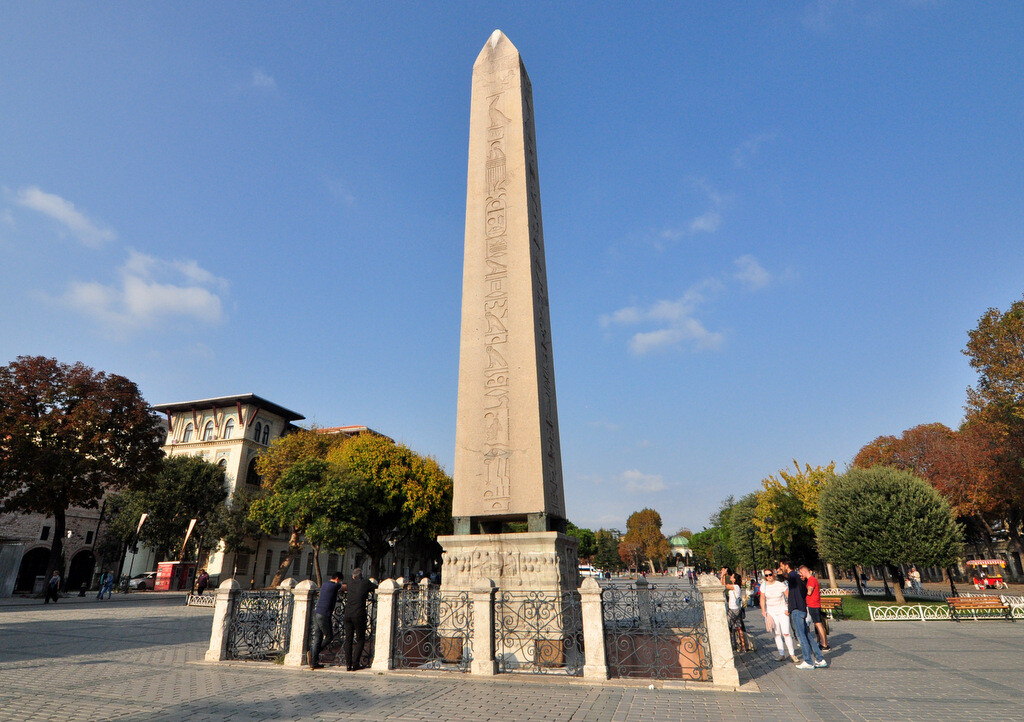
Among them stands the Obelisk of Theodosius, rising in the heart of the Hippodrome.
Originally erected in the 15th century BC for Pharaoh Thutmose III at the Temple of Karnak in Egypt, the obelisk was transported to Constantinople and re-erected in the late 4th century. Though only the upper portion survives today, its presence in the city carried a message far beyond its physical form.
This was not a religious symbol in the Christian sense. It was an imperial statement.
By bringing an ancient monument from Egypt—one of the oldest centers of civilization—into the heart of his capital, Theodosius was asserting continuity with the entire legacy of the ancient world. Constantinople was not merely a successor to Rome; it was now the center of a universal empire that claimed authority over all past civilizations.
The base of the obelisk reinforces this message with remarkable clarity. Carved in marble, it depicts Theodosius seated in the imperial lodge of the Hippodrome, accompanied by his court and his two sons, Arcadius and Honorius. Below, scenes of tribute and submission unfold, presenting a carefully constructed image of order restored and power secured.
Yet within this image lies a quiet turning point.
When Theodosius died in 395, the unity he had restored did not survive him. The empire was divided between his two sons: Arcadius ruled in Constantinople, while Honorius governed the western provinces. This division, intended as an administrative solution, became permanent.
In time, the Western Roman Empire would collapse, while the eastern half—centered on Constantinople—would continue its existence for nearly a thousand years.
In this sense, the obelisk stands not only as a monument of imperial power, but as a marker of transition. Beneath its shadow, the story of Rome becomes the story of Byzantium.
Even today, the obelisk rises above the former Hippodrome, surrounded by the layers of a city that has changed countless times. Its hieroglyphs still speak of a distant past, while its base tells the story of a moment when the Roman world was reshaped.
From this point onward, Constantinople is no longer simply a capital of the Roman Empire.
It is something new—something that will endure long after the old world has faded.
And at the center of this evolving identity stands the city’s greatest symbol of faith and power, soon to be rebuilt on an unprecedented scale: Hagia Sophia.
7. Hagia Sophia
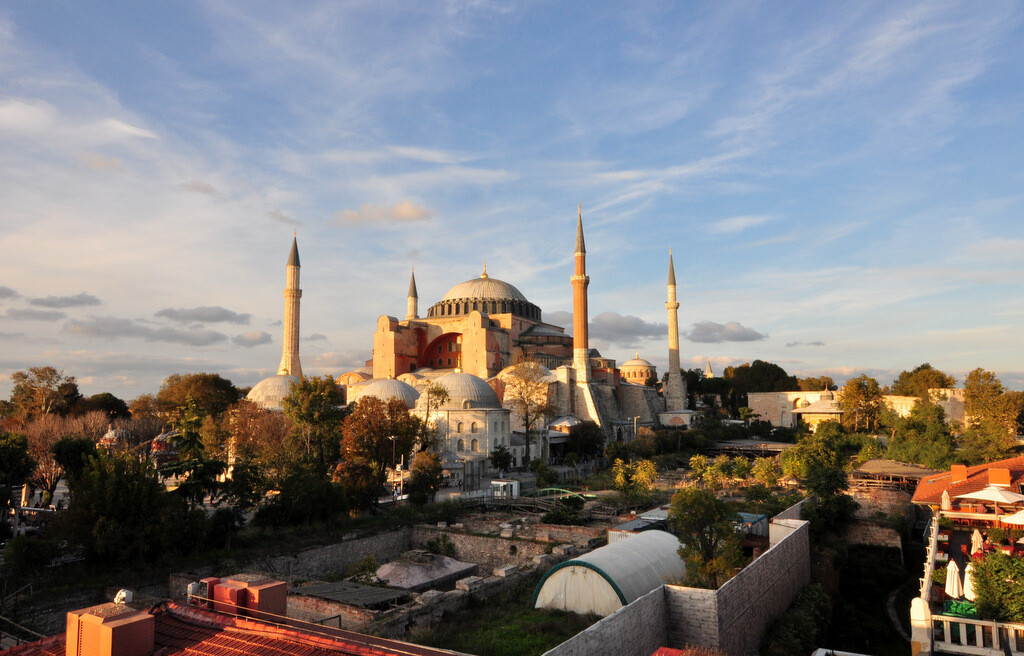
By the end of the 4th century, Constantinople had become the center of a new and evolving world.
After the death of Theodosius I, the empire was divided between his sons, and the eastern capital entered a period of fragile balance. Power no longer rested solely in imperial hands—it was now shared, contested, and negotiated between the court and the Church.
At the heart of this tension stood the city’s most important religious structure: Hagia Sophia.
The first church on this site, known as the Megale Ekklesia—the Great Church—was completed in the 4th century during the reign of Constantius II. Together with Hagia Irene, it formed the central cathedral complex of Constantinople, facing the imperial palace across the Augustaion.
This proximity was not symbolic—it was volatile.
Within a few decades, the space between palace and church became the stage for one of the earliest and most dramatic conflicts in the city’s history. At its center were two powerful figures: John Chrysostom, the charismatic patriarch known for his uncompromising sermons, and Aelia Eudoxia, the influential empress who exercised real authority at court.
Chrysostom’s words resonated deeply with the people of Constantinople. From the pulpit, he openly criticized the excesses of the imperial court, drawing particular attention to the luxury and ambition of the empress. His sermons were not abstract theology—they were direct challenges to power.
The conflict reached its peak when a statue of Eudoxia was erected near the church, an act that Chrysostom condemned as a symbol of vanity and pagan excess. His opposition was not tolerated. He was exiled from the city.
But the story did not end there.
The removal of Chrysostom triggered unrest among his followers, who saw him not only as a religious leader, but as a voice of moral authority against imperial corruption. Tensions escalated into violence, and in 404, the Great Church itself was set on fire during the turmoil.
The first Hagia Sophia—one of the defining structures of early Constantinople—was reduced to ashes.
What remained was more than the loss of a building. It revealed a fundamental reality of the Byzantine world: the uneasy balance between spiritual authority and imperial power. This tension would continue to shape the city for centuries.
Although Chrysostom died in exile, his influence endured. He would later be revered as one of the greatest Church Fathers, his legacy extending far beyond the events that led to the destruction of the church.
On this site, another church would rise. And then another.
Each would be shaped by the same forces—faith, power, and conflict—that defined Constantinople itself.
But before the city could reach its architectural and spiritual peak, it would first have to secure its survival against forces from beyond its walls.
8. Theodosian Walls
The destruction of the first Hagia Sophia revealed the tensions within Constantinople. But beyond the city, far greater threats were gathering.
As the Roman world entered the 5th century, waves of migrating peoples—often described in Byzantine sources as “barbarians”—pressed against its borders. The question was no longer how the city would govern itself, but whether it could survive at all.
It was under Theodosius II that Constantinople found its answer.
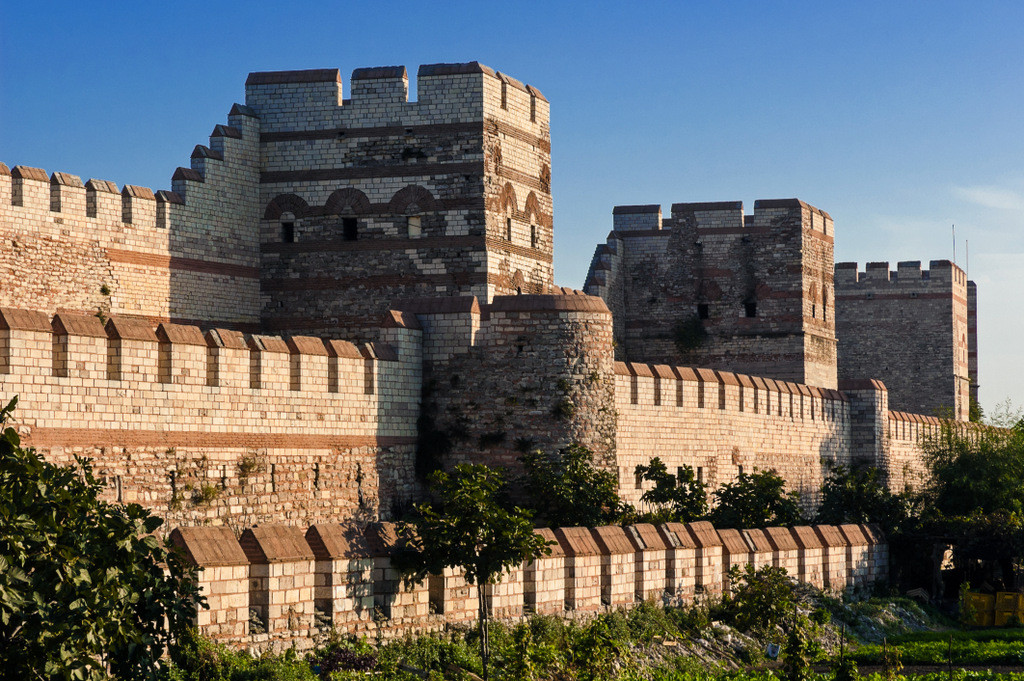
In the early 400s, a new line of fortifications was constructed along the western edge of the city, extending from the Sea of Marmara to the Golden Horn. These walls did not simply replace earlier defenses—they redefined the scale and security of the capital, allowing it to expand while remaining protected.
What made the Theodosian Walls extraordinary was not their height alone, but their design.
Rather than a single barrier, the system consisted of multiple layers: a wide moat, an outer wall, and a towering inner wall reinforced with regularly spaced towers. An advancing army would not face one obstacle, but a sequence of defenses, each designed to slow, expose, and exhaust the attacker.
This was not just architecture—it was strategy in stone.
The effectiveness of this system became evident almost immediately. In 447, a powerful earthquake damaged large sections of the walls at a moment when the Huns, led by Attila, were advancing toward the region. What followed was one of the most remarkable episodes in the city’s history: the population of Constantinople mobilized, and within weeks, the defenses were restored.
The city stood.
For centuries afterward, armies would arrive at these walls and fail. Persians, Avars, Arabs, Bulgarians, and others laid siege to Constantinople, only to be repelled. The walls became more than a defensive structure—they became a symbol of endurance, preserving the eastern Roman world long after the western half had collapsed.
In this sense, the survival of Constantinople was not inevitable. It was engineered.
Yet even the strongest systems have their limits. In 1453, with the arrival of large-scale gunpowder artillery, the balance shifted. Sections of the walls were breached, and the city finally fell. But by then, they had already fulfilled their purpose—extending the life of the empire for nearly a millennium.
Today, long stretches of these fortifications still stand, marking the ancient boundary of the Historical Peninsula. Walking beside them, it becomes possible to grasp the scale of the challenge they were built to meet—and the ingenuity behind their design.
Behind these walls, protected from the dangers beyond, the city continued to grow. But survival required more than defense alone. It depended on the careful management of resources within the city itself—especially water, stored and preserved in vast underground systems.
To understand how Constantinople endured not just attack, but time itself, we must look beneath the surface once again—into the hidden reservoirs that sustained life within the walls.
9. Theodosius Cistern
With the Theodosian Walls securing the city from external threats, the survival of Constantinople now depended on something far less visible.
Beneath the streets, hidden from sight, lay the systems that sustained life within those walls.
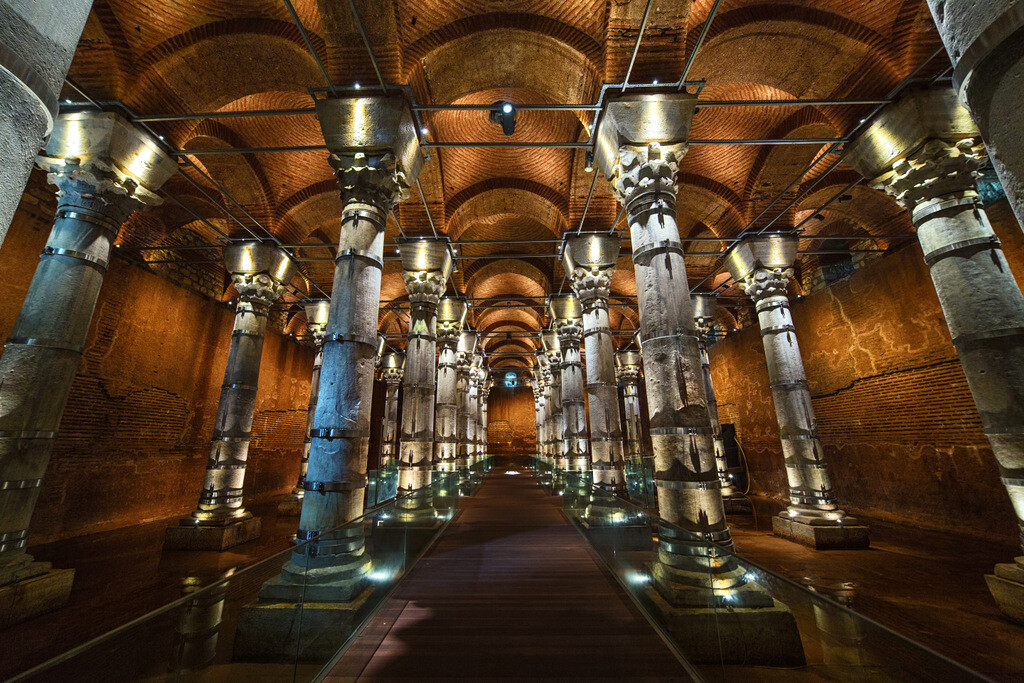
Among them was the Theodosius Cistern, constructed in the early 5th century during the reign of Theodosius II—one of the rulers who transformed Constantinople into a fully developed imperial capital.
If the aqueducts brought water into the city, it was the cisterns that ensured its survival.
Theodosius Cistern was part of a carefully designed network that stored and distributed fresh water carried from distant sources. Located close to the Forum of Constantine and the main ceremonial route of the Mese, it supplied nearby public buildings, baths, and imperial institutions—quietly sustaining the daily life of the capital.
Architecturally, the structure reflects both precision and order. Rows of marble columns support brick vaults above a rectangular underground chamber, forming a stable reservoir beneath the dense urban landscape. Unlike later cisterns that reused columns from older buildings, the columns here were carved specifically for this space, creating a sense of uniformity that mirrors the organized vision of the Theodosian era.
But the importance of this structure was not only practical—it was strategic.
Constantinople was a city under constant threat of siege. No matter how strong the walls were, a city without water could not endure. The cisterns transformed flowing water into stored security, allowing the population to survive long periods of isolation.
In this sense, the real strength of the city did not lie only in its visible defenses, but in these hidden reserves beneath its streets.
For centuries, structures like this remained unnoticed, buried beneath layers of later construction. Only in recent years has the Theodosius Cistern been restored and opened to visitors, revealing once again the silent architecture that supported the empire.
Standing inside today, surrounded by columns rising from the shadows, it becomes possible to understand Constantinople not only as a city of monuments, but as a system—carefully engineered, deeply interconnected, and designed to endure.
Yet even in a city so well protected and supplied, stability was never permanent.
As the 6th century approached, new tensions would emerge—this time not from outside the walls, but from within the political and social fabric of the empire itself. These forces would soon erupt in one of the most dramatic periods in the history of Constantinople.
10. Church of Sergius and Bacchus
As Constantinople entered the 6th century, the city stood secure behind its walls and sustained by its infrastructure. Yet within the imperial court, a different kind of struggle was unfolding—one shaped by ambition, rivalry, and the desire to define the future of the empire.
At the center of this new phase was Justinian I, a ruler whose reign would transform Constantinople more radically than any emperor since Constantine.
But Justinian did not inherit a stable world.
His rise to power was viewed with suspicion by the old aristocratic families of the city. Among them was Anicia Juliana, a woman of imperial lineage who represented the legacy of the old Roman elite. In response to the ascent of Justinian’s family—seen by some as outsiders—she commissioned the construction of an exceptionally grand church, asserting the cultural and political authority of her lineage.
This act was more than piety. It was a statement.
Justinian and his wife, Theodora, answered that statement not with words, but with architecture.
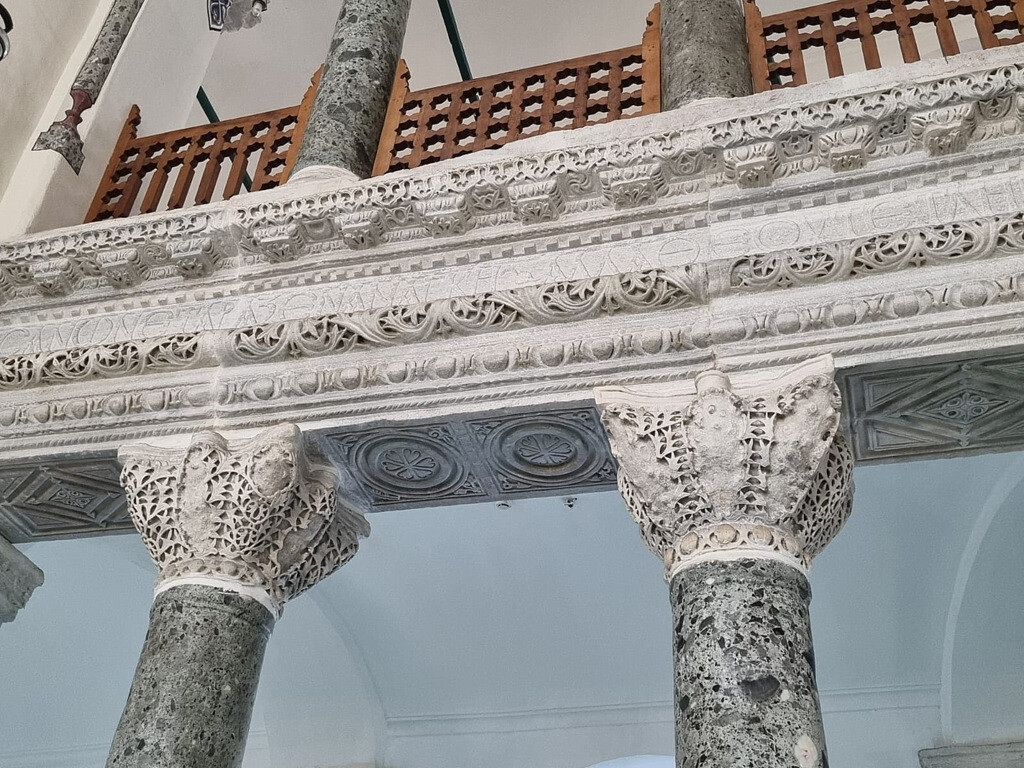
The Church of Sergius and Bacchus, built in the early years of Justinian’s reign, rose near the imperial residence overlooking the Sea of Marmara. Dedicated to two soldier saints closely associated with the Roman military tradition, the church reflected the origins of Justinian’s power—rooted not in ancient aristocracy, but in the structures of the state and the army.
Architecturally, the building marked a decisive shift. Instead of following the traditional basilica layout, it introduced a centralized plan organized around an octagonal core beneath a dome. This was not yet the monumental scale of later imperial churches, but it was something equally important: an experiment.
Within its walls, the architects explored new ways of shaping space, light, and structure—ideas that would soon be realized on a far grander scale. In this sense, the Church of Sergius and Bacchus stands as a moment of transition, where late Roman traditions began to evolve into a distinctly Byzantine architectural language.
The interior still preserves traces of this early vision. Marble columns, finely carved capitals, and inscriptions bearing the names of Justinian and Theodora reflect a space that was both personal and political—an assertion of presence as much as a place of worship.
Today, known as the Little Hagia Sophia, the building appears modest compared to the monuments that would follow. Yet its significance lies precisely in this scale. Here, the ambitions of Justinian can still be observed in a concentrated form—before they expanded to reshape the skyline of Constantinople.
For this was only the beginning.
The tensions within the city, the rivalries at court, and the ambitions of a new imperial vision were about to erupt into one of the most dramatic events in its history—an uprising that would shake Constantinople to its core and pave the way for a monument unlike anything the world had ever seen.
11. Hippodrome of Constantinople
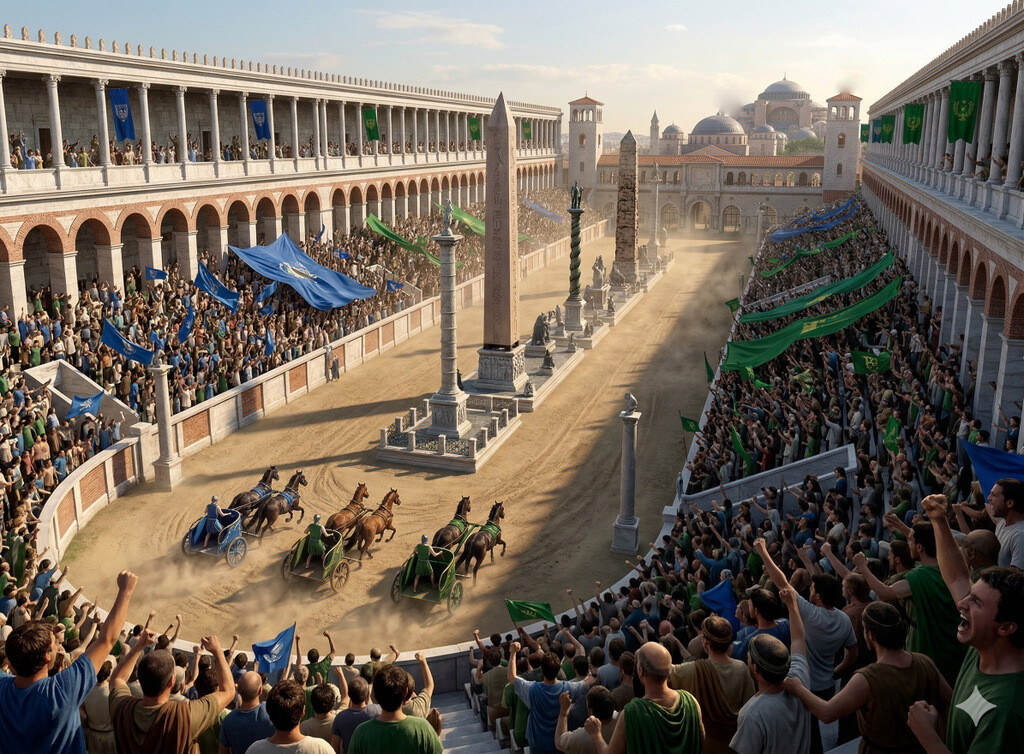
If the Great Palace was the seat of imperial authority, the Hippodrome was where that authority was tested.
Long before the city was defined by its churches and domes, this vast arena stood at the heart of Constantinople’s public life. Expanded under Constantine the Great, it followed the model of Rome’s Circus Maximus and could hold tens of thousands of spectators. Here, the emperor appeared before the people—not in isolation, but in full view of the city.
Yet what unfolded in the Hippodrome was never just entertainment.
The chariot races that filled the arena were organized around rival factions, most notably the Blues and the Greens. Over time, these groups came to represent far more than sporting allegiance. They became channels through which political frustrations, social tensions, and public opinion were expressed.
Within this space, the voice of the crowd could not be ignored.
From the imperial lodge—the Kathisma—connected directly to the Great Palace, the emperor watched the spectacle unfold. But he was also being watched. Every cheer, every protest, every moment of silence carried meaning.
In January 532, that fragile balance collapsed.
What began as unrest between the factions quickly transformed into a full-scale uprising. United under a single cry—Nika, meaning “Victory”—the crowds turned against Emperor Justinian I. Fires spread across the city, consuming major structures, including the church that had stood on the site of Hagia Sophia.
For several days, Constantinople was no longer under imperial control.
The turning point came not in the streets, but within the palace. As the situation deteriorated, Justinian considered fleeing the city. It was at this moment that Theodora intervened, delivering a speech that would become legendary. According to later sources, she declared that “royal power is a fine burial shroud,” urging the emperor to remain and confront the rebellion.
What followed was decisive.
Imperial forces, led by generals Belisarius and Narses, sealed the exits of the Hippodrome and entered the arena. The uprising ended in a massacre. Thousands—perhaps tens of thousands—were killed within the very space where they had gathered.
The Hippodrome, once the center of celebration, became a place of silence.
Yet from this destruction emerged transformation.
The city that had burned would be rebuilt on a scale never seen before. The emperor who had nearly lost his throne would go on to reshape Constantinople into the greatest capital of the Byzantine world.
Today, the vast structure of the Hippodrome no longer stands. Its tiers were dismantled over centuries, and its stones reused in later constructions. What remains is an open square—Sultanahmet—where only fragments hint at its former scale.
Along its central axis, however, a few monuments still survive: the Obelisk of Theodosius, the Serpent Column, and the Walled Obelisk. These markers preserve the memory of the arena’s spine, where chariots once raced and history unfolded.
Standing here now, it is difficult to imagine the roar of the crowd, the tension of the races, or the violence of the uprising. And yet, beneath the surface of this quiet square lies the imprint of one of the most decisive moments in the history of Constantinople.
For it was in the aftermath of this revolt that the city would be rebuilt—not only above ground, but also below it, through monumental works that reflected both power and control.
12. Basilica Cistern
In the aftermath of the Nika Revolt, Constantinople was no longer the same city.
Fires had consumed its monuments, its public spaces, and much of its imperial center. But for Justinian I, destruction was not an end—it was an opportunity to rebuild the capital on a scale that would surpass anything before it.
While new structures began to rise above ground, an equally ambitious transformation was taking place below.
The Basilica Cistern was constructed as part of this vast rebuilding program, designed to secure the water supply of the Great Palace and the surrounding imperial complex. It was the largest of the city’s underground reservoirs, capable of storing enormous quantities of water brought from distant sources through the aqueduct system.
Descending into the cistern reveals a space unlike any other in Constantinople.
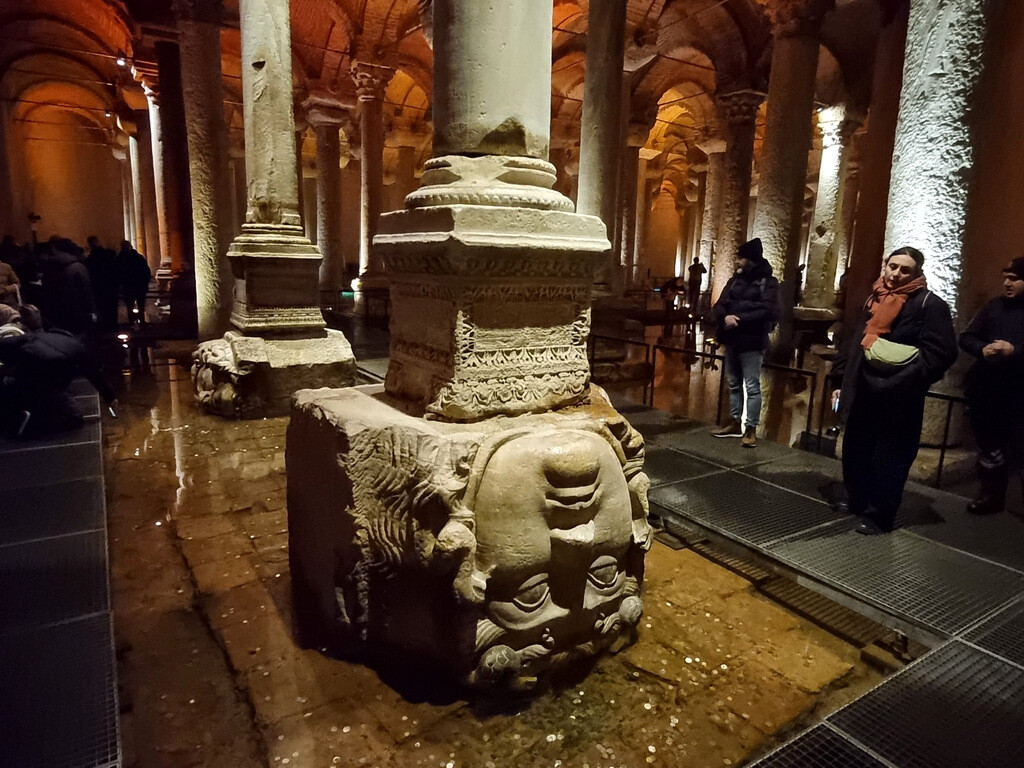
Hundreds of marble columns rise from still water, arranged in long, symmetrical rows that extend into the darkness. The light is dim, the air cool, and the sound subdued—creating an atmosphere that feels at once functional and ceremonial. This was not simply infrastructure. It was architecture on an imperial scale, hidden beneath the surface.
Many of the columns were not carved specifically for this structure, but brought from earlier monuments across the empire. This practice, known as spolia, reflects both practicality and continuity—reusing the material legacy of the ancient world to sustain a new one.
Among these reused elements, the Medusa heads stand out. Placed beneath two columns—one sideways, one inverted—they have long inspired curiosity. Whether positioned this way for structural reasons or symbolic intent, they illustrate how the classical past was absorbed into the fabric of Byzantine Constantinople, stripped of its original meaning and repurposed within a new context.
Above this hidden forest of columns once stood a large public basilica, from which the cistern takes its name. Over time, the structure was buried beneath layers of the evolving city, its presence forgotten for centuries.
Yet its purpose remained clear.
In a city defined by siege and uncertainty, the ability to store water determined survival. The Basilica Cistern transformed a vulnerable resource into a controlled reserve, ensuring that the capital could endure even when cut off from the outside world.
Today, visitors walk along platforms suspended above the water, moving through a space that feels both ancient and strangely alive. Reflections ripple across the columns, and the boundaries between structure and shadow blur.
Here, beneath the imperial city, the foundations of Constantinople reveal themselves—not in stone walls or grand domes, but in the quiet systems that sustained life through its most fragile moments.
With the city secured both above and below ground, Justinian could now turn his attention outward.
For the ambition that rebuilt Constantinople would soon extend beyond its walls—toward the lost provinces of the Roman world, where generals would fight to restore an empire that had long since begun to fade.
13. The Column of the Goths

With Constantinople secured from within, Justinian’s vision could no longer be contained by the walls of the city.
He did not see himself merely as the ruler of an eastern capital. For Justinian I, the empire was something greater—an inheritance that stretched back to Rome itself. And a Roman Empire without Rome was, in his eyes, incomplete.
Beyond the city, in the lands of Italy, the old capital had fallen under the control of the Goths. To reclaim it was not simply a military objective. It was an attempt to restore the unity of the Roman world.
At the center of this effort stood one of the most remarkable figures of the age: Belisarius.
Leading campaigns across the Mediterranean, Belisarius and, later, Narses pushed into North Africa, Italy, and parts of Spain. After years of difficult and destructive warfare, the Byzantine armies succeeded in retaking Rome and defeating the Gothic kingdoms that had taken root in the west.
These victories were celebrated as the restoration of empire.
And yet, here in Constantinople, the monument most closely associated with the defeat of the Goths tells a more layered story.
Hidden among the trees of Gülhane Park stands the Column of the Goths—an ancient structure that predates Justinian by centuries.
Erected in the late Roman period, likely in the 3rd or 4th century, the column commemorated earlier victories over Gothic tribes. Its Latin inscription honors Fortuna Redux—the goddess of safe return—and celebrates the defeat of the Goths.
In this sense, the column does not belong to Justinian’s age.
But its meaning does.
The inscription, carved long before Justinian’s campaigns, found a new resonance in his reign. The victories achieved by Belisarius and Narses echoed the same message—of enemies defeated and order restored. The column became, in retrospect, a silent witness to a recurring imperial ambition: to push back the forces threatening Rome and to reclaim what had been lost.
There is also a deeper irony in this story.
While Justinian’s armies succeeded in restoring Roman rule in Italy, the wars themselves devastated the region. Cities were ruined, populations declined, and the very lands that had once formed the heart of the empire were irreversibly transformed. The restoration of Rome came at the cost of its final decline as a classical center.
Standing today at the edge of the ancient city, overlooking the meeting point of the Bosphorus, the Golden Horn, and the Sea of Marmara, the column remains almost unnoticed. Yet it marks a place where multiple layers of history intersect—pagan Rome, Christian Byzantium, and the memory of an empire that sought to reclaim its past.
From this quiet monument, the story of victory moves toward its most visible expression.
For when victorious generals returned to Constantinople, they did not simply re-enter the city. They passed through gates designed to proclaim triumph—ceremonial entrances where conquest was transformed into spectacle.
And among these, none was more significant than the Golden Gate.
14. The Golden Gate

At the western edge of Constantinople, where the land walls meet the Sea of Marmara, stood the most ceremonial entrance to the city—the Golden Gate.
This was not an ordinary gateway.
It was the point where the outside world ended and the imperial capital began. Victorious emperors and generals did not simply return to Constantinople; they entered through this gate, transforming military success into public spectacle.
Originally constructed as a triumphal arch under Theodosius I and later incorporated into the land walls of Theodosius II, the Golden Gate embodied the continuity of Roman imperial tradition. Massive marble blocks formed its structure, while its doors—adorned with gilded elements—reflected the wealth and ambition of the empire.
From here began the ceremonial journey along the Mese.
Victorious commanders such as Belisarius would pass through this gate, leading triumphal processions that moved through the forums and into the heart of the city. These moments were carefully staged, reinforcing the image of an empire restored.
Yet the most striking passage through the Golden Gate belonged to another emperor—Heraclius.
In the early 7th century, after years of devastating war against the Sasanian Persians, Heraclius achieved what seemed an impossible victory. He defeated one of Rome’s greatest enemies and recovered the relic known as the True Cross, believed to be the cross on which Christ had been crucified.
When he returned to Constantinople, the expectations were clear. Tradition demanded a triumphal entry—an emperor crowned in glory, carried by the symbols of victory.
But what followed was something entirely different.
According to later accounts, Heraclius set aside the imperial display. Instead of entering in full regalia, he approached the city in humility, removing his imperial insignia and walking barefoot as he carried the sacred relic through the gate.
In that moment, the meaning of victory itself had changed.
The Golden Gate, once a symbol of Roman military triumph, now framed a different kind of authority—one shaped as much by faith as by conquest.
And yet, behind this moment of transformation lay a more fragile reality.
The long wars with Persia had exhausted both empires. Combined with the demographic impact of the plague that had spread during the reign of Justinian, the resources of Byzantium were stretched thin. What appeared as a final victory was, in many ways, the end of an era.
Within a few years, new forces emerged from the Arabian Peninsula. The territories that had just been reclaimed—Syria, Egypt, and beyond—would be lost again, this time permanently.
The outward expansion of the empire came to an end.
From this point forward, Constantinople would no longer define itself through conquest, but through survival.
Today, the Golden Gate stands silent, its arches partially sealed and incorporated into the later fortifications of Yedikule. The grandeur of its ceremonial past has faded, replaced by stone and stillness. Yet its presence continues to mark a threshold—not only between inside and outside, but between two phases of history.
Beyond this gate lies the memory of expansion.
Within it begins a different story—one of endurance, faith, and defense.
And in that story, the focus shifts from triumphal processions to the protective power of belief, embodied in the sacred images and spaces that would come to define the later Byzantine world.
15. Chora Church
After the last great triumphs at the Golden Gate, Constantinople entered a different age.
The empire no longer expanded outward. Instead, it turned inward—toward survival.
Near the Theodosian Walls, where the danger from outside was most immediate, stood the Church of the Holy Saviour in Chora. Its name, meaning “in the countryside,” reflects an earlier time when this monastery lay beyond the city’s first walls. As the city expanded, it became enclosed within the defenses it once stood outside of—a quiet reminder of how Constantinople had grown.
In the centuries that followed, these walls would be tested again and again. Persians, Avars, and later Arab armies reached the gates of the city. In these moments, defense was not only physical.
It was spiritual.
When the pressure on the city became unbearable, sacred icons—most famously the image of the Virgin Mary known as the Hodegetria—were carried along the walls. These processions transformed belief into a form of protection, strengthening the resolve of those defending the city.
In this context, places like Chora became more than monasteries. They stood at the intersection of faith and fear, where the city’s survival was entrusted as much to divine protection as to its fortifications.
And yet, the church we see today belongs to a much later moment.
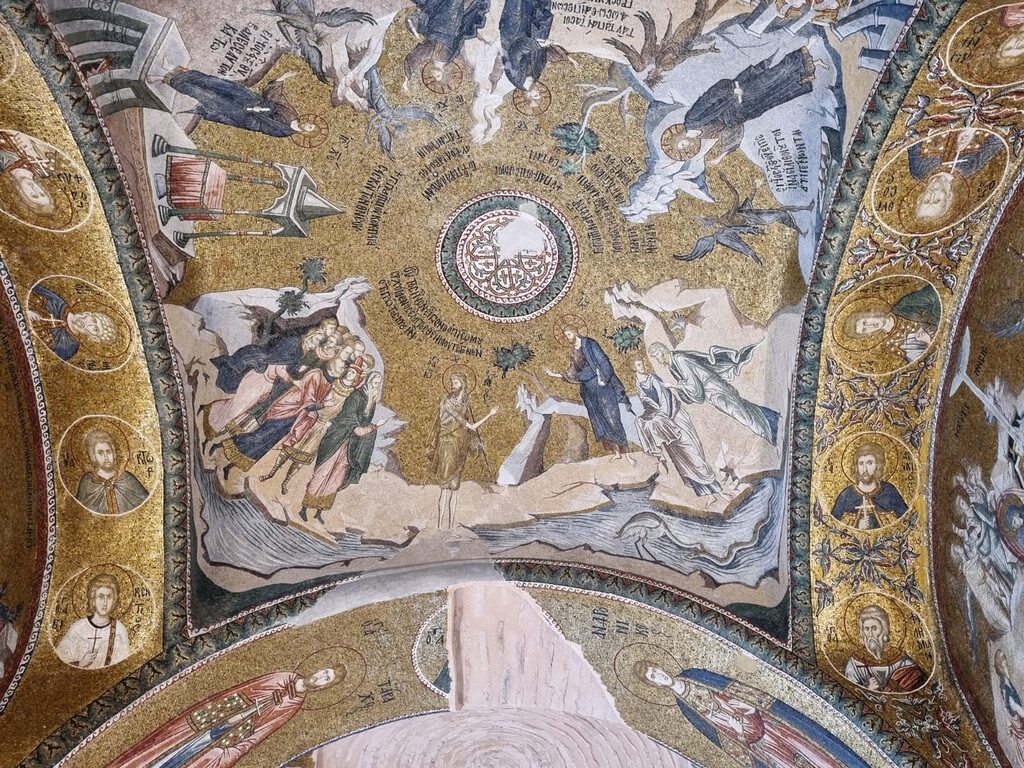
In the 14th century, during the final centuries of the empire, Chora was transformed into one of the most refined artistic spaces of the Byzantine world. Its mosaics and frescoes—filled with movement, emotion, and narrative depth—reflect a last cultural flourishing, often described as the Palaiologan Renaissance.
This contrast defines the site.
A place shaped by the anxiety of siege became, centuries later, a canvas for some of the most human and expressive works of Byzantine art.
Today, standing within its walls, it is possible to sense both layers at once: the fear of a city under threat, and the quiet confidence of a culture that still found ways to create beauty at the edge of decline.
From here, the story moves deeper into that tension.
For as the role of sacred images grew stronger in the life of the empire, it would eventually lead to one of the most profound internal conflicts in Byzantine history—a struggle not against external enemies, but over the very nature of faith itself.
16. Stoudios Monastery
As the Byzantine world turned inward, the struggle for survival did not only take place on the walls—it entered the heart of the empire itself.
In the 8th and 9th centuries, Constantinople was shaken by one of its deepest crises: Iconoclasm—the rejection and destruction of religious images.
At the center of this conflict stood the Stoudios Monastery.
Founded in the 5th century near the Golden Gate, it was already one of the most important religious institutions in the city. But its true significance emerged during this period, when it became a stronghold of resistance against imperial authority.
The issue was not only theological.
Emperors such as Leo III sought to ban icons, partly out of religious conviction, but also to weaken the growing power of monasteries. Wealthy, influential, and deeply embedded in society, these institutions had begun to rival the authority of the state.
The response from Stoudios was uncompromising.
Led by Theodore the Studite, the monastery became the intellectual and spiritual center of the iconophile movement. Even in exile, Theodore continued to organize resistance, defending the role of images in Christian worship and challenging imperial policy.
What had begun as a doctrinal dispute turned into a struggle over power.
Within the walls of Constantinople, emperors and monks confronted each other—one seeking control, the other defending tradition. The conflict would shape Byzantine identity for generations, leaving deep marks on both theology and art.
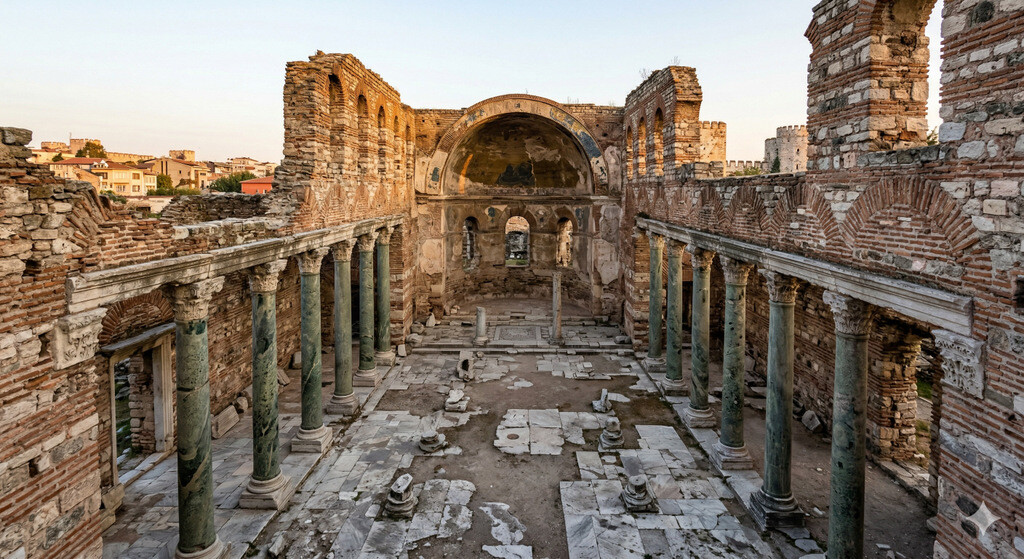
Today, the remains of the monastery stand in quiet isolation near Samatya. Its roof has long collapsed, and only fragments of its structure survive. Yet this silence conceals a past defined not by retreat, but by defiance.
From here, the consequences of this conflict become visible.
For the removal of images did not only affect belief—it changed the appearance of sacred space itself, leaving behind interiors stripped of the visual language that had once defined Byzantine art.
17. Hagia Irene
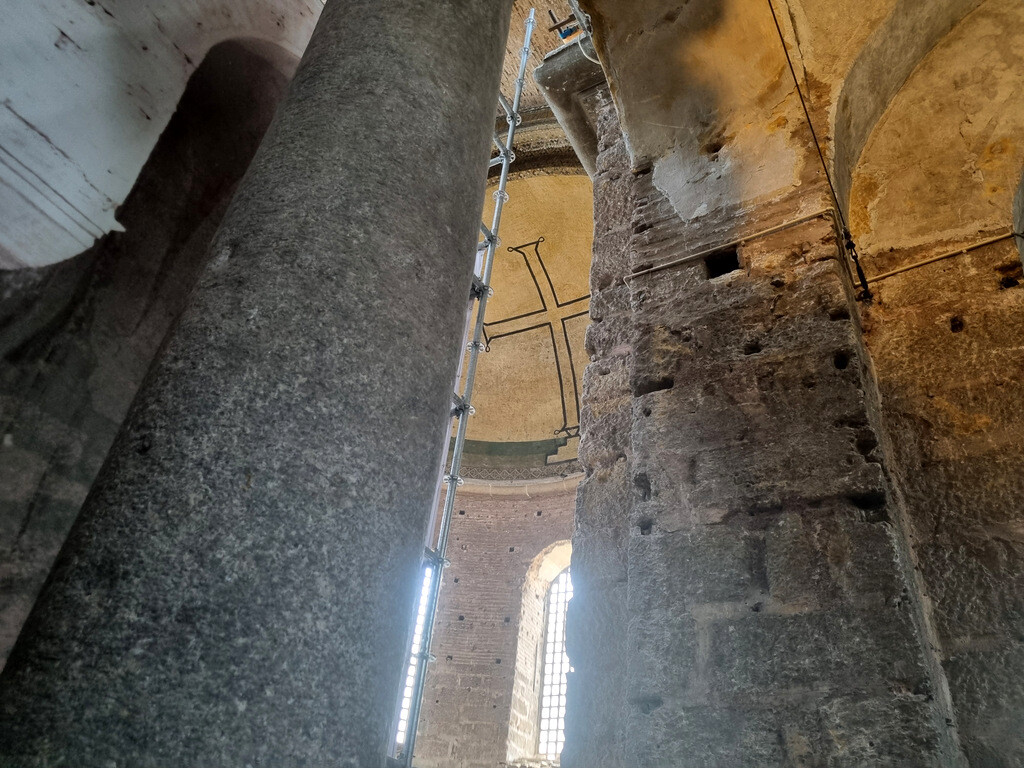
If Stoudios Monastery represents resistance, Hagia Irene reflects authority.
Located just beside Hagia Sophia, this was one of the earliest churches of Constantinople and once served as the city’s main cathedral. But the building we see today belongs to a different moment—one shaped by the radical policies of Iconoclasm.
After a major earthquake in 740, the church was rebuilt under Constantine V, one of the strongest supporters of the iconoclastic movement. What emerged was not a richly decorated interior, but something strikingly different.
The images were gone.
In place of mosaics depicting Christ, the Virgin, and the saints, a single large cross dominates the apse. Set against a gold background, it stands as a clear statement of a new theological order—one that rejected the use of human images in sacred space.
This simplicity is not the result of loss.
It is the result of choice.
Hagia Irene preserves, almost untouched, the visual language of a time when the empire sought to redefine the boundaries of faith. Where other churches were later redecorated, this one remained as a silent witness to that transformation.
There is another layer to its survival.
Unlike most Byzantine churches, Hagia Irene was not converted into a mosque after 1453. Instead, it became part of the Ottoman imperial complex and was used as an arsenal. This unusual history allowed its structure—and its iconoclastic character—to remain largely intact.
Today, its vast and empty interior feels almost austere. The absence of images creates a space defined by volume, light, and sound rather than narrative. It is a church where silence speaks louder than decoration.
Here, the conflict over images reaches its most visible form—not in destruction, but in absence.
Yet this period of division would not last forever.
In time, the empire would move beyond Iconoclasm, and with that shift, art would return—transformed, more expressive, and more human than before.
18. Monastery of Myrelaion
After the long crisis of Iconoclasm, the Byzantine world began to recover.
From the late 9th century onward, a new period of stability and cultural renewal emerged—often described as the Macedonian Renaissance. The empire regained confidence, and with it came a more refined architectural language.
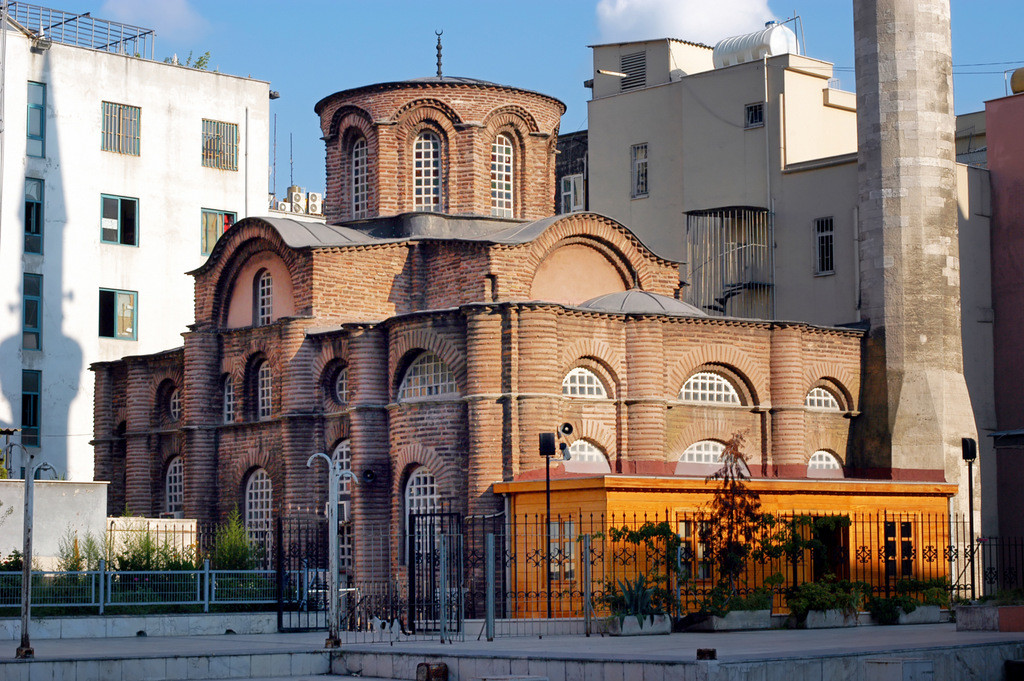
The Monastery of Myrelaion belongs to this moment.
Built in the early 10th century by Romanos I Lekapenos, the complex was not a grand public monument, but a private imperial foundation—both a palace chapel and a dynastic burial site. It reflected a new kind of power: less monumental, more controlled, and more personal.
Its design marks a clear shift from earlier centuries. Instead of vast basilicas, the church follows a compact cross-in-square plan, crowned by a single dome. The proportions are carefully balanced, the scale intimate—almost like a jewel box compared to the monumental spaces of earlier Constantinople.
Yet beneath this refined structure lies something unexpected.
The church was built on top of a massive circular substructure dating back to Late Antiquity. This earlier rotunda—later converted into a cistern—was filled with rows of columns to support the building above. It is this hidden layer that gave the later mosque its name: “Bodrum,” meaning underground.
This contrast defines Myrelaion.
Above ground, a controlled and elegant expression of imperial identity.
Below ground, the immense and inherited infrastructure of the earlier Roman world.
The story of its founder reflects a similar tension.
Romanos I did not come from an established imperial dynasty. Rising through the military, he secured his position by marrying his daughter into the ruling line, creating a new legitimacy for his family. This monastery, placed beside his palace, became the symbolic center of that ambition.
Today, the building stands quietly within the busy streets of Laleli, surrounded by shops and modern structures. Its scale is modest, its presence easily overlooked. Yet it represents a turning point—when Byzantium, after centuries of crisis, found a new balance between power, tradition, and form.
From here, that balance begins to shift once again.
For the center of imperial life would soon move away from the old ceremonial core, toward a new residence along the northern edges of the city—closer to the walls, and closer to the uncertainties of the world beyond.
19. The Palace of Blachernae
By the 11th century, the center of imperial life in Constantinople began to shift.
The Great Palace, once the heart of the empire, had become too vast, too costly, and too exposed. Maintaining its sprawling complex was no longer practical in a world where the empire was under constant pressure.
A new kind of residence was needed.
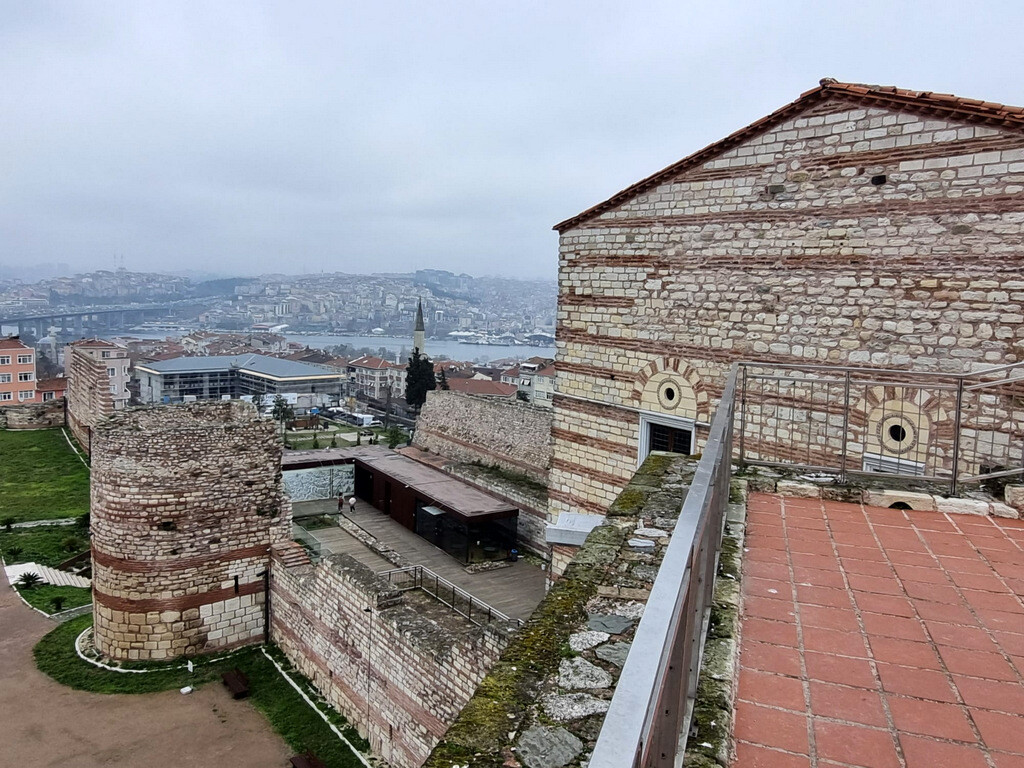
Along the northern edge of the city, where the Theodosian Walls meet the Golden Horn, a different imperial center emerged—the Palace of Blachernae.
This was not a ceremonial palace in the classical Roman sense.
It was a fortified residence.
Integrated directly into the city walls, the complex reflected a new reality: the emperor was no longer a distant figure presiding over a universal empire, but a ruler constantly preparing for defense. The palace stood at the most vulnerable and strategic corner of Constantinople, overlooking both land and sea.
From here, imperial power became more contained, more guarded, and more immediate.
Over time, Blachernae grew into a vast complex of halls, chapels, and residential quarters spread across the slopes of the sixth hill. Today, only fragments survive—most notably the structure known as the Palace of the Porphyrogenitus (Tekfur Palace), a rare example of late Byzantine secular architecture.
Its patterned brickwork and layered façade hint at the refinement of the period, even as the empire itself faced increasing uncertainty.
The shift to Blachernae was more than a change of address.
It marked a transformation in the nature of Byzantine power.
The open, ceremonial world of the early empire had given way to a more defensive, inward-looking state. The emperor now ruled from behind walls, closer to the front lines, where the survival of the city was no longer guaranteed.
This new center would witness both resilience and catastrophe.
In 1204, during the Fourth Crusade, it was along these northern defenses that the Latin armies breached the city. The palace itself became one of the first targets of the invasion, marking the beginning of one of the most devastating episodes in the history of Constantinople.
Today, standing near the remains of these structures, it is possible to sense that shift—from confidence to caution, from expansion to survival.
From here, the story begins to move beyond the walls.
For the forces that would reshape Constantinople did not come only from within the empire, but also from across the Golden Horn, where new powers were rising—closer than ever before.
20. Panagia Mouchliotissa
As the empire’s borders contracted, Constantinople faced a new and persistent threat from the east.
After the Battle of Manzikert in 1071, Anatolia—the heartland of Byzantine power—began to slip away to the Seljuk Turks. Military resistance alone was no longer enough. In response, the empire turned to a different strategy: diplomacy.
And at times, diplomacy came at a personal cost.
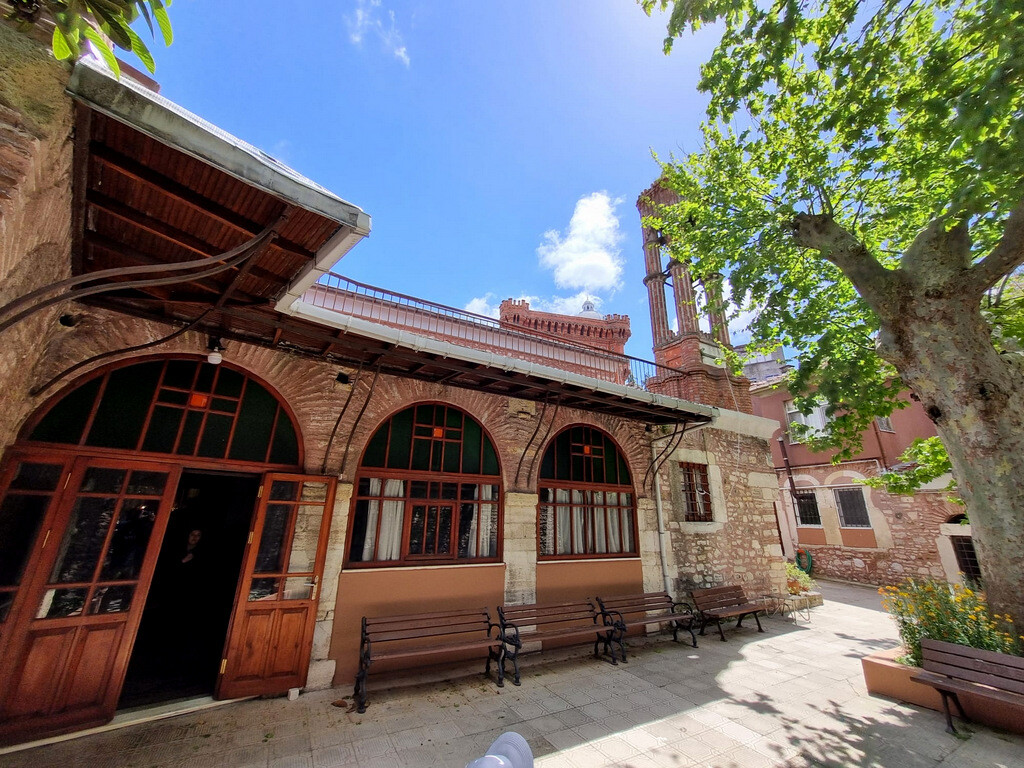
The Church of St Mary of the Mongols, known as Panagia Mouchliotissa, is closely tied to this moment. Built in its current form during the late Byzantine period, it is associated with Maria Palaiologina, a member of the imperial family whose life reflects the fragile alliances of the time.
As part of a political strategy, Maria was sent east to marry into the Mongol ruling elite—an attempt to secure support against the advancing Turkish powers. Years later, after being widowed, she returned to Constantinople and withdrew from public life, establishing a monastic foundation on this site.
In this story, the scale of the building is almost secondary.
What matters is what it represents.
A powerful empire that once celebrated conquest at the Golden Gate now sought survival through negotiation. The fate of territories was no longer decided only on the battlefield, but also through alliances forged far beyond the walls of the city.
There is another layer that makes this church unique.
Unlike most Byzantine churches in Constantinople, it was never converted into a mosque after the Ottoman conquest. According to tradition, an imperial decree granted it protection, allowing it to remain in continuous use by the Orthodox community.
This uninterrupted continuity sets it apart.
Within its walls, the rhythm of Byzantine religious life did not end in 1453. It continued—quietly, persistently—into the present.
Today, the church stands on the slopes above Fener, surrounded by narrow streets and high walls. Its presence is discreet, almost hidden, yet its story connects Constantinople to a wider world of shifting alliances, distant courts, and fragile diplomacy.
From this point, the narrative turns once again.
For while some emperors sought survival through negotiation, others would attempt to reverse the losses through force—launching new campaigns to reclaim what had been taken and to restore the strength of the empire.
21. Monastery of Christ Pantokrator
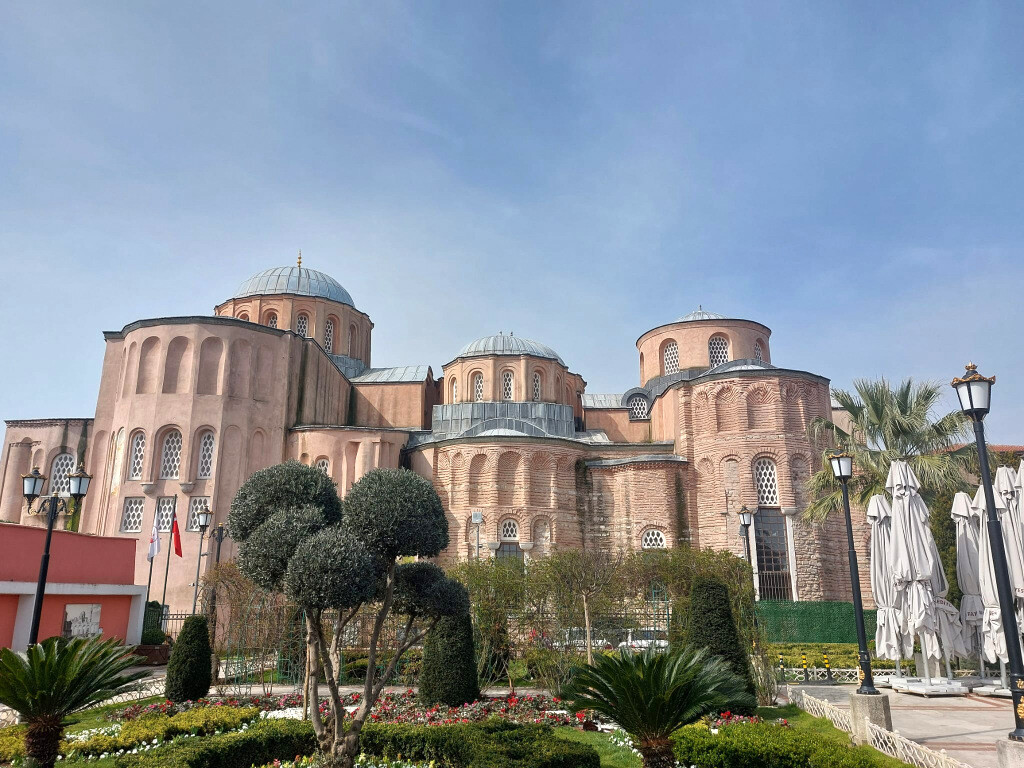
Before the empire turned fully to diplomacy and survival, there was one last period of renewed strength.
In the 12th century, under the Komnenian dynasty, Byzantium regained much of its lost confidence. Through careful strategy and calculated alliances, emperors such as Alexios I Komnenos and his successors managed to push back Turkish advances in Anatolia—often with the uneasy support of the Crusaders.
The Monastery of Christ Pantokrator was built during this revival.
Founded by John II Komnenos and Empress Irene in the early 12th century, the complex reflects the ambition and structure of this renewed imperial vision.
It was not a single church, but a carefully planned ensemble.
Two main churches, dedicated to Christ and the Virgin, were connected by a central chapel that served as a dynastic mausoleum. This layered design created both scale and continuity, turning the complex into one of the largest religious foundations of Constantinople.
But Pantokrator was more than a place of worship.
It functioned as a major institutional center, including a hospital, charitable services, and facilities for clergy. In this sense, it represented a model of Byzantine society at its most organized—where faith, care, and imperial patronage were closely intertwined.
Its location, on a hill overlooking the Golden Horn, reinforced this presence. From here, the complex stood above the city’s commercial lifelines, watching over a Constantinople that was once again active, confident, and connected.
Yet beneath this revival lay a dangerous tension.
The same Crusader forces that helped restore parts of Anatolia also introduced a new and unpredictable element into the region. As long as the Komnenian rulers maintained control, this balance held.
But it was a fragile equilibrium.
When their leadership came to an end, the forces they had managed so carefully could no longer be contained. In 1204, during the Fourth Crusade, Constantinople was attacked and sacked by the very armies that had once been its allies.
Pantokrator did not escape this fate.
Imperial tombs were opened, treasures were looted, and one of the most sophisticated complexes of the Byzantine world was reduced to a shadow of its former self.
Today, known as the Zeyrek Mosque, the building still dominates the skyline of its hill. Fragments of its marble floors and structural form survive, offering a glimpse into a moment when Byzantium, for a brief time, stood strong once more.
From here, the story moves into its most dramatic rupture.
For the fall of Constantinople in 1204 did not mark the end of the empire—but it shattered its continuity, leaving behind a city divided, occupied, and transformed by foreign rule.
22. Theotokos Kyriotissa
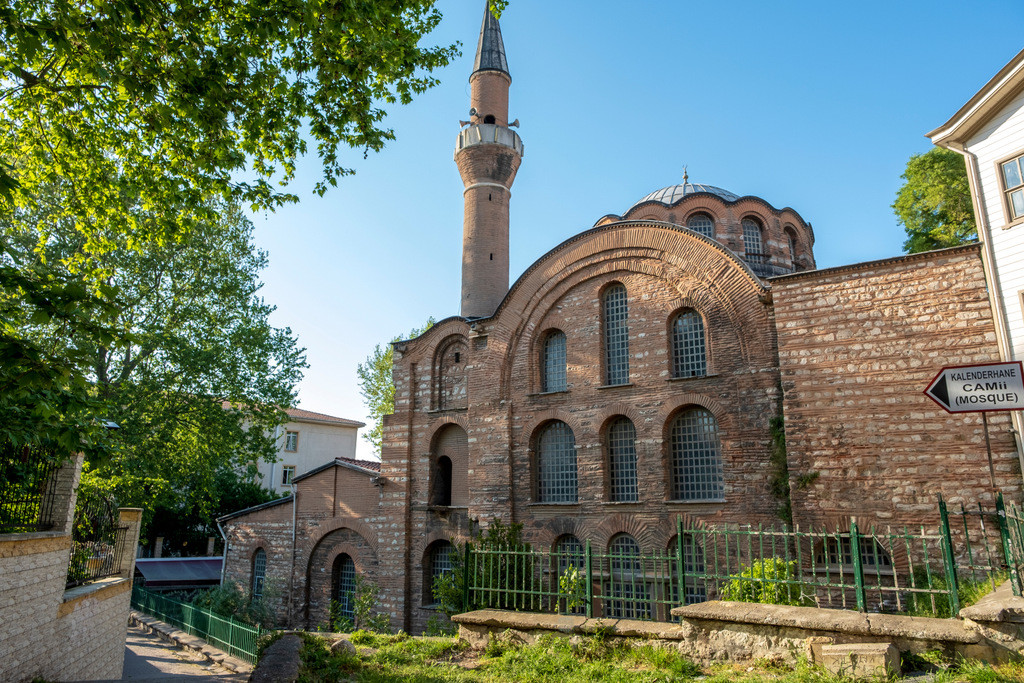
The balance that the Komnenian emperors had maintained could not last.
In 1204, the Fourth Crusade—originally intended to reclaim Jerusalem—turned instead toward Constantinople. What followed was not a battle between enemies, but a rupture within the Christian world itself.
The city was taken, looted, and devastated.
Churches were stripped of their treasures, imperial tombs were opened, and monuments accumulated over centuries were destroyed or carried away. The Byzantine capital, once the wealthiest city of the medieval world, was reduced to ruin.
The Church of Theotokos Kyriotissa reflects this moment.
Unlike monuments built in a single phase, this structure is a layered composition, incorporating elements from different centuries. Its present form largely dates to the late Byzantine period, but its foundations reach back to earlier Roman and early Christian phases—making it a silent record of the city’s long continuity.
During the Latin occupation (1204–1261), the building took on a different identity.
It was used by Franciscan monks, and within its walls appeared something rare in Constantinople: Western religious imagery. Frescoes depicting the life of Saint Francis of Assisi—unfamiliar to the Byzantine tradition—were added to the interior, marking a moment when the cultural boundaries of the city were temporarily reshaped.
This contrast is striking.
An Orthodox capital, occupied by Latin rulers.
A Byzantine church, bearing traces of Western devotion.
Yet the deeper transformation was not only cultural—it was structural.
When the Byzantines recaptured the city in 1261, Constantinople was no longer the same. Its population had declined, its wealth had been drained, and its institutions weakened. The empire survived, but as a diminished power.
Today, the building known as Kalenderhane Mosque stands quietly near the Valens Aqueduct, preserving these layers within its walls. Roman foundations, Byzantine structure, Latin intervention, and Ottoman adaptation coexist in a single space.
It is not a monument of continuity alone.
It is a monument of interruption.
From this point onward, the story of Constantinople unfolds in a different world—one in which the city must navigate not only internal decline, but also the growing influence of foreign powers operating just beyond its walls.
23. Galata Tower
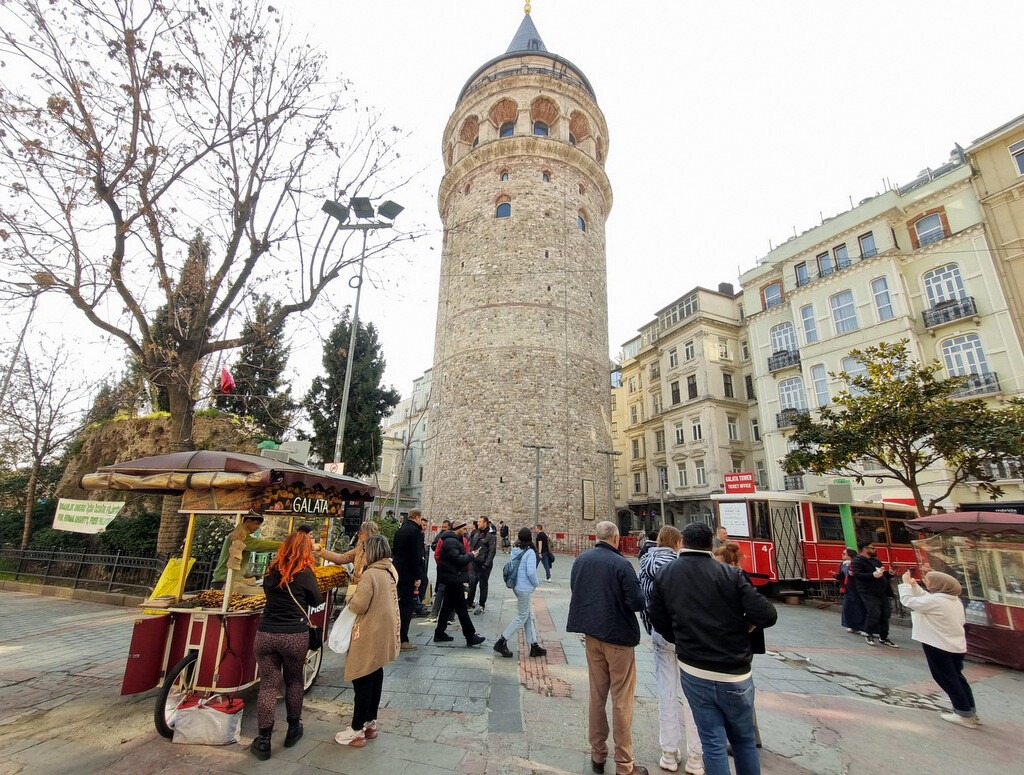
When Constantinople was recaptured in 1261, the empire regained its capital—but not its power.
The city that returned to Byzantine hands was weakened, its economy shattered, and its institutions diminished. To rebuild, the empire turned once again to external support.
This time, the price was high.
In exchange for naval assistance against Venice, the Byzantines granted extensive privileges to the Genoese. Across the Golden Horn, in the district of Galata, a new center of power emerged—one that operated independently from the imperial city.
At its highest point rose the Galata Tower.
Built in 1348 by the Genoese as part of their fortified colony, the tower served both as a watchtower and a symbol of control. From its height, the entire Golden Horn could be monitored—the lifeline of Constantinople’s trade.
But this was more than a military structure.
It represented a shift in authority.
While the Byzantine capital struggled within its walls, the Genoese colony prospered. Trade routes from the Black Sea and the Silk Road passed through Galata, and the wealth generated there far exceeded that of the empire itself. The economic heart of Constantinople had effectively moved across the water.
The contrast was stark.
On one side, an aging empire holding onto its past.
On the other, a rising commercial power shaping the future.
And yet, this relationship was not purely adversarial.
When the final siege of 1453 began, the Genoese presence did not remain entirely passive. Figures such as Giovanni Giustiniani took part in the defense of the city, fighting alongside the Byzantines at the walls.
It was a final moment of shared fate.
Today, the Galata Tower still rises above the modern city, its stone silhouette unchanged. It no longer watches over merchant fleets or defensive lines, but its presence continues to mark a turning point in the story of Constantinople.
For by the 14th century, the empire was no longer defined by expansion or control.
It was surrounded—economically, politically, and geographically—by forces it could no longer contain.
And beyond the Bosphorus, a new power was beginning to take shape, preparing a strategy that would bring the long story of Constantinople to its final chapter.
24. Rumeli Fortress
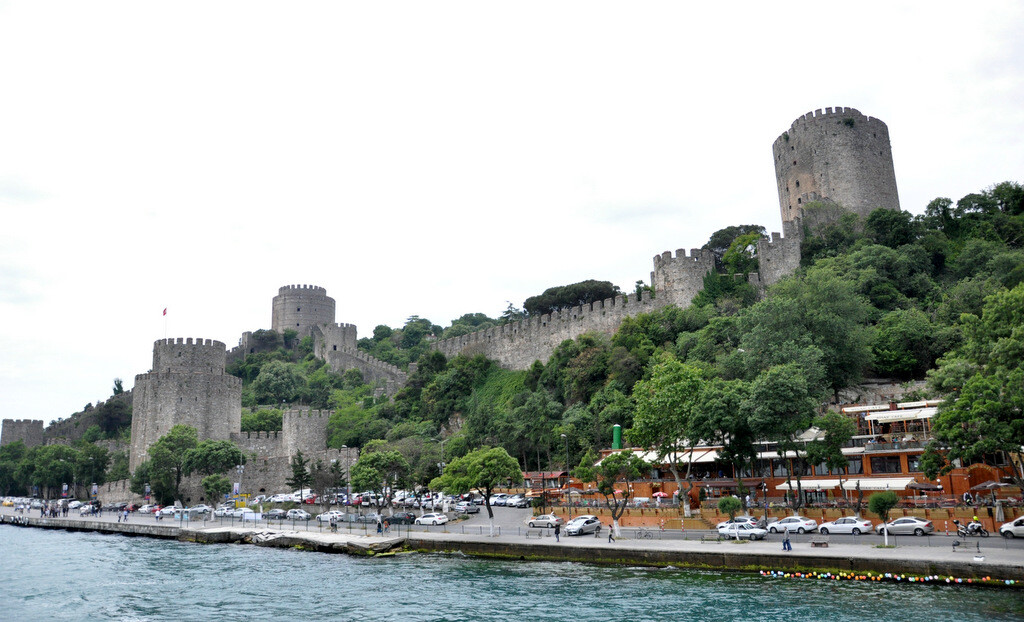
By the mid-15th century, the fate of Constantinople was no longer uncertain.
It was only a matter of time.
For decades, the city had survived through its walls, its diplomacy, and its strategic position between continents. But the conditions that once ensured its endurance were now being systematically dismantled.
Across the Bosphorus, a new force was preparing the final move.
Mehmed II understood what his predecessors had failed to achieve. Previous sieges had been unsuccessful not because the walls were impenetrable, but because the city could still receive support by sea. As long as Constantinople remained connected to the Black Sea, it could endure.
That connection had to be cut.
In 1452, on the narrowest point of the Bosphorus, the Rumeli Fortress was constructed—directly opposite an earlier Ottoman fort on the Asian shore. Together, these two strongholds transformed the strait into a controlled passage, sealing off the city from external aid.
The speed of its construction was itself a statement.
Built in just a few months under the supervision of Mehmed and his commanders, the fortress rose with a sense of urgency that reflected the clarity of its purpose. This was not a defensive structure.
It was an instrument of siege.
From its towers, cannons were positioned to control maritime traffic. Ships attempting to pass without permission risked destruction. The Bosphorus, once a corridor of movement, became a barrier.
Constantinople was now isolated.
For the first time in its history, the city faced a threat that combined strategic planning, technological force, and unwavering determination. The balance that had preserved it for centuries had shifted.
The walls still stood.
The city still lived.
But its lifeline had been cut.
Today, the massive towers of Rumeli Fortress rise above the Bosphorus, overlooking the same waters they once controlled. The setting is peaceful, the currents unchanged—but the meaning of the place remains clear.
This is where the final phase began.
From this point onward, the story of Constantinople is no longer about adaptation or recovery.
It is about resistance.
And beyond the Bosphorus, within the Golden Horn, the city prepared its last defense—one that had protected it for centuries, and would now be tested for the final time.
25. The Golden Horn Chain
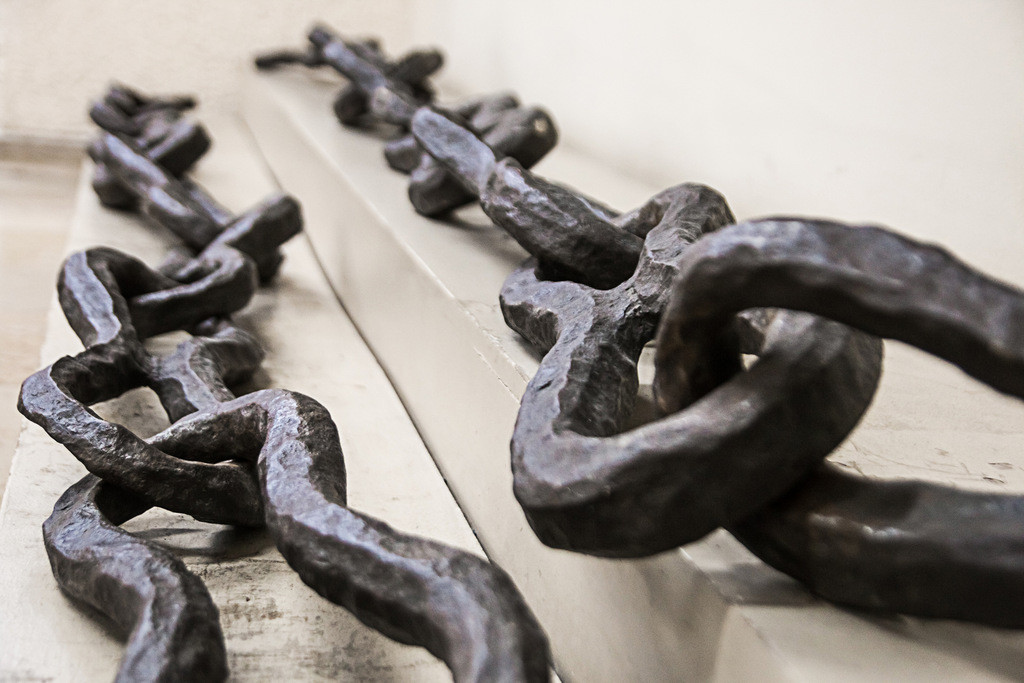
For centuries, the Golden Horn was Constantinople’s greatest advantage.
Its deep, sheltered waters formed one of the safest harbors in the medieval world. And at its entrance, stretched across the mouth of the inlet, was the city’s final line of defense—a massive iron chain.
Anchored between towers on both sides, the chain prevented enemy fleets from entering the harbor. Persian, Arab, and later Turkish forces had all been stopped here. As long as the Golden Horn remained closed, the city’s weakest side was secure.
For generations, this system had worked.
It became more than a defensive measure.
It became a certainty.
But in 1453, that certainty was broken.
Facing the chain, Mehmed II chose not to confront it directly. Instead, he bypassed it. Ottoman ships were transported overland, hauled across the hills of Galata on greased tracks, and launched into the Golden Horn behind the chain.
By morning, the impossible had happened.
The harbor was no longer safe.
The effect was immediate—not only strategic, but psychological. The defenses that had held for centuries were suddenly irrelevant. The city was no longer protected by its geography, its walls, or its traditions.
It was exposed.
With the Ottoman fleet now inside the Golden Horn, the already stretched Byzantine defenses were forced to divide. The weaker sea walls were attacked, and the balance that had sustained Constantinople for a thousand years began to collapse.
On May 29, 1453, the city fell.
Yet what followed was not destruction in the sense of disappearance.
Constantinople did not vanish.
It changed hands.
The city became the capital of a new empire—one that would carry forward its strategic importance, its urban structure, and even its name for centuries. Known as Konstantiniyye in Ottoman usage, it remained a center of power, continuity, and transformation.
Today, fragments of the great chain survive in museums across Istanbul, silent reminders of a system that once defined the limits of possibility.
But the meaning of the chain extends beyond its physical form.
It represents the final moment when the old world gave way to the new.
A city founded as the “New Rome” did not disappear—it became something else, shaped by a different empire, a different faith, and a different future.
And yet, walking through Istanbul today, the layers remain.
The forums, the walls, the churches, the cisterns—they continue to speak.
Not of an ending, but of a transformation.
Conclusion
The story of Constantinople cannot be contained within a single timeline—or a single article.
Each of the places you have seen here carries its own depth, and many of them deserve a closer look. On Istanbul Clues, you will find detailed guides that explore these monuments individually, supported by on-site observations and historical research.
This article offers something different.
It brings those places together into a single narrative—one that follows the rise, transformation, and endurance of a city that stood at the center of history for more than a millennium.
From the vision of Constantine to the final siege of 1453, Constantinople was never a static capital. It was continuously reshaped by power, belief, crisis, and adaptation.
And even after its fall, it did not disappear.
It continued—under a different name, within a different empire, but along the same streets, the same walls, and the same geography.
Today, as you walk through Istanbul, these layers are still visible.
The city you see is not separate from its past.
It is built upon it.
If you would like to explore this history in person, I have been guiding visitors through Istanbul’s Byzantine sites since 2004. My private tours focus on connecting these monuments into a coherent story—much like the one you have just read.
Because in the end, Constantinople is not only a subject to study.
It is a place to experience.

Finally a good article on Byzantine places in Istanbul that is not generic, adds new locations to the list and moreover offers interesting historical insights. Soothing really!
Hello Tudor, thank you for the feedback. I am glad to see that you have enjoyed the article. I intended this to be an original post, and it seems to have worked.
Am currently reading William Dalrymple’s “From the Holy Mountain” and wanted more info about Byzantium. I have found your information fascinating. A section of history of which I know very little, so thank you kindly.
Dear Imogen Gill, thank you for the feedback. It really makes me happy to see that my article is useful for those who want to learn about Byzantine history.
Awesome article.
Thank you! I am glad to hear that you like it!
Dear Serhat Engul,
I like your style to make your presence in your profession.
hope some day I make this trip to this land the created history….
Will call u then
Dear Oliveiro, Thank you very much for your kind review. I hope to see you in Istanbul one day. Best regards, Serhat Engul.