The Great Palace Mosaic Museum is one of the most understated yet historically significant Byzantine sites in Istanbul. Tucked away in the Sultanahmet district, this small museum preserves the surviving floor mosaics of the Great Palace of Constantinople—once the political and ceremonial heart of the Eastern Roman Empire.
I have been a licensed tour guide in Istanbul for over 20 years, and for much of that time I have led private Byzantine-themed tours for travelers from around the world who want to understand the city beyond its famous landmarks. For anyone seriously interested in Byzantine history, the mosaics displayed here are not decorative leftovers; they are primary historical evidence that helps explain how imperial Constantinople actually functioned as a lived-in palace complex.
In this guide, I focus on the historical context of the Great Palace, the significance of its mosaic program, and what visitors should realistically expect from the site. Practical details such as entrance information and visiting logistics are included for reference, but the real value of this museum lies in how it connects everyday life, imperial ideology, and urban history within the Byzantine capital.
If your main interest is Byzantine mosaics, it’s worth noting that this artistic tradition can still be experienced elsewhere in Istanbul. Sites such as Hagia Sophia and the Chora Church preserve some of the most remarkable surviving mosaic programs from the Byzantine period and remain accessible to visitors.
Insider’s Note: As a local guide, I began this article about the Great Palace Mosaic Museum by tracing the city’s story back to its Roman foundations and the rise of the Great Palace itself. I wanted to provide a solid historical background before focusing on the mosaics. If you’re mainly interested in the artworks, feel free to skip ahead to the middle section dedicated entirely to the mosaics.
History of the Great Palace (Constantinople)
The story of the Great Palace of Constantinople begins in the early 4th century, but its roots are inseparable from the Roman transformation of Byzantium. For nearly 800 years, Byzantium had existed as an independent Greek colony before coming under Roman control in 195 AD, a turning point that set the stage for the city’s imperial future.
1. Rome Arrives in Byzantium
The first Roman emperor to leave a lasting mark on the city was Septimius Severus. His arrival in the late 2nd century was far from peaceful. Byzantium had supported his rival, Pescennius Niger, and Severus responded by besieging and severely damaging the city.
Yet once the punishment ended, Severus recognized Byzantium’s strategic value. He ordered the city to be rebuilt and introduced its first Roman urban elements. At this stage, however, Byzantium was still a peripheral city within the vast Roman world.
2. Civil Wars and Strategic Awakening
Byzantium’s true importance emerged during the civil wars of the Tetrarchy, when multiple emperors fought for control of the empire. These conflicts brought the city to the center of imperial politics, particularly during the struggle between Constantine the Great and Licinius.
As Constantine advanced toward sole rule, Licinius used Byzantium’s defensible position—protected by sea and narrow land access—to his advantage. Eventually retreating to the Asian side of the Bosphorus, Licinius was decisively defeated at the Battle of Chrysopolis (Üsküdar). With this victory, Constantine ended the civil wars and emerged as the sole emperor.
3. The Birth of a New Capital
It was during this conflict that Constantine fully grasped the city’s potential. The peninsula’s natural defenses, combined with the Golden Horn acting as a secure inner harbor, made Byzantium uniquely suited to become an imperial capital. Constantine concluded that once strong land walls were constructed, the city would be virtually impregnable.
In 324 AD, he made a bold and controversial decision: to move the capital of the Roman Empire eastward. Many contemporaries were surprised, as Byzantium was not yet a major metropolis. History, however, proved Constantine’s vision correct. Constantinople soon became the most important political and commercial center of the Eastern Mediterranean.
4. “New Rome” and the Rise of the Great Palace

Constantine launched an ambitious reconstruction program, sending architects, engineers, and artists to reshape the city. Within a few years, Byzantium was officially proclaimed Nova Roma—the “New Rome.” At the heart of this transformation stood two monumental complexes: the Hippodrome and the Great Palace.
Stretching from the area of today’s Blue Mosque down toward the Sea of Marmara, the Great Palace formed an enormous ceremonial and residential complex. Mosaic-paved courtyards, churches, reception halls, pavilions, and even sporting grounds were woven together into a continuous imperial landscape.
5. From Imperial Residence to Ruin
From the 4th to the 11th century, Roman and later Eastern Roman emperors ruled from the Great Palace. Over time, however, imperial life gradually shifted northward toward the Blachernae Palace near the Golden Horn. The decisive blow came in 1204, when the Fourth Crusade devastated Constantinople.
During the 57-year Latin occupation that followed, the Great Palace fell into ruin. When the Byzantines finally reclaimed the city in 1261, there were neither the resources nor the political stability needed to restore this once-majestic complex. What remained slowly disappeared beneath later layers of the city—until fragments of its mosaic floors resurfaced centuries later, offering a rare glimpse into the heart of imperial Constantinople.
Things to See in Istanbul Mosaic Museum
The mosaics displayed in the Great Palace Mosaic Museum are among the most remarkable remnants of Byzantine art that survived from the Great Palace of Constantinople.
Dating back to the 5th and 6th centuries, they once decorated the floors of a large courtyard in the imperial complex — an area estimated to have covered nearly 2,000 m². Only a fragment of that grand mosaic pavement remains today, but what survives is enough to convey the refinement, imagination, and daily life of the Byzantine world.
1. The Mosaic Floor – A Journey Through Time
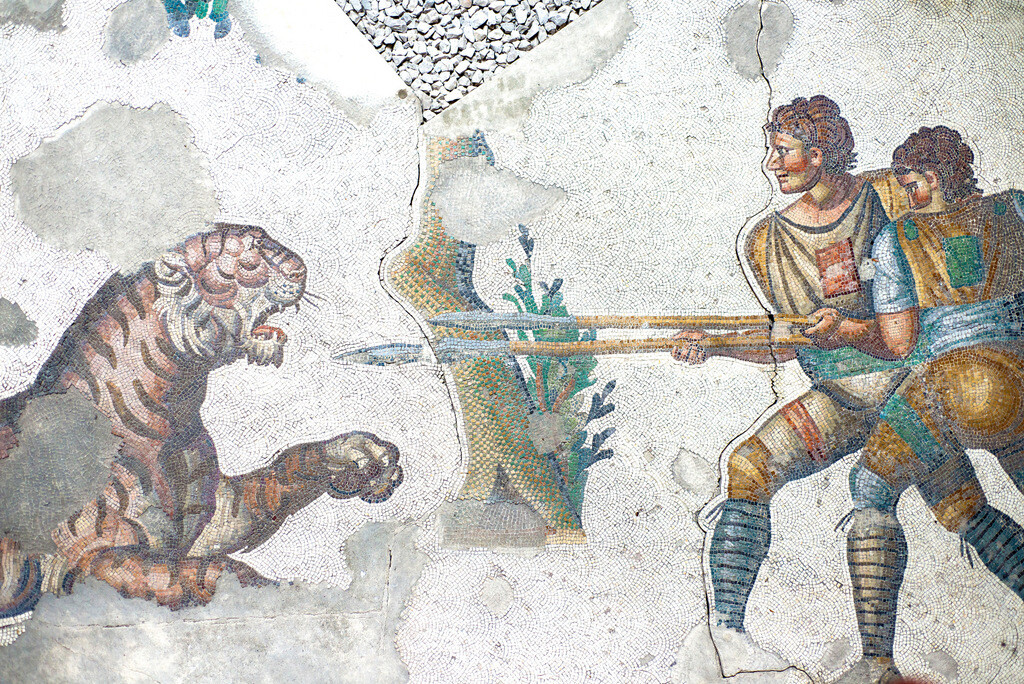
Walking through the museum feels like stepping onto the palace floor of an emperor. Each tessera (small stone piece) was hand-placed to form a vivid scene, using limestone, colored marble, and terracotta. The surviving section shows a lively world that is surprisingly secular — there are no saints or halos here, only scenes of nature, myth, and human life. This sets it apart from the religious mosaics of churches like Hagia Sophia or Chora.
2. Mythological and Animal Scenes
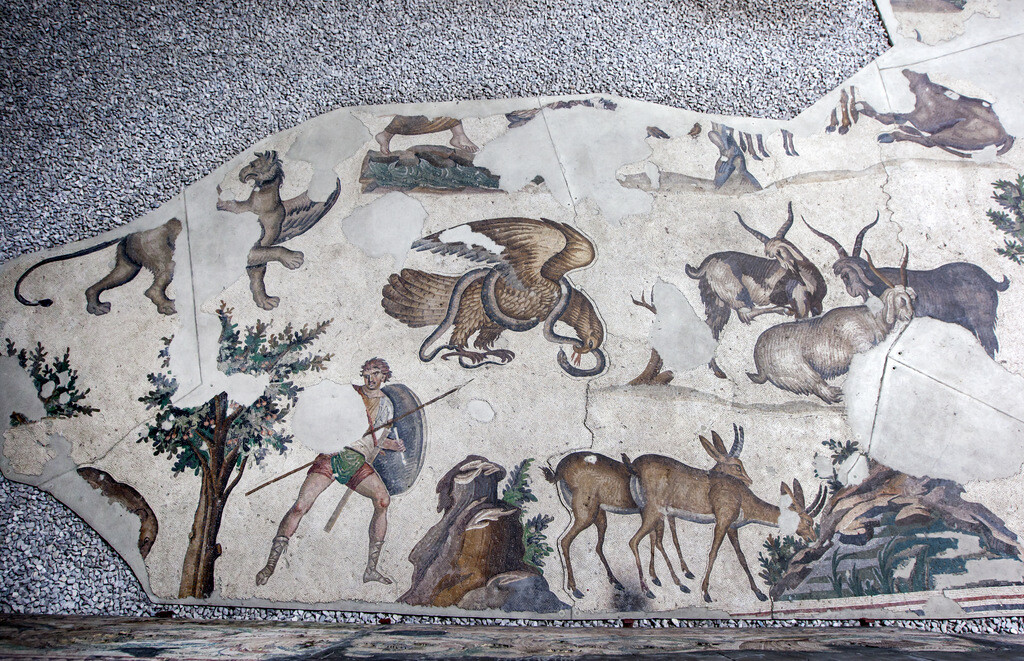
The mosaics are full of movement and drama. Lions, elephants, horses, and griffins are locked in fierce battles. A lion is seen attacking an elephant; an eagle swoops down on a snake; a griffin devours a lizard. These motifs may symbolize the eternal struggle between good and evil, or perhaps they simply reflect the Byzantine fascination with exotic beasts and far-away lands.
Between these wild encounters, you’ll also find peaceful glimpses of rural life: a shepherd leading his flock, a boy feeding a donkey, or children playing with geese. Such details reveal a softer side of Byzantine art — the joy of everyday scenes rarely captured elsewhere.
3. Technical and Artistic Details
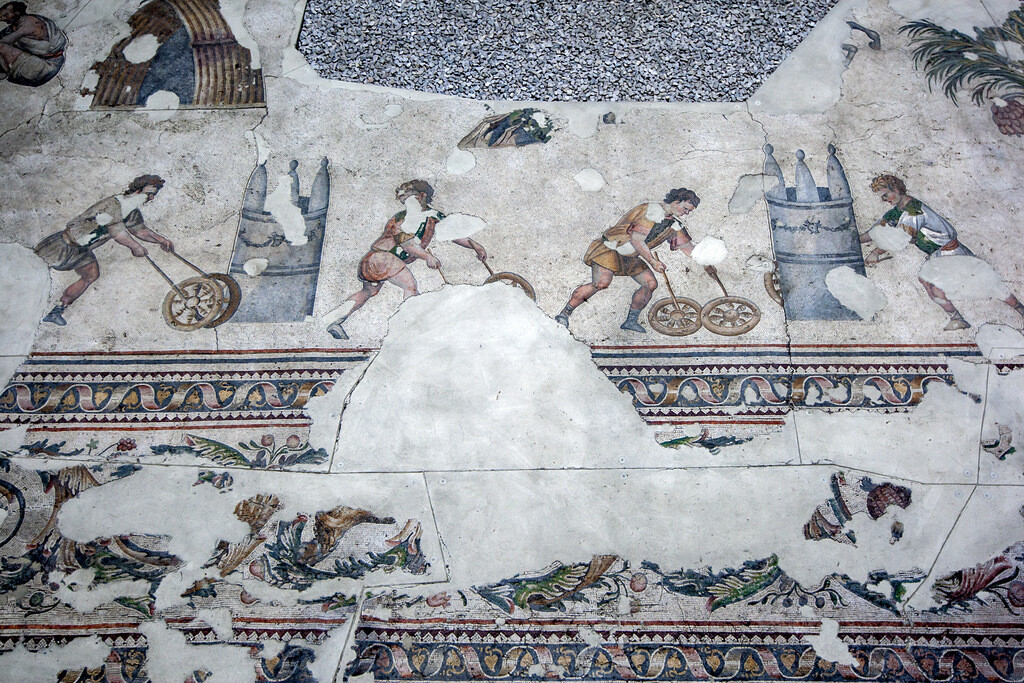
The craftsmanship of these mosaics is astonishing. Some panels feature intricate “opus vermiculatum” patterns, where each tiny stone follows the contour of a figure, creating fluid motion and depth. The color palette is dominated by natural tones — ochre, ivory, black, and deep red — chosen to give the figures a lifelike sense of warmth and volume. Unlike many other Byzantine artworks, these mosaics were never framed by geometric borders; instead, one scene flows seamlessly into the next, creating a continuous narrative across the floor.
4. The Museum Setting
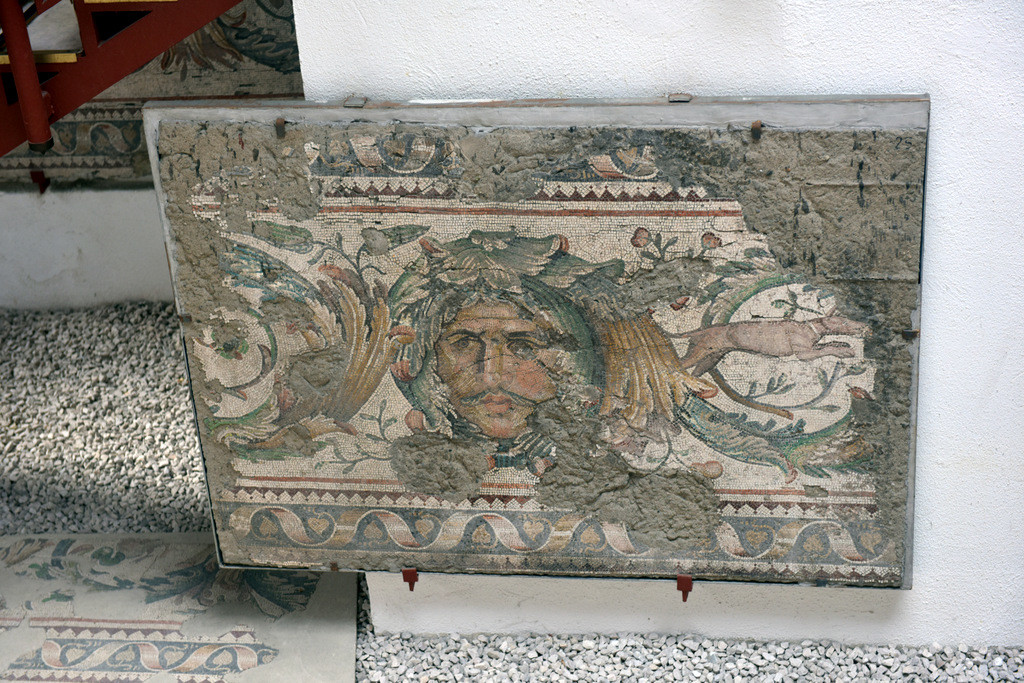
The museum itself is modest in size but atmospheric, located beneath the Arasta Bazaar, just behind the Blue Mosque in Sultanahmet. The lighting is soft, allowing you to focus on the delicate details of the mosaics. Informative panels explain the historical context, while a walkway above the ancient floor lets you view the artworks closely without damaging them. A visit here offers an intimate, almost contemplative experience — a quiet contrast to the bustling streets of Sultanahmet above.
5. Highlights Not to Miss
If you have limited time, make sure you notice:
- The Lion and Elephant Scene – the most dynamic and dramatic composition.
- Mare Nursing Her Foal – a tender portrayal of maternal instinct in nature.
- Boy Feeding a Donkey – a charming everyday image that brings warmth to the imperial setting.
- Griffin Devouring a Lizard – one of the finest mythological depictions, rich in detail and motion.
Each of these mosaics tells a fragment of a lost imperial world — a place where art bridged the realms of myth and reality. Though the museum is currently under restoration, its mosaics remain one of the most vivid links to the grandeur of Constantinople’s Great Palace, waiting to be rediscovered by the next generation of visitors.
Great Palace Mosaic Museum Entrance Fee (2026)
The last listed entrance fee for the Great Palace Mosaic Museum was 10 Euros.
At that time, the Museum Pass Istanbul was also accepted.
This pricing information reflects the museum’s status before its closure and was last verified on January 19, 2026, when the site was still open to visitors. Please keep in mind that ticket prices may change once the restoration is completed and the museum reopens.
Great Palace Mosaic Museum Opening Hours (2026)
Before its closure, the Great Palace Mosaic Museum was open daily from 09:00 to 19:00, including weekends.
These opening hours were last recorded on January 19, 2026, based on the museum’s most recent operational schedule. As with entrance fees, visiting hours may be revised following the completion of restoration work.
Museum schedules in Istanbul can change due to restoration projects, official events, or seasonal adjustments.
Before planning your visit, it is always advisable to check the museum’s official channels for the most up-to-date information—especially once reopening dates are announced.
How to Get to the Great Palace Mosaic Museum?
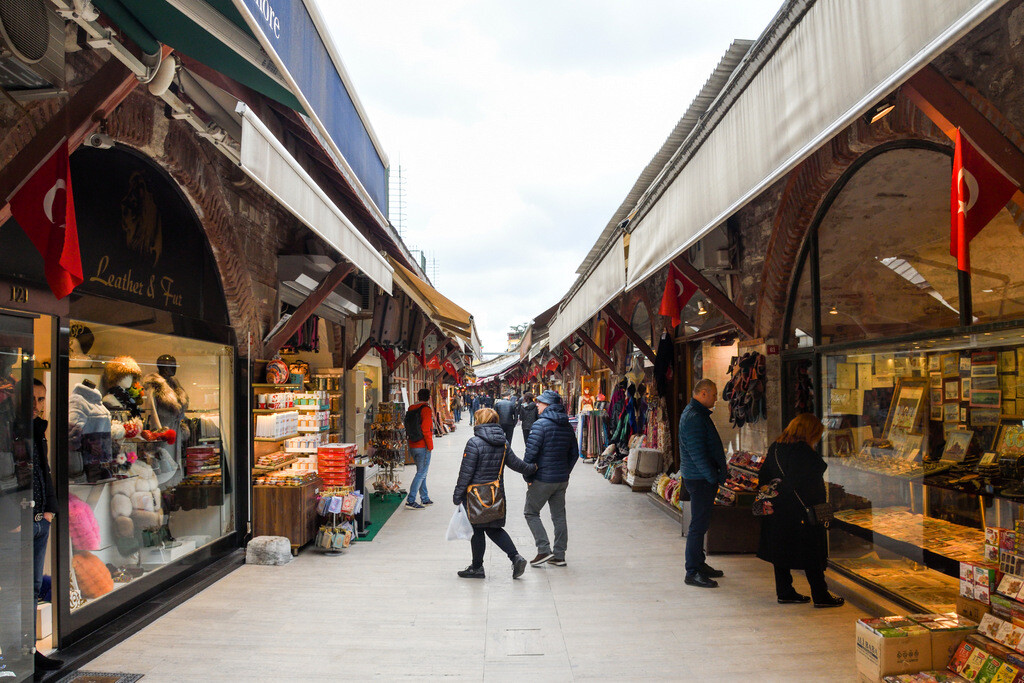
The Great Palace Mosaic Museum is located inside the Arasta Bazaar, directly behind the Blue Mosque in the Sultanahmet district.
The easiest way to reach the museum is to enter the Arasta Bazaar from Sultanahmet Square and walk along its main corridor. Unlike larger covered bazaars such as the Grand Bazaar, Arasta is an open-air, linear marketplace, making it easy to navigate even for first-time visitors.
As you walk through the bazaar, directional signs clearly point toward the Great Palace Mosaic Museum. These signs lead you to a small courtyard where fragments of Byzantine-era columns mark the entrance area of the museum.
Even though the museum is currently closed for restoration, the location itself is easy to identify and lies directly on the natural walking route between the Blue Mosque and the southern edge of Sultanahmet.
Conclusion
The Great Palace Mosaic Museum occupies a unique place among Istanbul’s museums. Rather than overwhelming visitors with scale or spectacle, it offers something far more intimate: a direct visual connection to daily life in Byzantine Constantinople. The mosaics—rich in movement, detail, and symbolism—remind us that the Great Palace was not only an imperial residence, but a lived-in world shaped by routine, ceremony, and artistry.
For travelers interested in Byzantine history, this museum represents a crucial missing link between monumental structures like Hagia Sophia and the quieter, more human layers of the city’s past. It helps explain how emperors, courtiers, and craftsmen once inhabited the very ground beneath Sultanahmet, long before the Ottoman skyline took shape.
That said, it is important to note that the Great Palace Mosaic Museum remains closed due to restoration work in 2026. While it is unfortunately not possible to enter the museum at this time, the site itself is far from silent. Through the iron gates, visitors can still glimpse Byzantine-era column fragments in the courtyard, offering a subtle but powerful reminder of what lies beneath the modern city.
Moreover, the surrounding area continues to reward those interested in Byzantine history. Just a short walk away stands the Little Hagia Sophia Mosque, originally built in the 6th century as the Church of Saints Sergius and Bacchus during the reign of Emperor Justinian. Even the brick walls scattered throughout the neighborhood—often overlooked—are in many cases remnants of the Eastern Roman Great Palace complex itself.
In other words, while the museum doors may be closed, the history is still very much present. This part of Sultanahmet was once the heart of the Byzantine Empire, and with a careful eye, its traces can still be read in stone, brick, and ground. Istanbul rarely reveals its past all at once—but here, it quietly invites you to look closer.
Written by Serhat Engul

Great website Serhat however would be great to have the fact that the mosaics museum is shut at the start of the article rather than in the middle after a section that has entrance prices for 2024.
Dear Paul Sode, thank you for your suggestion. I will take this into account when updating the article. It is difficult to keep the introduction of the articles up to date, but I will do my best.