The Monastery of the Theotokos Pammakaristos was one of the most important monuments of late Byzantine Constantinople. Today, the only surviving structure of this once-large monastic complex is known as the Pammakaristos Church, which functioned as the Fethiye Museum until its closure for restoration.
The name “Fethiye Museum” can occasionally cause confusion, as there is also a well-known seaside town in southwestern Turkey called Fethiye. However, this monument is located in Istanbul, in the historic district of Balat, and has no geographical connection to the modern resort town.
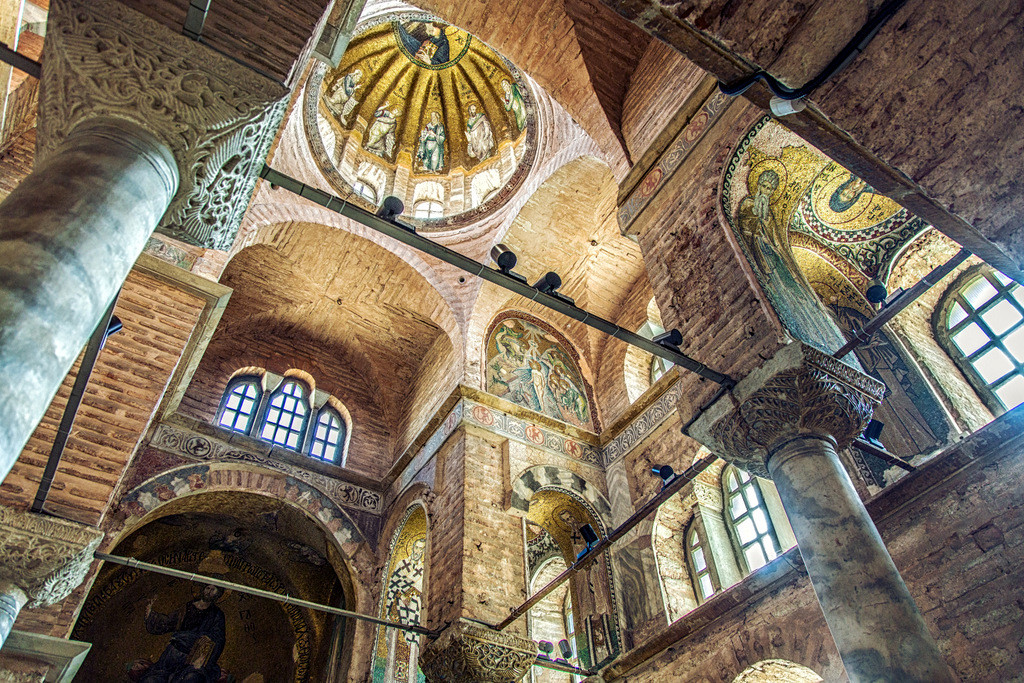
Before its closure, the Fethiye Museum was considered one of the city’s most important repositories of Byzantine mosaics, often mentioned alongside Hagia Sophia and the Chora Church for the quality and artistic refinement of its decoration.
Beyond its mosaics, the Pammakaristos Church is especially significant for understanding the architectural language of late Byzantine Constantinople. Its structure, proportions, and later additions provide valuable insight into how Byzantine church architecture evolved during the final centuries of the empire.
To place this monument in its proper historical and architectural context, it is necessary to briefly step back and look at the broader development of Christianity and church building in Byzantium before focusing on the Pammakaristos complex itself.
Christianity in Constantinople
The development of Christianity entered a decisive new phase when Emperor Constantine shifted the imperial capital eastward and founded Constantinople as the political and spiritual center of the Roman world. With this move, the axis of Christian authority gradually relocated from Rome to the eastern Mediterranean.
The Council of Nicaea and the subsequent ecumenical councils held in and around Constantinople played a defining role in shaping Christian doctrine, hierarchy, and institutional structure. By the 4th and 5th centuries, Constantinople had emerged not only as an imperial capital, but also as a city where theological debates, ecclesiastical authority, and sacred architecture converged.
As Christianity became fully integrated into imperial life, churches and monasteries in Constantinople evolved into symbols of both religious legitimacy and political influence. The growing authority of the Patriarch of Constantinople, especially in relation to other major Christian centers, reflects this transformation.
It is within this Constantinopolitan framework—where theology, power, and architecture were deeply intertwined—that monuments such as the Pammakaristos Church must be understood.
The Monastery of the Theotokos Pammakaristos
The Ecumenical Patriarchate of Constantinople has been the spiritual heart of Eastern Orthodox Christianity for centuries. Although today Orthodoxy is organized into autocephalous churches, the Ecumenical Patriarch continues to hold a unique honorary status as primus inter pares — first among equals.
After the Ottoman conquest of Constantinople in 1453 and the conversion of Hagia Sophia into a mosque, the Patriarchate was relocated several times. One of its most significant temporary residences was the Monastery of the Theotokos Pammakaristos, which served as the seat of the Patriarchate from the mid-15th century until the late 16th century.
This period transformed Pammakaristos from a monastic complex into a site of exceptional symbolic importance. Hosting the Patriarchate elevated the church’s status far beyond its architectural scale, placing it at the very center of Orthodox religious life during the early Ottoman era.
History of Pammakaristos Church
The origins of the Pammakaristos Church date back to the Middle Byzantine period, when noble families sponsored church construction as both acts of piety and statements of prestige. The original structure was founded during the Komnenian era and later expanded during the Palaiologan period, a time marked by artistic revival despite political decline.
After the reconquest of Constantinople in 1261, the church came under the patronage of Michael Tarchaneiotes Glabas, a prominent Byzantine aristocrat who restored and enlarged the complex. Following his death, his wife Maria Doukaina commissioned an elaborately decorated parekklesion (funerary chapel) to the south of the main church, adorned with some of the finest surviving mosaics of late Byzantine art.
Between 1455 and 1587, the church functioned as the seat of the Ecumenical Patriarchate. In the late 16th century, it was converted into a mosque during the reign of Sultan Murad III and renamed Fethiye Mosque, commemorating Ottoman military victories. While the main church was adapted for Islamic worship, the parekklesion eventually came under museum authority, allowing its Byzantine mosaics to survive into the modern era.
Today, although the complex is no longer accessible to visitors due to ongoing restoration, the Pammakaristos Church remains a key reference point for understanding late Byzantine architecture, elite patronage, and the religious history of Constantinople.
Fethiye Museum (Istanbul) Entrance Fee 2026
Before its closure for restoration, the entrance fee for Fethiye Museum was 3 Euros, and the Museum Pass Istanbul was accepted for entry to the former Pammakaristos Church.
This ticket information reflects the museum’s last operational status and was last verified on January 21, 2026, reflecting the pricing before its closure.
Please note that ticket prices may change once the restoration is completed and the museum reopens.
Fethiye Museum (Istanbul) Visiting Hours 2026
Prior to its closure, Fethiye Museum was open daily from 09:00 to 17:00 and remained closed on weekends.
These visiting hours are based on the last available official schedule, last updated on January 21, 2026. As with entrance fees, opening hours may be revised after the restoration period ends.
Museum schedules in Istanbul can change due to restoration projects, official events, or administrative decisions.
Before planning a future visit, it is always advisable to check the museum’s official channels once reopening dates are announced.
How to Get to Fethiye Museum
Fethiye Museum (formerly the Pammakaristos Church) is located in the Çarşamba district of Fatih, slightly uphill from the Golden Horn shoreline. Although it appears close to Fener and Balat on the map, the final approach involves a noticeable climb, which can be tiring depending on your route.
The easiest way to reach the site is by using buses that go directly to Draman, a stop located just a few minutes’ walk from the museum. From Eminönü, bus 90 (Eminönü–Draman) provides the most practical access. Visitors arriving by metro can reach Vezneciler Station on the M2 line and continue with bus 90B, which also stops near Draman.
If you prefer a more scenic approach, you can reach the area from the Golden Horn waterfront by getting off at the Fener stop on buses running along the shore. From there, the museum can be reached on foot in about 10–15 minutes, but the walk is uphill and includes steep streets. This route is rewarding for those who enjoy exploring Fener and Balat, though it requires more effort.
From Sultanahmet, the most practical option is to take the T1 tram to Eminönü and transfer to one of the buses mentioned above. A taxi ride from Sultanahmet usually takes around 15–20 minutes, depending on traffic; asking for “Çarşamba, Fethiye Camii” is generally sufficient.
As a local tip, be aware that Google Maps may suggest shortcuts involving stairways. To conserve energy, it is often easier to go uphill by bus to Draman and explore the surrounding neighborhoods on the way down.
Current Restoration Status of Fethiye Museum
Fethiye Museum (formerly the Pammakaristos Church) has been closed to visitors for an extended period due to comprehensive restoration works. As of January 2026, the museum remains closed, and no official reopening date has been announced.
The restoration is not limited to surface repairs. According to available information, the project includes structural strengthening of the building, which significantly extends the overall timeline. In addition to reinforcement works, the restoration also involves careful cleaning and conservation of the Byzantine mosaics, as well as improvements to the interior lighting system in order to present the artworks under more appropriate conditions once the site reopens.
A comparable example in Istanbul is the Chora Church, where a similar combination of structural intervention, mosaic conservation, and lighting upgrades resulted in a restoration period of nearly six years. In the case of the Pammakaristos complex, the process has taken even longer, reflecting both the building’s architectural complexity and the sensitivity required when working on late Byzantine monuments.
Given the scope of the works, the prolonged closure should not be interpreted as inactivity but rather as an indication of a deep and technically demanding conservation project. This article will be updated once official information regarding the reopening of the museum becomes available through authorized channels.
Conclusion
Even while closed to visitors, the Fethiye Museum (Pammakaristos Church) remains one of the most compelling places in Istanbul for understanding late Byzantine art and architecture. Alongside Hagia Sophia and the Chora Church, it belongs to a small group of monuments that allow visitors to experience the artistic language of Byzantium not in fragments, but in a concentrated and meaningful form.
What makes Pammakaristos especially distinctive is its focus on the late Byzantine period—a time of extraordinary artistic refinement that unfolded despite political instability and decline. The mosaics of its parekklesion represent some of the most sophisticated expressions of Byzantine visual culture, making the site particularly exciting for travelers with a genuine interest in art history, iconography, and medieval aesthetics.
When restoration is complete, the Fethiye Museum will once again offer an experience that complements Hagia Sophia’s imperial grandeur and Chora’s narrative richness, completing the picture of Byzantine Constantinople from a more intimate and aristocratic perspective.
For readers interested in exploring this world further, Istanbul Clues hosts an extensive archive dedicated to Byzantine history and surviving monuments in Istanbul. A good starting point is the article Byzantine Churches in Istanbul, from which the site branches into a wide-ranging collection covering churches, monasteries, mosaics, architectural forms, and historical context across the city.
Whether you are planning a future visit or simply seeking a deeper understanding of Byzantium’s artistic legacy, the story of Pammakaristos remains an essential chapter—one that continues to reward curiosity, patience, and informed exploration.
Written by Serhat Engul


Is it possible to visit the upper galleries of Santa Sofia?
Hello Matias, yes, the upper floor galleries of Hagia Sophia have been opened to tourists as of January 15, 2024.