Pamukkale is one of those rare places where nature and history are inseparable.
The brilliant white travertine terraces — shaped over thousands of years by thermal waters — are visually striking on their own. But what truly elevates the experience is what lies above and around them: the ancient city of Hierapolis.
This is not just a natural wonder you photograph and leave behind.
Pamukkale is a walkable archaeological landscape, where Roman streets, monumental theaters, sacred pools, and necropolises coexist with flowing mineral water.
In this guide, you’ll find clear, up-to-date, and experience-based information — written from the perspective of a licensed local guide with nearly two decades of on-site guiding across Turkey — so you can visit Pamukkale with the right expectations and the right timing.
A Brief History of Hierapolis
Long before Pamukkale became a visual icon, Hierapolis was a sacred city.
Archaeological evidence suggests settlement in the area predates the Hellenistic period, possibly connected to Anatolian mother-goddess cults. The city as we know it was formally founded in the 2nd century BC by Eumenes II of Pergamon, and later reshaped under Roman rule.
After a major earthquake during the reign of Emperor Nero, Hierapolis was rebuilt as a fully Roman city — complete with monumental baths, a grand theater, colonnaded streets, and one of the largest necropolises in Anatolia.
During the Byzantine era, the city gained new significance as a Christian pilgrimage center, believed to be the place where Saint Philip was martyred. This layered history is why Hierapolis feels less like a single-period ruin and more like a compressed timeline of ancient belief systems.
The “Gates of Hell” and the Immortal Priests
One of the most fascinating — and well-documented — aspects of Hierapolis is the Ploutonion, a cave complex once believed to be an entrance to the underworld.
Ancient writers such as Strabo describe how animals brought inside the cave would die almost instantly due to toxic gases, while priests emerged unharmed — earning them the reputation of “immortal priests.”
Modern scientific studies (including research published in Archaeological and Anthropological Sciences) confirmed the presence of carbon dioxide gas concentrated near ground level. The priests’ survival was not divine immunity, but knowledge of timing, airflow, and elevation.
It’s a powerful reminder that Hierapolis was not only a spiritual center, but also a place where ancient science and ritual quietly intersected.
Things to Do in Pamukkale & Hierapolis (2026)
Pamukkale is best experienced slowly and on foot. Rushing through it reduces the site to a checklist — and that would miss the point entirely.
1. Walk the Travertine Terraces
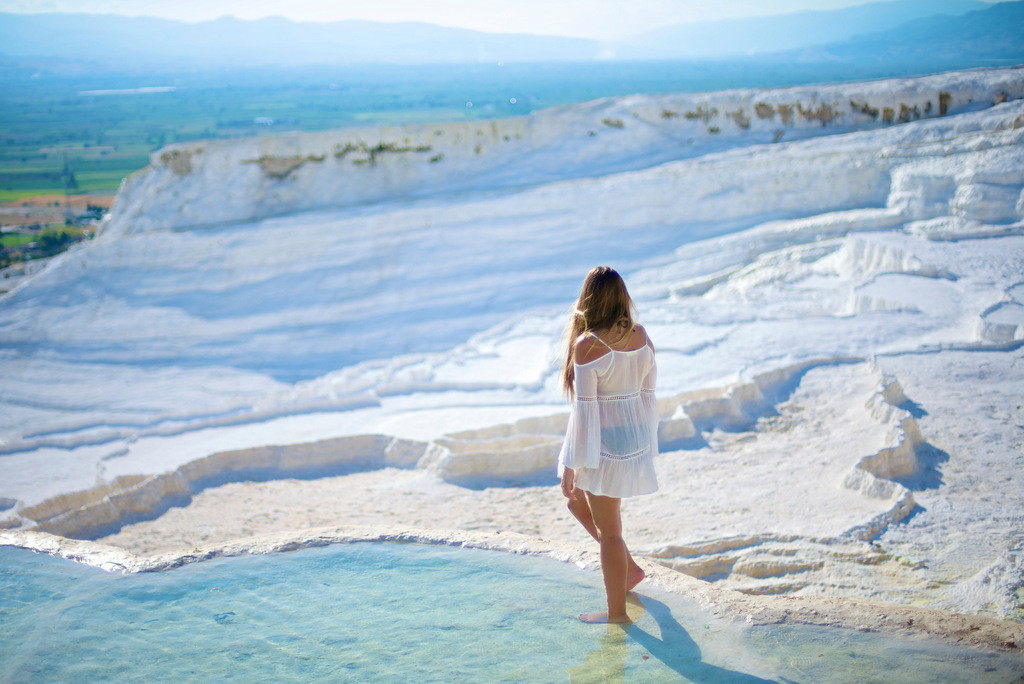
The white travertines are the visual heart of Pamukkale. Walking barefoot on the terraces, with warm mineral water flowing beneath your feet, is a uniquely sensory experience.
Reality check:
Water levels vary by season and conservation needs. The terraces are not always filled wall-to-wall with water — and that’s normal.
2. Explore the Great Theater
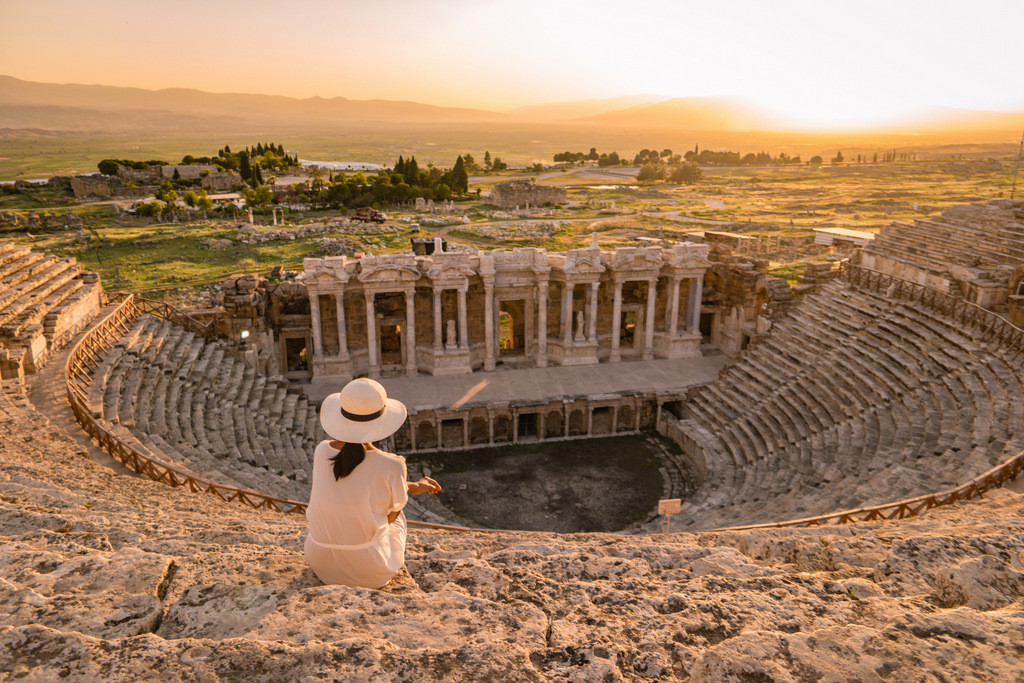
The Hierapolis Theater is one of the best-preserved Roman theaters in the eastern Mediterranean. Its scale, reliefs, and elevated position offer both architectural insight and panoramic views.
This is not a quick photo stop — it’s a place to sit, observe, and understand how Roman cities were designed for spectacle and symbolism.
3. Swim in Cleopatra’s Antique Pool (Optional)

This thermal pool, filled with fallen ancient columns, offers a rare chance to swim inside an archaeological setting.
Important:
Entry requires an additional ticket, and access may be limited during peak hours.
4. Visit the Pamukkale Archaeology Museum
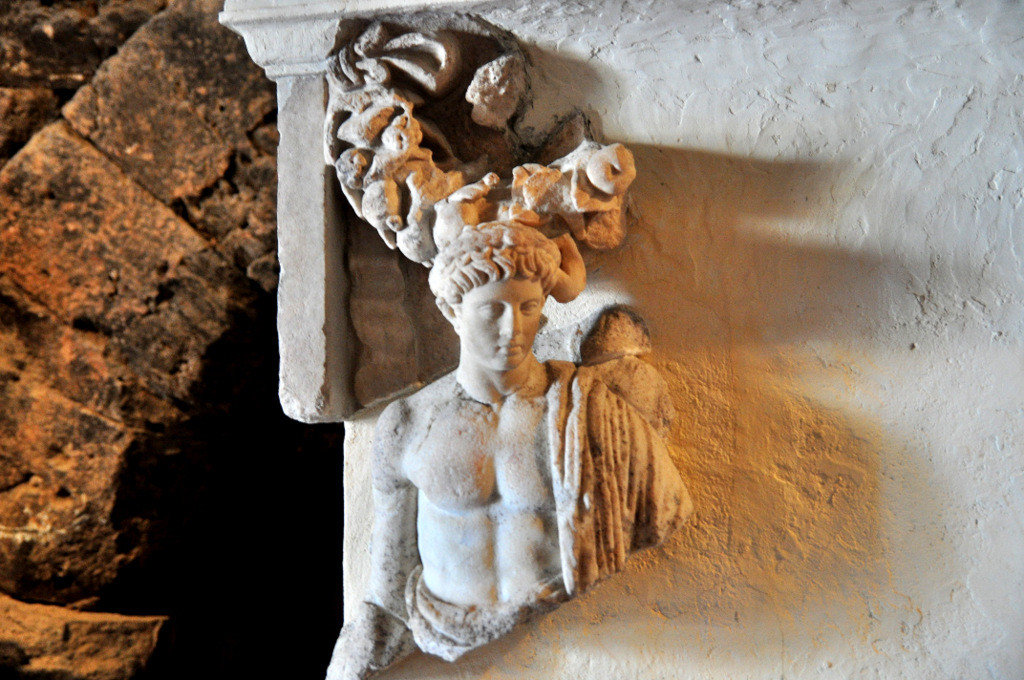
Housed in the former Roman baths, the museum provides essential context for what you see on-site — especially sarcophagi, reliefs, and sculptures from Hierapolis and Laodicea.
If you want Pamukkale to feel meaningful rather than just photogenic, don’t skip this.
5. Hot Air Balloon Flights (Early Morning)
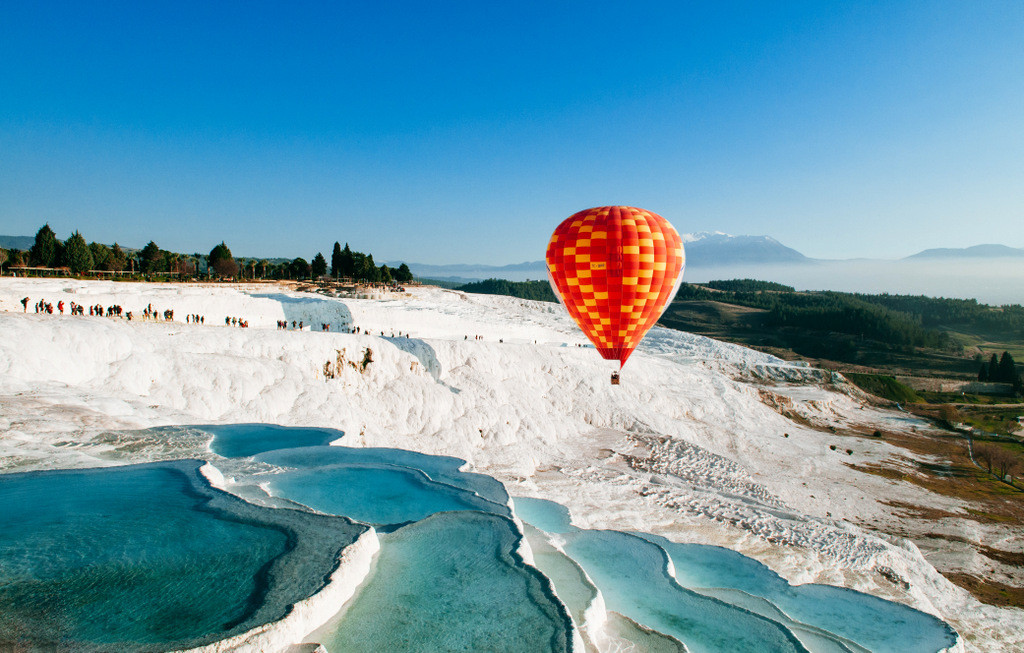
Pamukkale is one of the few places in Turkey where balloon flights are available outside Cappadocia.
Flights are weather-dependent and not guaranteed daily, but when conditions allow, they offer a striking aerial perspective of the travertines and surrounding valley.
Pamukkale Entrance Fee (2026)
- Entrance fee: €30
- Included:
- Travertine terraces
- Hierapolis Ancient City
- Pamukkale Archaeology Museum
- Not included:
- Cleopatra’s Antique Pool (extra fee)
Last updated: February 9, 2026
Pamukkale Opening Hours (2026)
- Daily: 08:00 – 20:00
Seasonal evening openings may apply during the summer as part of Turkey’s Night Museology program, but these are limited and subject to change.
Always check official updates before your visit, especially during restoration periods or special events.
How to Get to Pamukkale (2026 Guide)
Pamukkale is located in southwestern Turkey, within Denizli Province. Reaching the site is straightforward once you choose the option that best fits your itinerary — whether you are coming directly from Istanbul or combining Pamukkale with Ephesus or the Aegean coast.
Below are the most practical and commonly used routes.
From Istanbul to Pamukkale (Fastest Option)
Traveling by road from Istanbul takes around 7–8 hours, which only makes sense if you are on a longer Aegean road trip. For most travelers, flying is the most efficient choice.
Direct flights operate daily from both Istanbul airports (IST and SAW) to Denizli Çardak Airport (DNZ), with a flight time of about 1 hour 15 minutes. The airport is approximately 70 km (about 1 hour) from Pamukkale. Upon arrival, shared airport shuttles and transfers provide a simple and affordable connection to Pamukkale village or nearby hotels.
From Izmir or Selçuk (Ephesus) by Train (Most Relaxed Route)
If your itinerary includes Ephesus or Izmir, traveling to Pamukkale by train is one of the most comfortable and scenic options.
Trains run from Izmir Basmane Station and Selçuk Station directly to Denizli Train Station. The journey takes around 4.5–5 hours from Izmir and about 3.5 hours from Selçuk. Tickets are inexpensive, and advance reservations are usually not required, making this a popular choice for independent travelers.
From Denizli to Pamukkale (Final Leg)
Whether you arrive in Denizli by train or intercity bus, reaching Pamukkale itself is very easy.
From Denizli Bus Terminal, go down to the lower level where local minibuses operate. Minibuses marked “Pamukkale” or “Karahayıt” depart every 15–20 minutes and reach the Pamukkale entrance area in approximately 20 minutes, dropping passengers close to the site.
Final Thoughts: Is Pamukkale Worth It?
Absolutely — if you approach it correctly.
Pamukkale is not just a stop between Istanbul and Cappadocia. It is a destination that rewards visitors who understand that:
- The travertines are part of a protected ecosystem
- Hierapolis is a serious archaeological site
- The experience improves dramatically with time, context, and realistic expectations
If you have one extra day in your itinerary, Pamukkale is not just “worth it” — it becomes one of the most distinctive memories of your journey through Turkey.
Written by Serhat Engul

Hello. May i know if there is locker or luggage storage service provided at Pamukkale? Thank you in advance.
Hello Nur, unfortunately I do not have definitive information on this subject. There are lockers in train stations and airports. However, I do not know if it exists around Pamukkale.
Well, prices seem to have really gone up like crazy, just about anywhere in Turkey, with an inflation of more than 80 %, and the lira devaluated, the Turks have adjusted all the prices in the tourist industry, so hotel are 3 to 4 times more expensive than in 2021, and Pamukkale nowadays, from what I just read is 700 liras, 25 US dollars, when you think that it was 50 liras not so long ago… have the salaries of Turks increase 3 to 4 times since? But the tourists assume, and pay!
Pamukkale entrance fee was 50 Turkish Liras in 2019. However, at that time 1 Dollar was approximately 6 Turkish lira. Now 1 dollar has increased 5 times compared to that period and is approximately 29 TL. From this perspective, it is normal for prices to increase to a certain extent. However, as you said, museum entry prices also increased against the dollar after the pandemic.
Merhaba Serhat,
Really appreciate your insights on the blog. I’m wondering:
1. What’s the entrance fee if I queue?
2. Are there separation entrance fee for different places of these – travertine thermal pools, the ancient city of Hierapolis, the archeology museum and the Cleopatra antique pool? What I meant is that I may just want to go to certain of these places due to time limit.
Looking forward your kind response.
Sophia
Hi Sophia, waiting in line does not give a discount on the ticket price. The current entrance fee is already written in the article.
The ticket sold in Pamukkale includes the places I mentioned in the relevant section in the article. It is not possible to buy separate tickets for each section.
By the way, I haven’t been to Pamukkale for a long time. Rules in museums can change frequently. Recently, a friend of mine said that there is an extra entrance fee for the Cleopatra Pool. However, there is no information about this on the official website.
On the official site there is a fixed price for a single ticket and I have to assume that this applies to all sections (as it used to be).
Hello
How long does time needs properly to explore for all this sections ?
Thank you
Hi Abrurrahim,
Since Pamukkale consists of several different parts, you can easily spend the whole day exploring this place. I think it would take at least two hours to visit Hierapolis alone. You can also spend at least an hour in the thermal pools.
In addition, there is the Archaeological Museum, which will take about half an hour. But there is also the Cleopatra Pool. Swimming among the ancient pillars here is also a great experience.
In my opinion, instead of running around, it would be appropriate to spend at least 5 hours and visit Pamukkale slowly and with understanding. Of course, this is my personal opinion, everything depends on your interest in history and archeology.
Have a nice trip,
Serhat
Hello, can you pay the entrance on your card or is it cash only?
Hi Zoe, you can pay by credit card.
Hi, is it possible to buy entrance tickets and go to one place one day and the ancient city the next for example?
Going in a couple of weeks, any advice would be gratefully received. Thank you!
Diana
Hi Diana, this is quite a complex question. Since I haven’t been to Pamukkale for a long time, I don’t know how the new tickets work.
However, due to the plan of Pamukkale ruins, once you enter, you will have access to all sections and you will have used the ticket at once. For this reason, I do not think that you will have the opportunity to enter each section separately (and on different days).
However, I would like to point out that I am not 100% sure. I’m only guessing from what I already know.
Hi, you wrote in the above article that the all-inclusive combined ticket costs 110 TL. Is it a must for me to visit all places or can i choose to visit the Thermal Pools , Hierapolis and Cleopatra Antique Pool?
Hi Yong, yes, the price of the all-inclusive ticket is 150 TL. (the price seems to have increased since the beginning of the year, I will update it) However, you do not have the chance to buy separate tickets for each section anyway. There is only one ticket and it covers all three places.
I think it would be a big mistake to go there and not see the ancient city of Hierapolis. For a history buff like me, missing the ancient city is unthinkable. So maybe I’m not the right person to ask this question. But I think you’ll find it’s worth it.
Timings in January and February?
Hello Muhammad, as far as I can see from the official site of Pamukkale Museum, the opening time for winter months is 06:30 in the morning and the closing time is 8:00 in the evening. However, these hours may change due to Covid measures. You can confirm one last time before going to Pamukkale from the link at the end of the article.
Hello,
is it also possible to go there by yourself or just with a bus tour?
Are there parking opportunities?
Is it open due to Covid-19 at the moment?
Many thanks in advance for your reply!
Hi Ina, I don’t know all the details as I haven’t been to the area for a long time due to the pandemic. However, when you check the official site, Pamukkale seems open to visitors. Regarding transportation, Pamukkale is located in Denizli. It is possible to reach the ruins from Denizli’s city center by minibus in 25 minutes. You can also go by private vehicle. As far as I know there is also a parking lot.
Hi… Can I purchase the ticket on the site or ticket should purchase prior to visit?
Hello, yes, you can buy your ticket directly from the ticket office in Pamukkale. The alternatives suggested here are guided skip-the-line tickets.
Hi,
is Pamukkale open on Sundays? We want to visit Pamukkale this May 2021.
Hi Janice, yes it’s open on Sundays. Yet you have to be careful about opening hours. It may change due to Covid-19 situation.
Does anyone have any advice about getting to Pamukkale from Izmir? I want to take a day tour but it looks difficult- should I just stay the night in Pamukkale?
Thanks
Dana
Hi Dana, there is a bus terminal in Izmir to get anywhere in Turkey. You need to take a bus to Denizli. Pamukkale is located in that city. You can consult to agencies in the bus terminal.