Beneath the busy streets of Istanbul lies the Basilica Cistern, a vast underground reservoir built in the 6th century during the reign of Emperor Justinian. At first glance, it feels less like infrastructure and more like a hidden palace — a forest of columns rising from the water in carefully measured symmetry.
For those of us who explore Istanbul through its Byzantine layers, the cistern is more than an engineering project. It is one of the clearest reminders of how Constantinople sustained life behind its monumental walls. The Basilica Cistern not only demonstrates the technical sophistication of the Byzantine Empire, but also reveals how the city quietly carried its past into later centuries.
In this guide, you will find practical information for planning your visit, along with the insights I regularly share during my Byzantine-themed walking tours in Istanbul. Over the years, certain questions come up again and again — about timing, queues, photography, and how to understand what you’re actually looking at — and I’ve gathered those answers here to help you make the most of your time underground.
📸 Bring your camera. Inside, you’ll walk among 336 ancient columns, illuminated by soft green and red reflections. And if you look closely at the bases of a few columns, you’ll find the famous Medusa heads, quietly resting in the shadows — one of the most intriguing survivals of the city’s Byzantine past.
History of the Basilica Cistern
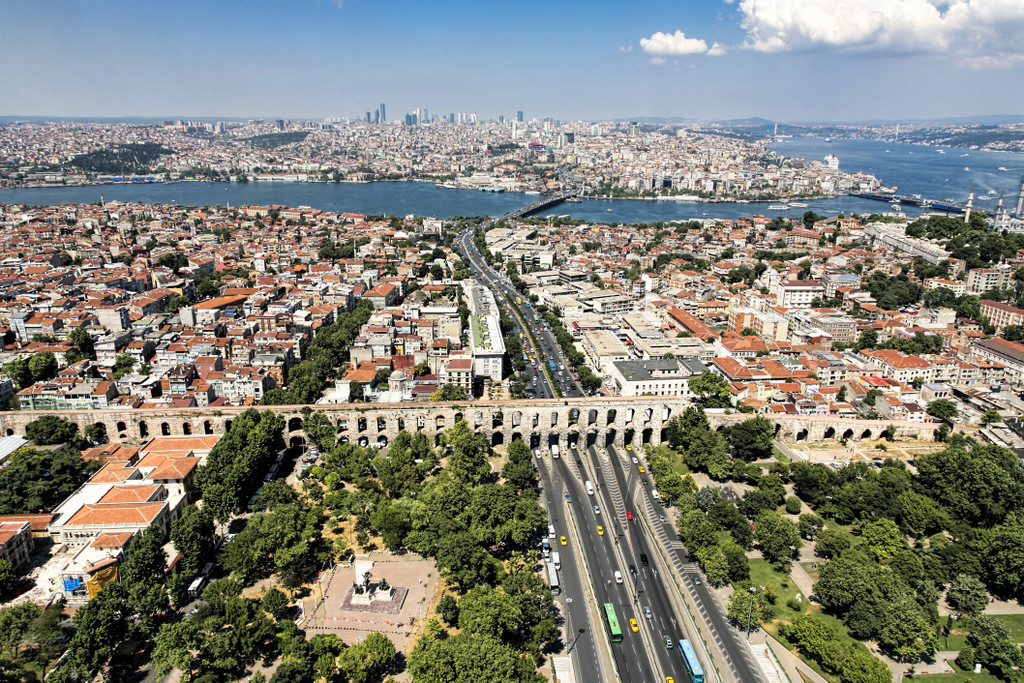
The history of Basilica Cistern dates back to the 6th century. Built by Justinian, the most famous ruler of the Byzantine Empire, the cistern was one of Constantinople’s most important water resources.
The Historical Peninsula on which Constantinople was founded was a place known for its scarcity of water resources. Lack of water became a major problem as the city’s population grew.
A Roman Aqueduct was built in late antiquity to bring water to Constantinople from the mountains of Thrace. A part of these aqueducts built by Emperor Valens can still be seen in Istanbul.
Many cisterns were built in the city to store the water coming from this aqueduct. The largest of these was the Basilica Cistern, and it carried water to monumental structures such as Hagia Sophia and the Great Palace.
The Basilica Cistern takes its name from the Basilica Stoa (also known as the Basilica of Illus), a large roofed public basilica complex that once stood above it. This structure was not an open square, but an important civic building used for law courts, administrative activities, and commercial functions in Late Antique Constantinople.
The ceiling of the cistern is supported by 336 reused columns, many of which were taken from earlier Greek and Roman structures. The cistern measures approximately 138 meters in length and 65 meters in width, covering an area of nearly 9,000 square meters.
1. Byzantine Cisterns in Istanbul
Most of the Byzantine cisterns in Istanbul are found in and around Sultanahmet. Theodosius Cistern, Cistern of Philoxenos and Basilica Cistern can be visited as museums. In addition, there is the Sarnic (Cistern) Restaurant and the Nakilbent Cistern located under a carpet store.
There are many articles on this website for those who want to trace the Byzantine heritage in Istanbul. For example, you can find a list of the most important Byzantine buildings in Istanbul here.
2. Rediscovery of the Cistern
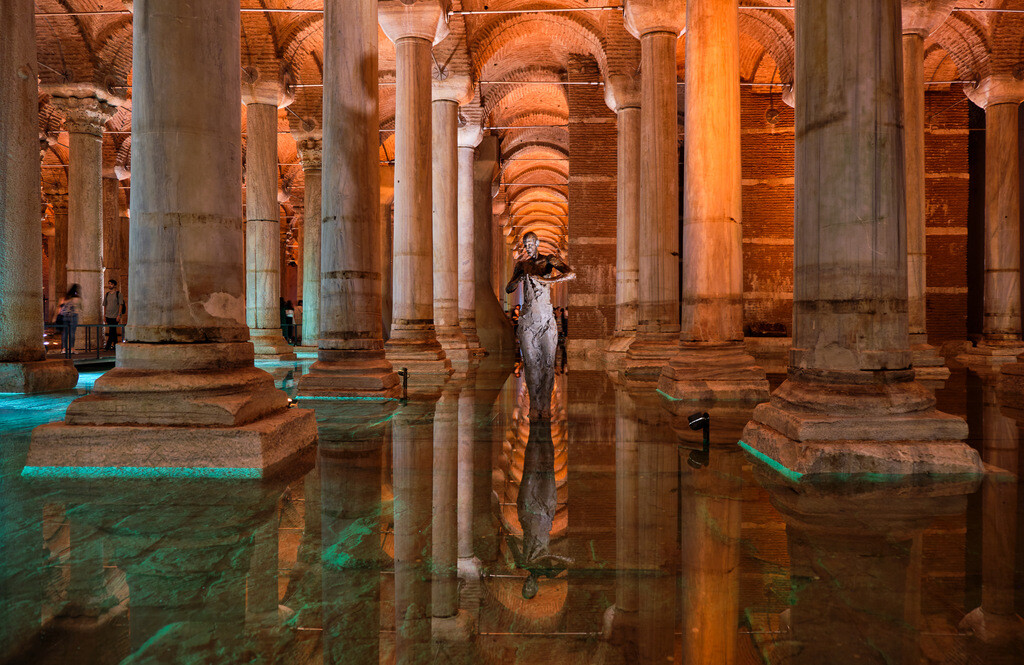
It may seem surprising that such a monumental structure could disappear from memory for centuries. Yet after the Ottoman conquest of Constantinople in 1453, the Basilica Cistern gradually fell into obscurity.
The Ottomans restored the Valens Aqueduct and continued to supply water to the city using the ancient Roman system. However, instead of relying on underground cisterns, they redirected the water to the public fountains they built throughout the city, making these fountains the primary source of daily water.
As a result, many Byzantine cisterns beneath Istanbul were slowly forgotten. The Basilica Cistern itself was eventually rediscovered in the 16th century by the French scholar and historian Petrus Gyllius, who documented its existence while living in Ottoman Istanbul.
3. Famous Movies Filmed in the Cistern
The atmospheric setting of the Basilica Cistern has made it a memorable backdrop for several internationally known films. Its first major appearance on the big screen was in the 1963 James Bond movie From Russia with Love, starring Sean Connery, where the cistern’s shadowy columns added to the film’s Cold War intrigue.
Decades later, the cistern returned to global attention as the location for the final scene of Inferno, the film adaptation of Dan Brown’s novel. Shot in 2016, the movie starred Tom Hanks and once again showcased the cistern’s dramatic lighting and mysterious atmosphere, reinforcing its status as one of Istanbul’s most cinematic historical spaces.
4. Medusa Heads in the Cistern
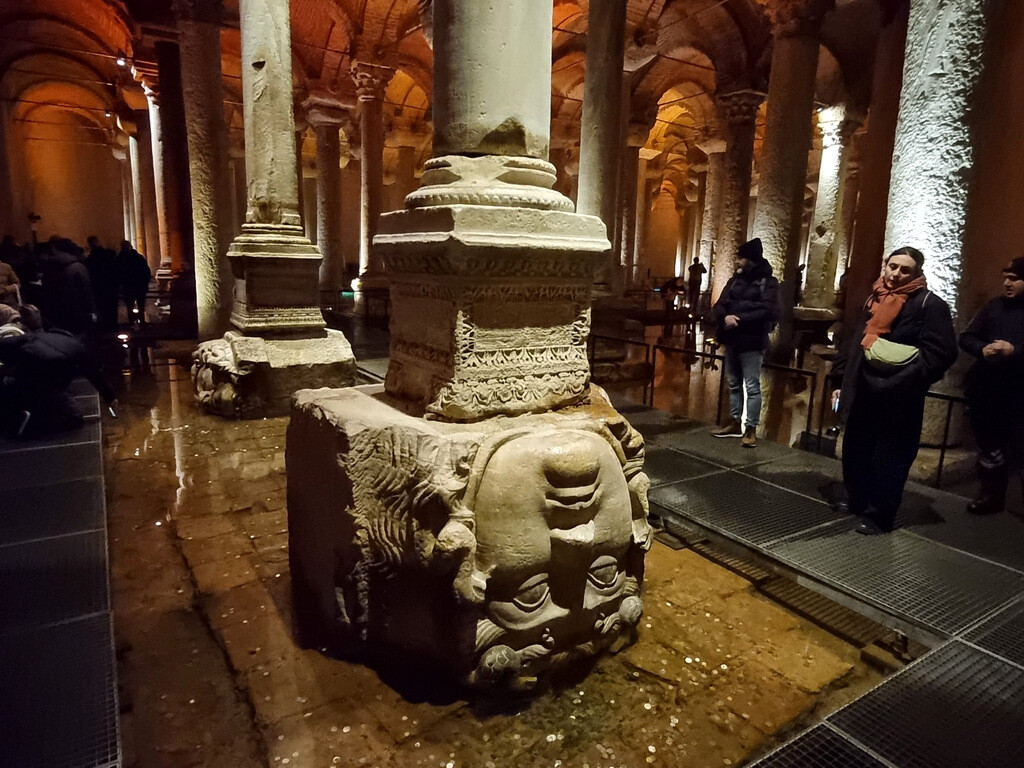
The Medusa Heads hidden in the farthest corner of the cistern will be the most interesting part of your visit. Since most of the columns in the cistern are taken from other structures, their lengths are different. For this reason, you will see stone blocks of various sizes under each.
The largest of these stone blocks are placed under the two short columns at the end of the cistern. The face of Medusa, a mythological creature, is engraved on these giant blocks, which cannot be noticed at first sight.
You will see that one of these Medusa Heads is placed sideways and the other is placed upside down. Many historians consider this to be due to the superstitions of Byzantine society.
Medusa has been a powerful figure since ancient times because it is a monster that turns people into stone. They didn’t want to face her, even if she was going to be submerged in a cistern.
Basilica Cistern Entrance Fee 2026
The entrance fee for the Basilica Cistern in 2026 is 1950 Turkish Lira per person. Please note that the Museum Pass Istanbul is not valid at the Basilica Cistern. This section was last updated in February 2026.
As of 2026, there is also a special program called “The Night Shift”. While the cistern can be visited at standard prices until 18:30, it remains open for special events between 19:30 and 22:00, and the ticket price for this evening experience is 3000 TL.
Basilica Cistern Entry & Tour Options
Below you can compare Basilica Cistern ticket options, including a skip-the-line entry ticket and a combo option with Hagia Sophia.
Basilica Cistern Opening Hours 2026
The Basilica Cistern is open daily from 09:00 AM to 06:30 PM in 2026. The site welcomes visitors every day of the week. This information was last updated in February 2026.
In addition, the Basilica Cistern offers evening access under the “Night Shift” program. From 19:30 to 22:00, special concerts and events take place, and tickets for this experience are sold separately at 3000 TL per person.
For the most up-to-date official information about Yerebatan Sarnıcı (Basilica Cistern), including opening hours, ticketing details, and visitor guidelines, you can visit the official site here.
How to Get to the Cistern?
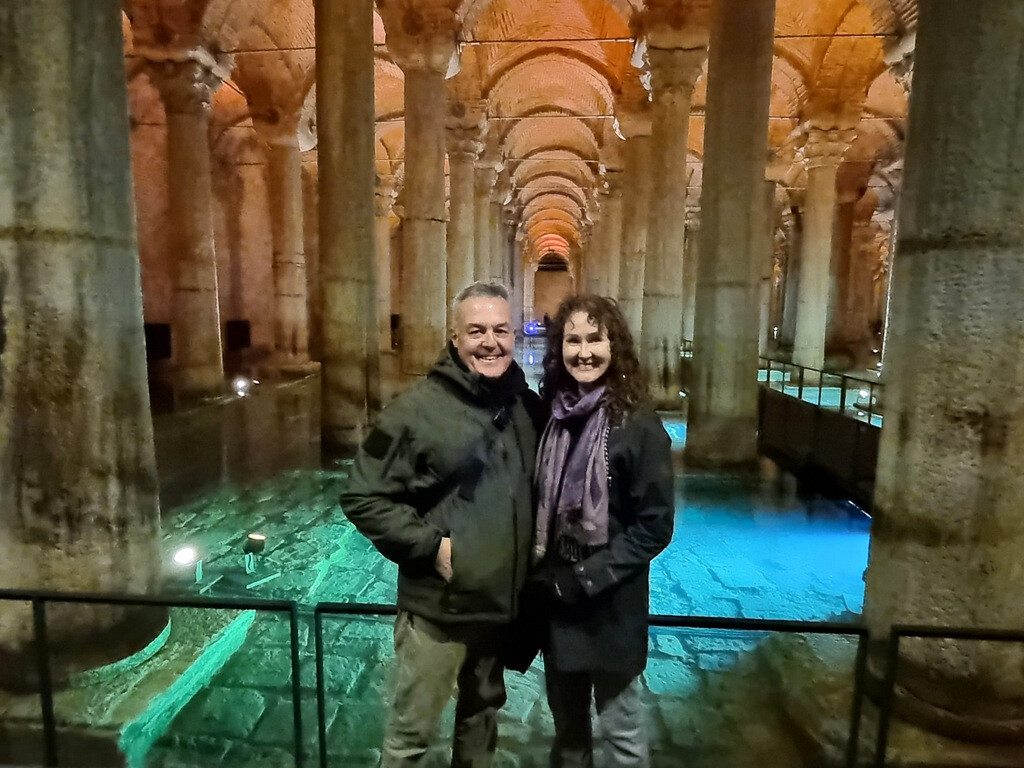
Basilica Cistern is located in the heart of Sultanahmet, Istanbul’s most touristic district. For this reason, it is very easy to reach the museum. You can walk from distinctive structures such as Hagia Sophia or Blue Mosque to the cistern.
In order to get to the Cistern from Taksim Square, you must first go to Kabatas with Funicular F1. If you take Tram T1 from Kabatas Tram Station, you can reach Sultanahmet Tram Station in 15 minutes.
It will take only a few minutes to walk from Sultanahmet Tram Station to the cistern. The Theodosius Cistern, another Byzantine cistern serving as a museum, is also located very close. You can get there on foot from the same tram stop.
Conclusion
The Basilica Cistern is one of my favorite historical monuments as a local guide in Istanbul. A remarkable achievement of Roman engineering, it supplied water to Constantinople for nearly a thousand years and remains one of the city’s most atmospheric landmarks.
After exploring iconic sites such as the Blue Mosque and Hagia Sophia, descending into the Basilica Cistern feels like stepping into a different world altogether. The subdued light, the forest of columns, and the quiet echoing space create an experience unlike any other monument in Istanbul.
Written by Serhat Engul

Hi Serhat,
First of all thanks for an excellent blog about Istanbul!
I would like to know if there is a discount price for foreign students with isic student card for Basilica Cistern?
Tanja
Hi Tanja, thank you for your feedback on the blog. But unfortunately I don’t think there is any discount for foreigners at Basilica Cistern. I’m not 100% sure about this, so you can ask the staff at the ticket office at the entrance.
Hi Serhat,
Thank you so much for your all work! This blog is so informative and it helped be prepare for our family trip to Istanbul.
I just wanted to inform you that I visited the Basilica Cistern today and the price is now 550 TL!!!
We still went and were lucky to also wittness a live concert (Not sure if that is the norm, but it provided a fantastic atmosphere).
Hi Hina, first of all thanks for your words about the blog. In fact, as stated in the article, the entrance fee to the Basilica Cistern between 09:00 and 19:00 during the day is 350 Turkish Liras.
According to the new practice, they keep the cistern open until 22:00 during the summer months. However, those who enter between 19:00 and 22:00 pay 550 TL.
Are there currently any renovations/repairs being done at Basilica Cistern, the Blue Mosque and Hagia Sophia? The last time I visited Istanbul the Cistern was closed and the Blue Mosque was under renovations?
Yes, the renovations of the Basilica Cistern and the Blue Mosque, which have been going on for many years, were completed this year. However, the second floor in Hagia Sophia is still closed for renovations.
Holy guacamole, 300? We visited during the renovation works and paid 60? 70?
Must be Turkey regretting turning Hagia Sophia into a mosque. All the money that used to come in from there now need to be made elsewhere.
Theodosius Cistern used to be free, now they want 350. It’s ridiculous. Not going this time then.
Hi Katy, yes, the entrance fees of museums in Istanbul have become a bit expensive right now. However, the period you visited was probably before the pandemic and it should not be forgotten that the USD-TL rate was very different compared to this time.
Basilica Cistern was closed to visitors during the pandemic (2020-2022). If you came during the renovation period (2015-2020), 1 Dollar was approximately 6 Turkish Liras at that time. Now, 1 dollar is about 19 TL.
For this reason, it wouldn’t be surprising if the price tripled. However, the recent price increase in cistern tickets was a bit exaggerated in my personal opinion. I think around 200 Turkish Lira, which equates to about 10 Dollars, would have been a fair price.
Maybe they wanted to foresee inflation and get ahead of it and to find an optimum price for the 2023 tourist season. From that perspective, it seems logical.
Hi Serhat,
Your blog has so much valuable and detail information. It’s our go-to blog for planning our upcoming trip to Istanbul.
The Madusa head in the Cistern remain mysterious. Besides what you have described in your blog, is there any other “stories” about it that you could share ? I guess we are just very curious about it.
Thank you so much!
Hi Jing, thank you very much for your feedback on the blog. Yes, there are many stories to be told about the Basilica Cistern. But of course, I haven’t told all of what I know here.
If I write everything on the website, there will be nothing left to tell my guests who join my private guided tours. : )
We’ll be there mid July .. still crossing my fingers it will be open by then:-)
Hello Ingrid. Yes, I hope it opens by then. But even if it doesn’t open, the Cistern of Philoxenos is a good alternative as one of the biggest cisterns from the Byzantine period.
Does anyone know when the Bascilica Cistern will reopen?
Hi Lacy, no official information has been given about when the Basilica Cistern will reopen. However, as it seems from the outside, the restoration has come to its final stage.
Hi. Is it still closed? I’m planning to go to Istanbul in May and I wish I could visit the cistern.
Unfortunately the Basilica Cistern is still closed. However, there are other Byzantine cisterns that can be visited as an alternative.
For example, Binbirdirek Cistern (Cistern of Philoxenos) is open to visitors every day except Sundays and the ticket price is 50 Turkish Liras.
Also, Serefiye Cistern (Theodosius Cistern) is open every day of the week and the ticket price is 100 Turkish Liras. This cistern can be visited every hour and there is a 10-minute light show.
Hi Serhat,
Thanks for the wonderful summary. Want to know if it’s open for visit now.
Thanks
Sofia
Hi Sofia, thanks for the feedback. Unfortunately it hasn’t been opened yet. It looks like the restoration will continue throughout this year. If there is a change, I will note it in the article.
Thanks Serhat,
I read somewhere that they opened it for visitor while restoration but wasn’t sure. Thanks for the info : )
You are welcome. In fact, the Basilica Cistern has been under restoration since 2015. For a long time we were able to visit even though the renovation was going on. However, it was completely closed in 2020 due to Covid and never opened again. I was in Sultanahmet a few days ago and it was still closed. Have a nice trip!
Hi! Thank you for your awesome post and amazing pictures. Although I’m not a fan of dark, damp, underground places I’ll try to visit the underground Basilica Cistern when i visit Istanbul soon – for the first time ever!
Hi Zana, thank you for the great review. Let me know if you need any help when you visit Istanbul. Have a good day!