Hagia Sophia is not simply a historic building.
It is a structure that has survived empires, belief systems, and centuries of structural stress without ever losing its central importance.
For nearly 1,500 years, it has remained at the heart of Istanbul’s identity. It began as a cathedral of the Byzantine Empire, became an imperial mosque after the Ottoman conquest, was later transformed into a museum, and today functions again as a mosque. This sequence is not a contradiction, but a reflection of its universal significance. Every power that ruled the city chose to preserve it rather than replace it.
Today, Hagia Sophia operates with a dual structure. The ground level is used as an active place of worship, while the upper galleries—where the architectural system and Byzantine mosaics can be observed most clearly—are open to visitors with a separate ticket system.
As a licensed Istanbul tour guide with over 20 years of experience, I have brought countless visitors beneath this dome. In this guide, I will not only present historical facts, but explain how this building works—why it was built the way it was, how its massive dome remains standing, and how it has adapted to survive for so many centuries.
Because Hagia Sophia is not a monument that can be understood at a glance.
It is a structure that needs to be read.
The History of Hagia Sophia
The history of Hagia Sophia is inseparable from the history of Constantinople itself. Each phase of the building reflects a different moment in the political, religious, and architectural development of the city.
The structure that stands today is not the first church built on this site. It is the third major construction, shaped by destruction, reconstruction, and changing imperial priorities. From the early basilica of the 4th century to the monumental design of Emperor Justinian in the 6th century, each phase reveals how the building evolved in response to both opportunity and crisis.
Understanding these phases is essential to understanding Hagia Sophia as a whole. The building is not the product of a single moment, but the result of a sequence of decisions that gradually transformed it into one of the most influential structures in architectural history.
The following sections examine this process through the reigns of the emperors who shaped it.
1. Hagia Sophia during Constantius II
The first version of Hagia Sophia was completed in 360 AD during the reign of Emperor Constantius II, the son of Constantine the Great. Although many visitors assume that Constantine himself built Hagia Sophia, this is not accurate. Constantine founded Constantinople and initiated major construction projects, but the first church on this site was finalized by his successor.
At the time, the structure was not the domed monument we see today. Instead, it followed the traditional Roman basilica plan, with a rectangular layout and a wooden roof. Together with the nearby Hagia Irene, it formed a large ecclesiastical complex known as Megale Ekklesia, meaning “The Great Church.” This name reflected its status as the most important religious building in the city.
The church stood in the political and ceremonial heart of Constantinople, near the imperial palace and the Hippodrome. This location was not accidental. In the Byzantine world, imperial authority and religious authority were closely intertwined, and Hagia Sophia functioned as a central stage where both were displayed.
However, the first Hagia Sophia had a relatively short life. In 404 AD, it was destroyed during a major uprising triggered by tensions between the imperial court and the Church. The conflict centered on John Chrysostom, one of the most influential religious figures of the time, and Empress Aelia Eudoxia.
Chrysostom openly criticized the luxury and political behavior of the imperial court. His sermons, which targeted the excesses of the elite, created a direct confrontation with the Empress. When he was eventually exiled, public unrest followed. These tensions escalated into riots that spread across the city, and in the chaos, the wooden-roofed basilica was set on fire and completely destroyed.
This first destruction established a pattern that would define the history of Hagia Sophia:
the building was never just an architectural project, but a structure deeply connected to power, belief, and political tension.
2. Hagia Sophia during Theodosius II
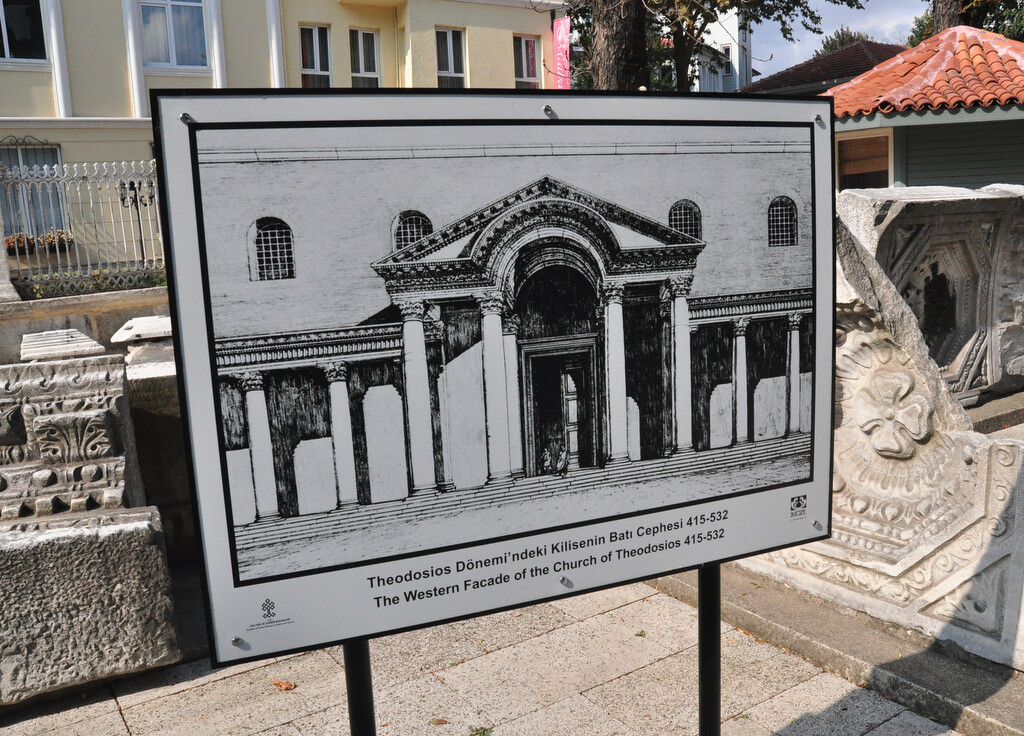
After the destruction of the first church in 404 AD, a new Hagia Sophia was commissioned by Emperor Theodosius II. Unlike its predecessor, this second structure was built primarily of stone and marble, making it more durable and architecturally refined.
Completed in the early 5th century, this version of Hagia Sophia continued to serve as the main cathedral of Constantinople. However, despite its stronger construction, it would not survive the political instability of the following century.
The turning point came in 532 AD during the reign of Emperor Justinian I. At that time, Constantinople was not only a political capital but also a city where public factions played a powerful role in urban life.
These factions, known as the Blues and the Greens, were originally organized around chariot races held at the Hippodrome. Over time, however, they evolved into influential social and political groups representing different segments of the population. Their rivalry often extended beyond sport and reflected deeper tensions within the city.
In January 532, these tensions escalated into what is now known as the Nika Revolt. What began as unrest during the races quickly turned into a large-scale rebellion against imperial authority. For several days, large parts of Constantinople were set on fire, and major buildings—including Hagia Sophia—were severely damaged or completely destroyed.
At one point, Justinian reportedly considered abandoning the city. However, he ultimately remained in power, largely due to the decisive actions of Empress Theodora, who urged him to stay and defend his throne.
The revolt was eventually suppressed by imperial forces led by generals such as Belisarius. The repression was brutal, with tens of thousands of rebels killed in the Hippodrome. While this restored order, it also left the city in ruins.
For Hagia Sophia, this destruction marked a decisive transition. The earlier structures had been significant religious buildings, but they were still within the limits of traditional architecture. After the Nika Revolt, Justinian sought to build something entirely different—
a monument that would not only replace what was lost, but also redefine imperial authority itself.
3. Hagia Sophia during Emperor Justinian
After the destruction caused by the Nika Revolt, Emperor Justinian I faced a critical challenge. Although he had suppressed the rebellion and secured his throne, his authority had been seriously weakened. Restoring control over the city required more than military force; it required a visible and lasting statement of power.
For this reason, Justinian decided to rebuild Hagia Sophia on an unprecedented scale. The new structure would not simply replace the earlier churches on the site, but surpass them in size, complexity, and symbolic meaning.
To achieve this, he appointed Anthemius of Tralles and Isidore of Miletus, two scholars known more for their expertise in mathematics and geometry than for traditional architectural practice. This choice reflects the nature of the problem they were expected to solve: constructing a vast domed space that could not be achieved using conventional Roman building techniques.
Unlike earlier monumental structures such as the Pantheon, which relied on massive cylindrical walls, Hagia Sophia required a system capable of supporting a large dome over a square base. This challenge led to the development and refinement of structural elements such as pendentives, which allowed the weight of the dome to be transferred onto four massive piers. This solution marked a turning point in the history of architecture.
The construction process itself was equally remarkable. Ancient sources suggest that thousands of workers were organized into teams, and the project was completed in approximately five years. For a structure of this scale, this was an exceptionally short period, indicating both the resources available to the emperor and the urgency behind the project.
Materials were brought from different parts of the empire, including columns taken from earlier pagan temples. This practice, known as spolia, was not only practical but also symbolic. By incorporating elements from older monuments, the new Hagia Sophia visually demonstrated the continuity and dominance of the imperial order.
The result was a building unlike anything that had existed before. Hagia Sophia was not only a place of worship, but also a carefully constructed representation of imperial authority, technological innovation, and religious identity.
The Architecture of Hagia Sophia
The architecture of Hagia Sophia is defined by a central question:
how to place a massive dome over a wide and open interior space without enclosing that space with heavy walls.
The solution developed in the 6th century was unlike anything that had been attempted before. Instead of relying on a single structural method, the builders combined multiple systems—domes, semi-domes, arches, and supporting elements—into a unified framework.
This framework was not only designed to carry weight, but also to shape space. The interior of Hagia Sophia expands outward and upward at the same time, creating a balance between structural necessity and spatial effect.
However, this solution also introduced long-term challenges. The forces generated by the dome placed continuous stress on the building, requiring later interventions and adjustments over the centuries.
For this reason, the architecture of Hagia Sophia cannot be understood as a fixed design.
It is a system that has been tested, corrected, and reinforced over time.
The following sections examine this system step by step, beginning with the fundamental structural challenge and continuing through its solutions, weaknesses, and eventual stabilization.
1. The Structural Challenge of Hagia Sophia
The architecture of Hagia Sophia begins with a fundamental structural problem. The builders of this monument planned a central dome approximately 32 meters in diameter, rising about 49 meters above the ground. For the 6th century, this was an extremely ambitious scale.
The difficulty was not simply the size of the dome, but how to support it. In earlier Roman architecture, large domes were typically placed on thick, circular walls, as seen in structures such as the Pantheon. This approach relied on mass and continuity, allowing the weight of the dome to be distributed evenly around a solid base.
Hagia Sophia, however, required a different solution. The intention was to create a vast interior space that was open, luminous, and uninterrupted by heavy enclosing walls. This meant that the traditional method of using massive circular supports could not be applied. Instead, the dome had to be carried above a large, nearly rectangular space.
From a structural perspective, this introduced a critical challenge. A dome does not only exert vertical weight; it also pushes outward. If this lateral force is not properly controlled, the supporting elements begin to spread, and the structure becomes unstable. In a city like Constantinople, which lies in an active seismic zone, this problem was even more serious.
For this reason, the construction of Hagia Sophia was not simply a matter of building larger walls or thicker supports. It required a different way of thinking about structure itself. The question was no longer how to place a dome on top of a building, but how to transfer its weight through space without enclosing that space.
This challenge defines the entire architectural system of Hagia Sophia.
The solutions developed to address it—both during the initial construction and in later centuries—explain why the building appears both massive and surprisingly open at the same time.
2. The Dome and Its Supporting System
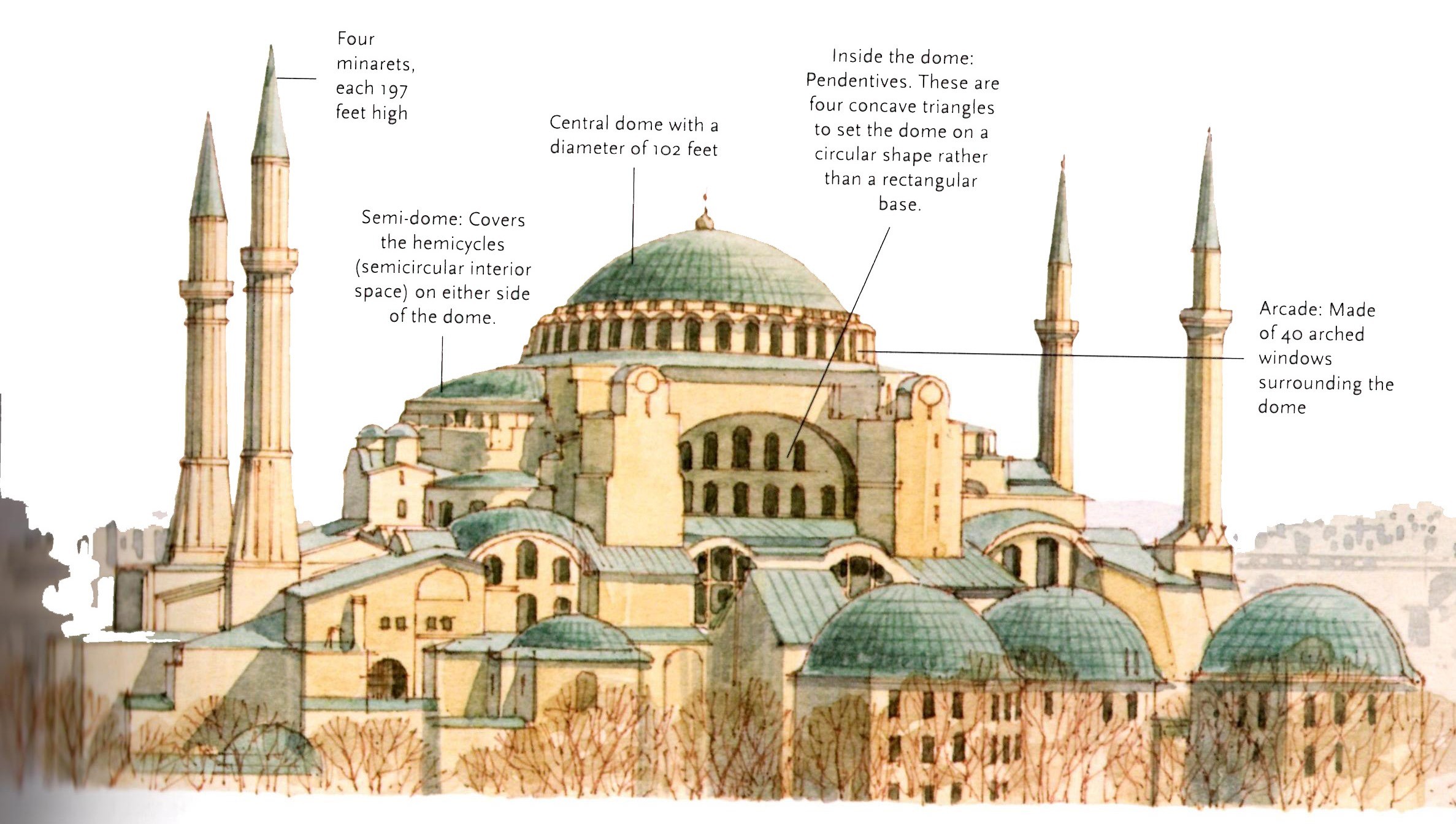
The central dome of Hagia Sophia is not an isolated architectural element. It is part of a carefully designed system that distributes weight, expands space, and shapes the entire interior experience of the building.
At the core of this system is a dome approximately 31–32 meters in diameter. While this dimension is smaller than the dome of the Pantheon, the engineering challenge it presents is fundamentally different. Unlike the Pantheon, which rests on a continuous circular wall, Hagia Sophia’s dome is carried by four massive piers through a transitional system of curved triangular elements known as pendentives. This allows the dome to rise above a square base, creating a more open and flexible interior.
However, the dome does not function alone. The structural load it generates is transferred outward through a sequence of supporting elements. On the eastern and western sides, two large semi-domes extend the space longitudinally. These semi-domes receive part of the load from the central dome and distribute it further downward and outward.
Beyond them, smaller exedrae (quarter domes) continue this process, forming a cascading system of support. From an engineering perspective, this creates a layered load path: the weight of the main dome is not concentrated at a single point but gradually transferred across multiple structural levels. This reduces the risk of localized failure and allows the building to maintain a relatively open central space.
This system also defines the spatial perception of Hagia Sophia. Instead of a confined, centrally focused volume, the interior expands toward the east and west, creating a continuous and flowing space. The dome appears to dominate the structure, but in reality, it depends on a complex network of supporting elements that extend far beyond its base.
Light plays a crucial role in this perception. The ring of windows at the base of the dome allows light to enter at the transition point between the dome and its supports. This reduces the visual weight of the structure and contributes to the well-known impression that the dome is suspended above the interior.
It is important to note that these windows were part of the original 6th-century design by Anthemius of Tralles and Isidore of Miletus. After the collapse of the original dome in 558, the reconstruction carried out by Isidore the Younger preserved this concept while modifying the structure. The rebuilt dome was made steeper, reducing lateral forces, and reinforced with ribs that strengthened the connection between the windows and the supporting system.
As a result, the dome of Hagia Sophia is not only a geometric form but a coordinated structural system. Its stability depends on the interaction between the dome, the semi-domes, and the supporting framework beneath them. This integration is what allows the building to appear both massive and unexpectedly light at the same time.
3. From Basilica to Hybrid Plan
The plan of Hagia Sophia cannot be fully understood by looking at its dome alone. It is equally defined by how that dome is integrated into the overall layout of the building.
In early Christian architecture, two main spatial traditions existed. The first was the basilica plan, derived from Roman civic buildings. This type of structure is longitudinal, guiding movement along a central axis toward the apse. It creates a sense of direction and progression, often associated with liturgical processions.
The second was the centralized plan, typically used in structures such as martyria or baptisteries. In these buildings, space is organized around a central point, often covered by a dome. Instead of directing movement forward, the design focuses attention inward and upward.
Hagia Sophia combines these two approaches in a single structure. The central dome establishes a strong vertical and centralized focus, while the semi-domes extending to the east and west preserve the longitudinal character of a basilica. As a result, the building is often described as a “domed basilica,” a term that reflects this hybrid condition.
This combination is not only formal but also functional. The longitudinal axis allows for ceremonial movement within the space, while the central dome creates a unified visual field that draws attention upward. These two spatial logics operate simultaneously, producing a complex and layered interior experience.
From a structural perspective, this hybridization also introduces tension. The extended basilica form increases the span of the building, while the dome concentrates weight toward the center. Balancing these opposing tendencies requires a carefully coordinated system of supports, which becomes more apparent when examining the load distribution of the structure.
For this reason, Hagia Sophia is not simply an enlarged version of earlier churches. It represents a deliberate attempt to reconcile two different architectural traditions within a single system. This synthesis is one of the key reasons why the building occupies a unique place in the history of architecture.
4. Load Distribution and Structural Elements

The stability of Hagia Sophia depends on how the weight of its dome is transferred to the ground. This process is not handled by a single element, but by a coordinated system of structural components working together.
At the center of this system are the pendentives. These curved triangular surfaces form the transition between the circular base of the dome and the square layout below it. Instead of allowing the weight of the dome to spread randomly, the pendentives concentrate it toward four specific points.
These points correspond to four massive piers, which act as the primary load-bearing elements of the building. Each pier carries a significant portion of the dome’s weight and transfers it directly downward. Unlike slender columns, these piers are large, solid structures designed to absorb both vertical loads and lateral forces.
Connecting these elements are four large arches aligned along the main axes of the building. These arches form the structural framework that supports the dome above and stabilizes the system. However, due to the rapid construction of Hagia Sophia, the mortar used between the bricks had not fully hardened during the early phases. As a result, the structure began to deform slightly even during construction, leading to a subtle outward expansion of the supporting system.
This phenomenon is still visible today. The base of the dome is not perfectly circular, but slightly elliptical, reflecting the long-term effects of lateral forces acting on the structure. This detail illustrates that Hagia Sophia is not a rigid construction, but a dynamic system that has adapted over time.
Another important aspect of this design is how the structural elements are visually integrated into the interior. The massive piers, which carry the main load, are partially concealed within the architectural composition. Covered with marble panels and aligned with the surrounding walls, they appear less dominant than they actually are. In contrast, the more visible columns inside the building often serve secondary functions, such as supporting galleries rather than the main dome.
Taken together, these elements form a continuous load path: from the dome to the pendentives, from the pendentives to the arches, from the arches to the piers, and finally to the foundations. This system allows Hagia Sophia to maintain both structural stability and spatial openness, balancing engineering requirements with architectural intent.
5. Structural Weakness and the Need for Support
Although the structural system of Hagia Sophia was highly innovative, it also carried an inherent weakness. The central dome did not simply press downward with its weight. It also generated a strong lateral thrust, pushing outward against the supporting system over time.
This problem was particularly serious because the original dome was lower and flatter than the one seen today. A flatter dome creates more horizontal force, which means that instead of directing most of its weight safely downward, it behaves more like a wedge pressing outward against the structure. In the case of Hagia Sophia, this force was transmitted especially along the east-west axis, where the central dome rested on the semi-domes.
The semi-domes were designed to absorb and redistribute part of this load, but the pressure was so great that the building gradually began to deform. The structural system did not fail immediately, but it was placed under continuous stress from the very beginning. This was made worse by the speed of construction. Because the building rose so quickly, parts of the mortar and structural framework had not fully settled before they were asked to carry enormous loads.
As a result, Hagia Sophia began to shift and spread over time. The deformation was slow, but real. The geometry of the building changed slightly under pressure, and by the later Byzantine centuries parts of the structure were already showing signs of outward movement and instability.
The problem was further intensified by the seismic reality of Constantinople. In a city repeatedly affected by earthquakes, even small structural weaknesses could become dangerous. Each major shock increased the strain on a system that was already operating very close to its limits.
For this reason, Hagia Sophia should not be understood as a perfectly stable monument that was completed once and simply left standing. From an early stage in its history, it became a building that required correction, reinforcement, and long-term care. Its survival depended not only on the brilliance of its original design, but also on the ability of later generations to recognize its weaknesses and respond to them.
This ongoing need for support explains why external reinforcements eventually became essential. The building could not rely on its original system alone forever. It needed help from outside the structure itself.
6. Buttresses and Later Interventions
The long-term structural problems of Hagia Sophia eventually made it clear that the original system alone was not sufficient to ensure the building’s stability. The continuous lateral forces generated by the dome, combined with earthquakes and gradual deformation, required additional support beyond the internal structure.
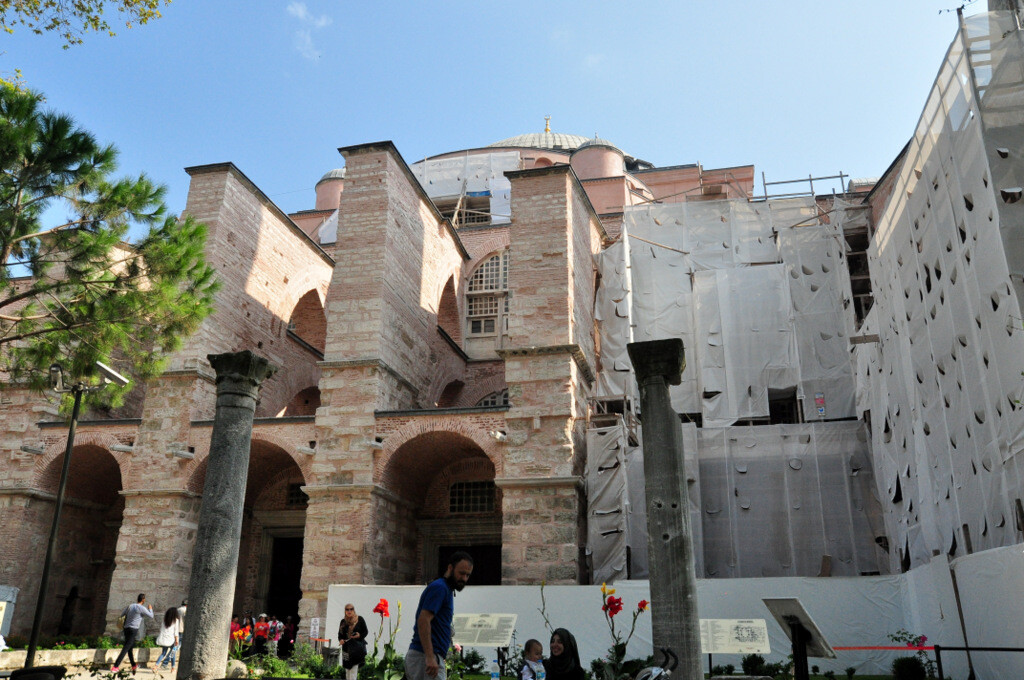
The solution was to reinforce the building from the outside. Massive buttresses were constructed to counteract the outward pressure of the dome and stabilize the walls. These elements do not belong to a single construction phase. Instead, they represent a series of interventions carried out over centuries.
During the late Byzantine period, the most urgent problem appeared on the western side of the building, where the structure had begun to lean. In response, external supports—often described as flying buttresses—were added to resist the lateral movement. Unlike the slender and decorative buttresses of Gothic architecture, those at Hagia Sophia were designed as heavy counterweights, prioritizing structural stability over visual refinement.
A similar structural risk later emerged on the eastern side during the Ottoman period. By this time, the building had already accumulated centuries of stress. The response came through large-scale reinforcement works, particularly under the supervision of Mimar Sinan, who carefully analyzed the building’s behavior and introduced additional buttresses to stabilize the structure.
These interventions were not merely repairs. They were essential adjustments to a system that had been operating at its limits since the 6th century. The buttresses absorbed and redirected forces that the original design could no longer fully control on its own.
As a result, the exterior of Hagia Sophia appears far heavier and more irregular than its interior. This contrast reflects a fundamental architectural reality: the light and expansive space inside is sustained by a dense and reinforced structure on the outside.
For this reason, the later additions to Hagia Sophia should not be seen as secondary or intrusive. They are an integral part of the building’s history and a necessary condition for its survival. Without these external supports, the structure would not have remained standing for nearly fifteen centuries.
7. The Collapse and Reconstruction of the Dome
The structural weaknesses of Hagia Sophia became fully visible only a few decades after its completion. The original dome, although remarkable in scale, was relatively shallow in form. This geometry increased the lateral forces acting on the supporting system, placing continuous stress on the building.
These conditions were further intensified by a series of earthquakes in the mid-6th century. The damage accumulated over time, and in 558 AD a major collapse occurred. A large portion of the dome, particularly on the eastern side, gave way, bringing down part of the adjacent semi-dome and causing significant destruction within the building.
At the time of the collapse, the original architects—Anthemius of Tralles and Isidore of Miletus—were no longer alive. The responsibility for reconstruction was given to Isidore the Younger, who approached the task not as a simple repair, but as a structural correction.
The key issue was identified as the shape of the original dome. Its relatively low profile had generated excessive outward pressure. To address this, the new dome was built with a steeper curvature, effectively raising its height by approximately 6 meters. This change redirected more of the load downward rather than outward, reducing the lateral forces acting on the structure.
At the same time, the original concept of a windowed dome was preserved. The ring of windows at the base continued to allow light into the interior, maintaining the visual effect that defines Hagia Sophia. However, the rebuilt dome was structurally reinforced with more clearly defined ribs, which helped stabilize the relationship between the dome and its supports.
This reconstruction represents a critical moment in the history of the building. The collapse revealed the limits of the original design, while the rebuilding process introduced adjustments that allowed the structure to endure over the long term.
As a result, the dome seen today is not an exact replica of the one completed in 537. It is a revised and more stable version, shaped by both failure and engineering insight. This process of collapse and correction is an essential part of understanding how Hagia Sophia has survived for nearly fifteen centuries.
8. Materials and Construction Techniques
The construction of Hagia Sophia was not based on unknown or mysterious materials, but on a highly advanced and carefully controlled use of known building techniques. The success of the structure lies not in hidden formulas, but in how these materials were combined to solve specific structural problems.
One of the most important components of the building is the mortar used between the bricks. Contrary to popular belief, this mortar was not a secret substance that becomes stronger over time. It was a variation of the well-known Roman pozzolanic mortar, enriched with crushed brick particles, which gave it its characteristic pinkish color.
What makes its use in Hagia Sophia remarkable is not its composition, but its proportion. In many parts of the structure, especially in arches and vaults, the mortar layers are unusually thick—sometimes even thicker than the bricks themselves. This was a deliberate choice. Instead of creating a rigid and brittle system, the builders introduced a degree of flexibility into the structure.
This flexibility proved essential in a seismic environment. The mortar behaves almost like a buffer, absorbing small movements and reducing the impact of shocks during earthquakes. Rather than resisting force in a completely rigid way, the structure can adjust slightly, which helps prevent sudden failure.
The bricks themselves were also selected with great care. While most of the building was constructed using standard fired bricks, lighter and more porous materials were used in the dome to reduce weight. This was not a matter of exotic volcanic stones, but a practical solution to minimize the load carried by the upper structure.
Another key aspect of the construction is the use of spolia, or reused architectural elements. Columns and marble blocks were brought from different parts of the empire, including regions such as Egypt, Anatolia, and Greece. This practice had both practical and symbolic dimensions. On one hand, it accelerated the construction process, allowing the building to be completed in a relatively short time. On the other, it visually incorporated materials from earlier monuments into a new imperial context.
Because these elements were not originally designed for Hagia Sophia, they often had to be adapted to fit the structure. Differences in size and proportion were adjusted through additional supports and connectors, demonstrating a high level of technical flexibility during construction.
Taken together, these materials and techniques reveal a consistent approach: the builders of Hagia Sophia were not seeking perfection in isolated elements, but balance within the entire system. Strength, flexibility, and adaptability were combined to create a structure capable of responding to both its own internal forces and the external conditions of its environment.
9. The Ottoman Transformation
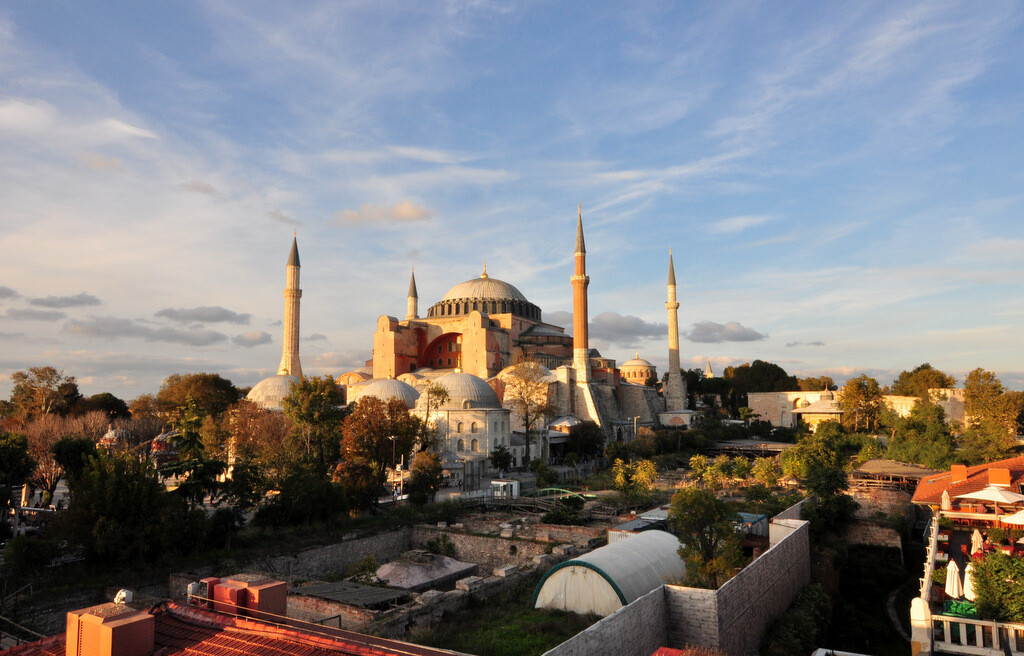
After the fall of Constantinople in 1453, Hagia Sophia entered a new phase of its history. Instead of being replaced, the building was preserved and adapted to serve as an imperial mosque.
This decision reflects an important reality. The structure was not only the most significant religious building of the city, but also an architectural achievement that was recognized and respected by the new rulers. Rather than constructing a new monument, the Ottomans chose to incorporate Hagia Sophia into their own imperial system.
The transformation required both functional and architectural adjustments. Elements such as the mihrab, minbar, and minarets were added to align the building with Islamic worship practices. At the same time, many of the existing features were retained. Byzantine mosaics, for example, were not destroyed, but covered in accordance with religious requirements, allowing them to survive for centuries beneath protective layers.
More importantly, the Ottoman period played a critical role in the structural preservation of the building. By the 16th century, Hagia Sophia had already accumulated significant stress from its original design and earlier deformations. The stability of the structure required careful intervention.
This responsibility was taken up by Mimar Sinan, who approached Hagia Sophia as a structural problem rather than a historical artifact. Through detailed observation and analysis, he introduced additional supports, strengthened existing elements, and contributed to the long-term stability of the building.
These interventions were not isolated repairs. They formed part of a broader effort to maintain the structural balance of Hagia Sophia. The large buttresses added during the Ottoman period, together with other reinforcements, helped counteract the lateral forces generated by the dome and prevented further deformation.
At the same time, the interior of the building evolved through carefully placed additions. Large chandeliers, monumental calligraphic panels, and other elements introduced during the Ottoman period did not replace the existing structure, but were integrated into it. As a result, Hagia Sophia developed a layered identity, where Byzantine and Ottoman elements coexist within the same space.
This phase of the building’s history demonstrates that Hagia Sophia did not survive by remaining unchanged. It survived because each period recognized its value and adapted it to new conditions while preserving its core structure.
10. Mosaics and the Interior Surface
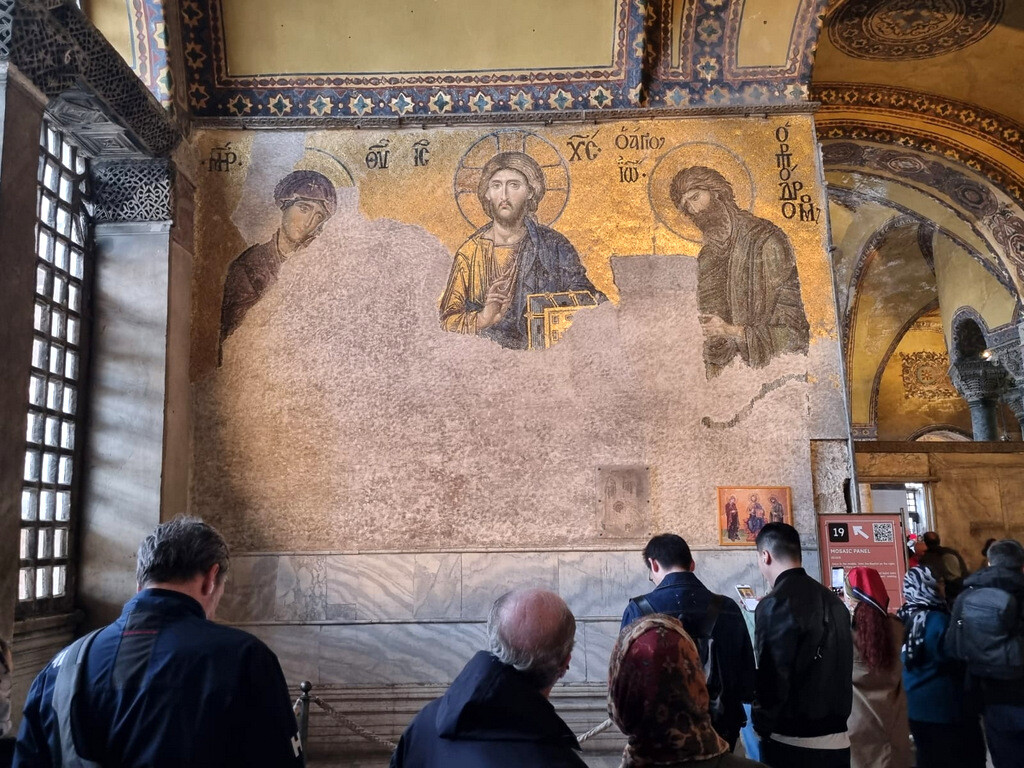
The interior surfaces of Hagia Sophia were not left undecorated. They were originally covered with extensive mosaics, many of which were designed to interact directly with the architectural system of the building.
In particular, the use of gold tesserae allowed light entering through the dome and upper windows to reflect across the walls, reinforcing the sense of a luminous and expanding space. In this way, the mosaics were not only decorative elements, but also part of the overall visual strategy that shaped how the interior was perceived.
Today, some of these mosaics can still be seen in the upper galleries.
For a detailed explanation of their history, themes, and symbolism, you can read my full guide to the Hagia Sophia mosaics.
Conclusion
Hagia Sophia is often described as a masterpiece of architecture.
But once you begin to examine how it was built, it becomes something more than a monument.
It becomes a record of decisions—of problems identified, solutions tested, and adjustments made over time. The dome, the supporting system, the reinforcements, and even the materials themselves all reflect a continuous effort to balance ambition with structural reality.
Some elements reveal innovation.
Some reveal limitation.
Some, like the later buttresses, reveal the necessity of intervention.
Together, they form a building that was never static. Hagia Sophia did not survive because it was perfect. It survived because it was adaptable.
If you would like to explore this story further, you can continue with my detailed articles on Byzantine Constantinople and Byzantine Churches in Istanbul, where I examine how this architectural and cultural system extended beyond a single monument into the wider city.
As a licensed tour guide specializing in Byzantine history in Istanbul, I also offer private walking tours that focus on the lesser-known layers of the city—from hidden churches to surviving fragments of the imperial past.
Because in Istanbul, Hagia Sophia is not an isolated structure.
It is part of a much larger story, still visible for those who know how to read it.

Hi Serhat!
May I please use the image ‘The Architecture of Hagia Sophia’ above – I am trying to find copyright owner but could not. I will acknowledge it was sourced through your website, for educational use only.
Turkey is so beautiful in photos, hope to visit one day!
Thank you so much!
Best,
Editha PANGAN
Copyright Manager
The Open Polytechnic of New Zealand
Hi Editha,
Unfortunately I do not have any authority regarding the copyright of this image. I used this image as a visual support for an educational article just like you.
Unfortunately I could not find the owner of the image either, but I thought it became anonymous because it was used on dozens of web pages.
If you are going to use it on an online platform, I do not think there will be a problem.
Best regards,
Serhat Engul
Thank You Serhan,
Great story.
Raymond Bandar
Dear Raymond, thank you for the feedback. I am happy to see that you have enjoyed my article.