The Byzantine Empire map is more than a collection of borders. It is a visual record of how one of the longest-lasting civilizations in history expanded, adapted, and gradually transformed over more than a thousand years.
What began as the eastern half of the Roman Empire after the division of 395 did not remain the same. Over time, this state developed into a distinct political and cultural world that we now call Byzantium.
In this article, you will follow that transformation step by step. Through a series of maps and carefully structured sections, the story moves from the foundation of Constantinople to the final fall of the city in 1453. Rather than focusing only on dates and events, the aim is to understand how the empire changed — where it expanded, where it lost ground, and why those shifts mattered.
Because of its long history, the Byzantine Empire cannot be explained through a single narrative. It is a story of continuity and change, shaped by wars, internal conflicts, religious debates, and shifting political realities.
Seen through the lens of a map, however, this complex history becomes much easier to follow.
Byzantine Empire Map Over Time with Facts
The maps in this guide show how the Byzantine Empire changed over time, beginning with the eastern half of the Roman world after its division and continuing through periods of expansion, contraction, and final decline.
At its greatest extent under Justinian I, the empire briefly re-established control over much of the Mediterranean. In later centuries, those territories were gradually lost, and the map became smaller and more fragmented.
To understand these changes more clearly, it is helpful to begin with the final phase of the Roman Empire. This provides the necessary context for how the Eastern Roman Empire — later known as Byzantium — emerged and developed.
The following sections are organized into 18 key moments. Each one focuses on a turning point, supported by maps that allow you to see how the empire evolved over time.
1. Foundation of Constantinople
The story of the Byzantine Empire does not begin with a sudden collapse or a dramatic break. It begins with a decision.
In the early 4th century, the Roman Empire was still vast, powerful, and very much alive. But governing such a large territory from a single center had already become impractical. Emperors were no longer living in Rome for long periods. Instead, they moved between strategic cities such as Milan, Trier, and Nicomedia, staying closer to the frontiers where real threats were emerging.
These threats were not minor. In the west, Germanic tribes were constantly testing the borders. In the east, the Sassanian Persian Empire remained a powerful and organized rival. The empire did not need a symbolic capital. It needed a functional one.
This is the context in which Constantine the Great made one of the most consequential decisions in Roman history.
After defeating his last rival Licinius in 324, Constantine became the sole ruler of the empire. Soon after, he turned his attention to a modest but strategically positioned city on the Bosphorus: Byzantium.
This was not an empty landscape. Byzantium had existed for centuries as a Greek colony. But Constantine saw something beyond its past. He saw its position.
From here, he could monitor both the Danube frontier in the north and the eastern provinces stretching toward Persia. The city stood at the intersection of major land and sea routes, connecting the Black Sea to the Mediterranean and linking Europe with Asia. Just as importantly, it sat on a naturally defensible peninsula, surrounded by water on three sides.
In 330, this vision took physical form.
Constantine inaugurated the city under the official name Nova Roma — New Rome. Although the name did not survive in common use, the idea behind it shaped everything that followed. This was not meant to replace Rome culturally overnight, but to extend its power into a new geographic reality.
The transformation was rapid and deliberate. Existing structures were expanded, and monumental projects were initiated almost simultaneously. The Hippodrome, already begun in earlier periods, was enlarged into a vast arena for public life and imperial spectacle. Nearby, the Great Palace was constructed as the political heart of the new capital. Along the main ceremonial avenue, the Mese, Constantine established his forum, marked by a towering column that carried his imperial image high above the city.
This was more than urban development. It was the relocation of imperial gravity.
Constantine also ensured that the city would not remain an empty shell. Members of the Roman elite were encouraged to settle here, often with incentives such as land grants and tax privileges. Administrative institutions followed. Trade networks quickly adapted.
Within a generation, Constantinople was no longer an alternative capital. It was the center.
And from this point on, when we look at a map of the Byzantine Empire, everything begins here.
2. The Division of the Roman Empire
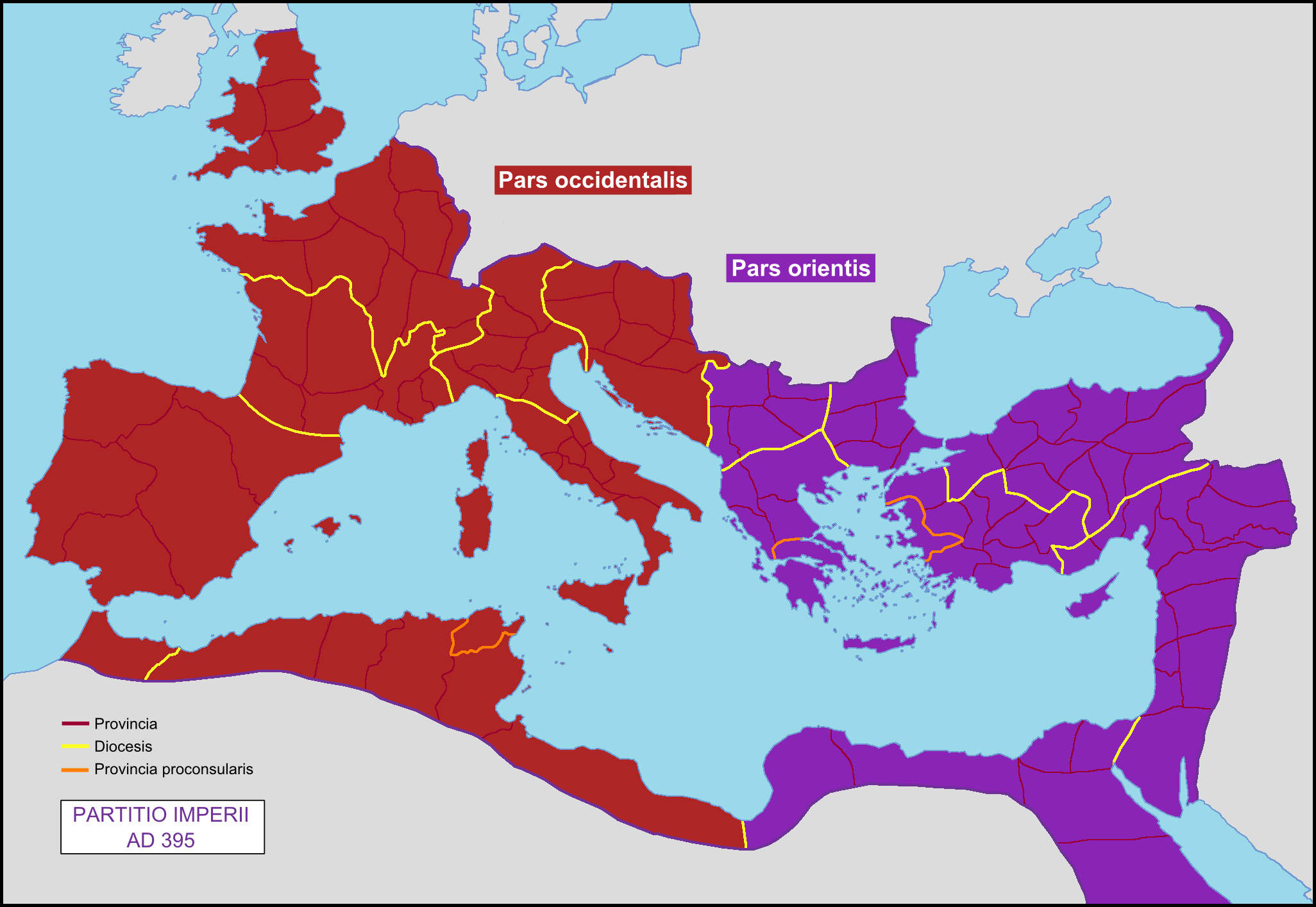
The division of the Roman Empire is often misunderstood as a dramatic split between two rival states. In reality, it was a practical solution to a long-standing problem.
By the late 4th century, the empire had simply become too large to govern effectively from a single center. Emperors were already managing different regions separately, supported by their own courts and administrative systems. What happened in 395 was not a sudden rupture, but the formalization of an arrangement that had been developing for decades.
When Theodosius I died in 395, he left the empire to his two sons. Arcadius took control of the eastern provinces from Constantinople, while Honorius ruled the western half, initially from Milan and later from Ravenna.
At this stage, there were still not two separate empires in the minds of their citizens. There was one Roman world, governed by two emperors.
Over time, however, the differences between East and West became more visible.
The Western Roman Empire faced increasing pressure from migrating and invading Germanic groups. These movements disrupted local economies, weakened central authority, and gradually fragmented the political structure. By contrast, the Eastern provinces remained relatively stable. They retained strong urban centers, more efficient tax systems, and access to the major trade routes that connected the Mediterranean with Asia.
Geography played a decisive role in this divergence. The eastern territories included Anatolia, the Levant, and Egypt — regions that were not only easier to defend but also significantly wealthier. The control of key agricultural lands, especially the grain supplies of Egypt, ensured a steady flow of revenue. At the same time, Constantinople’s position allowed the eastern government to respond more quickly to threats along both the Danube frontier and the eastern borders.
This imbalance became clear in the 5th century.
While the West struggled to contain external pressures, the East adapted. In some cases, it even used its financial strength to redirect threats rather than confront them directly. Groups that could not be stopped militarily were sometimes paid, negotiated with, or pushed toward western territories.
In 476, the Western Roman Empire collapsed when the last emperor was deposed. But this was not the end of Rome.
In the East, the empire continued — politically organized, economically functional, and fully aware of its Roman identity.
And from this point forward, when we look at the map, what survives is not a new empire, but the eastern half of an old one that learned how to endure.
3. Facts about the Byzantine Empire
At this point, a modern reader might expect the story to continue with a new name. But that is not how it worked.
The people living in Constantinople and across the eastern provinces did not see themselves as part of a “Byzantine Empire.” They called themselves Romans.
Their emperors ruled as Roman emperors, and their political system was a direct continuation of the Roman state. Figures such as Julius Caesar, Augustus, and Constantine were not distant historical references for them, but part of their own lineage and identity.
The term “Byzantine Empire” is a much later invention. It was introduced by Western scholars in the 16th century as a way to distinguish the medieval Eastern Roman Empire from the earlier Roman Empire centered in Italy. The name itself comes from Byzantium, the ancient Greek settlement on which Constantinople had been built.
This distinction, however, reflects a modern perspective rather than the reality of the time.
For centuries after the fall of the Western Roman Empire, Constantinople remained the only functioning center of Roman political authority. From its own perspective, it was not preserving Rome’s legacy — it was Rome.
At the same time, the character of this empire gradually evolved. While its institutions remained rooted in Roman law and imperial tradition, its culture became increasingly shaped by the Greek-speaking world of the eastern Mediterranean. Greek replaced Latin as the dominant language of administration and daily life, and Orthodox Christianity became a defining element of its identity.
This dual nature — Roman in structure, Greek in culture — is one of the defining features of what we now call the Byzantine Empire.
The gap between how the empire saw itself and how it was perceived in the West also widened over time. After the coronation of Charlemagne as a rival emperor in Western Europe, the political meaning of “Rome” became contested. In this context, referring to the eastern empire as something other than Roman was not just a matter of terminology, but also of legitimacy.
Interestingly, this Roman identity did not disappear even after the empire itself came to an end.
When Mehmed II captured Constantinople in 1453, he adopted the title “Kayser-i Rûm” — Caesar of Rome. Likewise, the Orthodox Christian population of the former empire continued to be known as “Rum,” meaning Roman, within the Ottoman system.
In other words, the name “Byzantine” may help us describe this empire today. But for those who lived within it, there was never any doubt about who they were.
4. The Roman Capital Constantinople
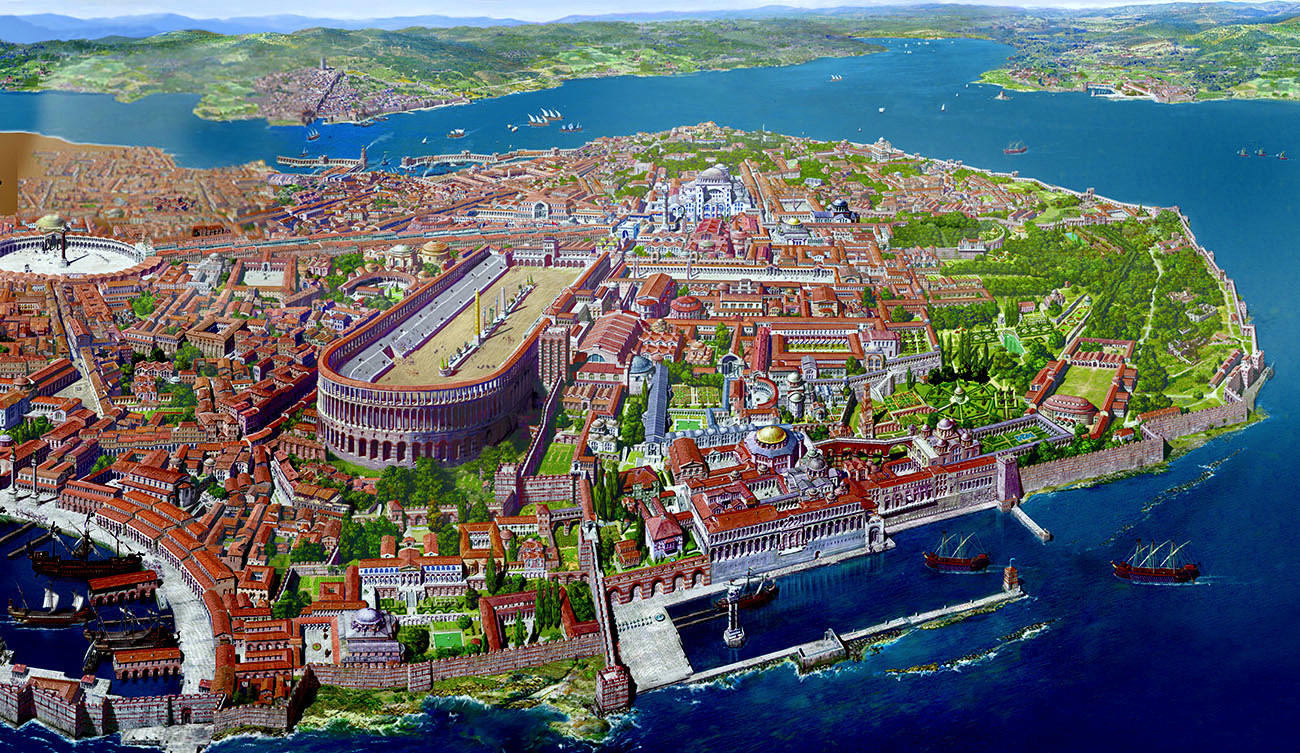
Constantinople was not just a new capital. It was a fully functioning Roman city, built to reflect the power, structure, and daily life of the empire.
At the heart of this urban life stood the Hippodrome of Constantinople. Inspired by the Circus Maximus in Rome, it was far more than a place for entertainment. Chariot races were the main attraction, but the Hippodrome also served as the only space where the emperor and the public could directly interact.
The atmosphere here was rarely neutral. The crowds were organized into factions, most notably the Blues and the Greens. These were not simply sports teams. Over time, they came to represent broader social and political identities within the city. The Blues were often associated with the aristocracy and the established elite, while the Greens drew much of their support from merchants, craftsmen, and seafaring communities.
Through these factions, the Hippodrome became something close to a public arena of opinion. It was where celebrations took place, but also where discontent could surface. In a city where formal political participation was limited, this space carried a different kind of voice.
The imperial presence was never far away. The Hippodrome was directly connected to the Great Palace of Constantinople, allowing the emperor to appear before the crowds without ever fully leaving the controlled environment of the palace. This physical connection was deliberate. It reflected the balance between visibility and authority that defined imperial rule.
Beyond the Hippodrome, the city was structured along monumental lines. The main ceremonial avenue, known as the Mese, linked the key public spaces of Constantinople. Along this route stood the Forum of Constantine, marked by a towering column that once carried the statue of Constantine the Great himself.
The city was also filled with monuments brought from across the empire. One of the most striking examples is the Obelisk of Theodosius, originally erected in Egypt and later transported to Constantinople. Its presence in the center of the Hippodrome was not accidental. It symbolized the reach of Roman power, gathering pieces of distant lands into a single imperial setting.
Other major structures defined the skyline of the early capital. The Church of the Holy Apostles stood as one of the most important religious buildings of the city, while palaces, forums, and public spaces created a dense and organized urban fabric that followed long-established Roman traditions.
Much of this world has disappeared over time, but it has not vanished completely.
Even today, fragments of this Roman capital remain embedded in modern Istanbul. Columns, obelisks, and sections of ancient structures still stand where they were first placed, quietly marking the outlines of a city that once served as the center of an empire.
5. Barbarian Attacks and Religious Divisions
From the 5th century onward, the Eastern Roman Empire faced growing pressure from forces beyond its borders. While the Western Empire struggled to contain these movements, the East was forced to defend its own frontiers with increasing urgency.
Among the most formidable of these threats were the Huns.
Under the leadership of Attila, their campaigns devastated large parts of the Balkans in the mid-5th century. Cities were sacked, agricultural lands were disrupted, and the imperial administration was pushed to its limits. At times, the threat came close enough to raise concerns for Constantinople itself.
Yet the capital did not fall.
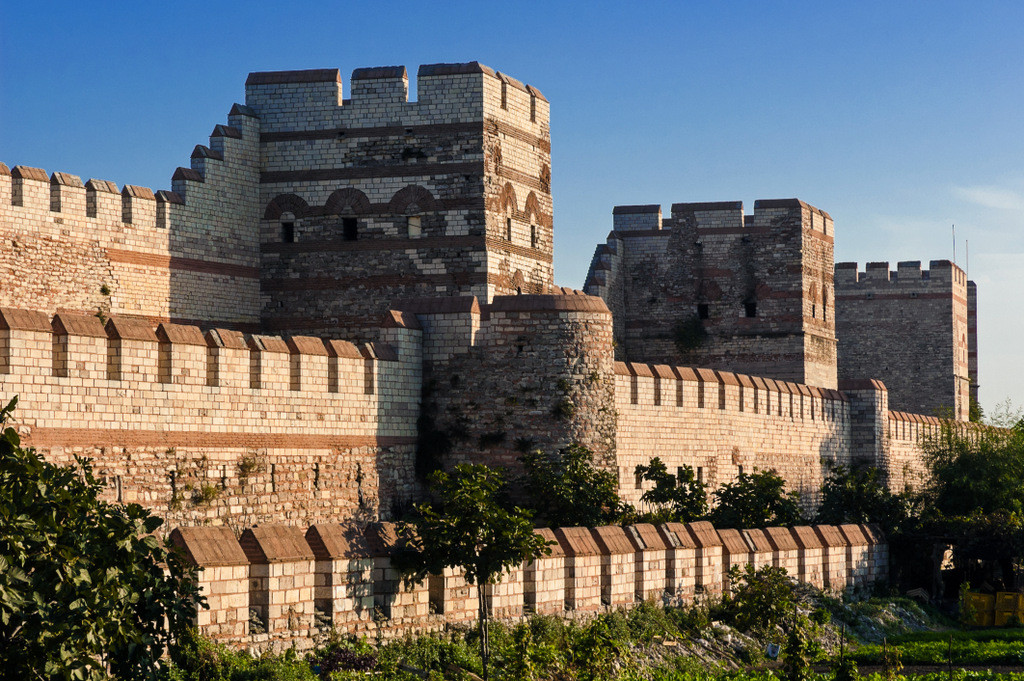
One of the key reasons was the construction of the massive land walls built during the reign of Theodosius II. These fortifications, stretching across the western edge of the city, created a defensive system that would protect Constantinople for centuries. While the surrounding regions suffered repeated incursions, the city behind these walls remained secure.
This defensive advantage also explains why the Eastern Empire was not in a position to assist the West in a decisive way. While the Western Roman Empire was collapsing under the pressure of Germanic invasions, the East was managing its own survival. Diplomacy, tribute, and strategic defense often replaced direct confrontation.
In 476, the Western Roman Empire came to an end. But the pressures that contributed to its fall did not disappear. They simply shifted.
At the same time, another form of division was emerging within the empire — one that could not be contained by walls.
Religious disagreements, especially those concerning the nature of Christ, began to create deep and lasting divisions. One of the most significant of these was the rise of Monophysitism, a theological position that differed from the doctrine accepted by the imperial church.
What might appear today as a purely doctrinal debate had much broader implications at the time. Religious identity was closely tied to regional, cultural, and political loyalties. Provinces such as Egypt and Syria, which were among the most economically valuable parts of the empire, became strongholds of beliefs that did not always align with the decisions made in Constantinople.
These differences gradually weakened internal cohesion.
Even in the capital, the divisions could be felt. The rival factions of the Hippodrome, the Blues and the Greens, were no longer only social or political groups. Their rivalries increasingly reflected deeper ideological and religious tensions within the city.
By the end of the 5th century, the Eastern Roman Empire had survived the external pressures that had brought down the West. But it had also entered a new phase, where internal divisions would become just as significant as threats from beyond its borders.
6. Byzantine Empire Map under Justinian
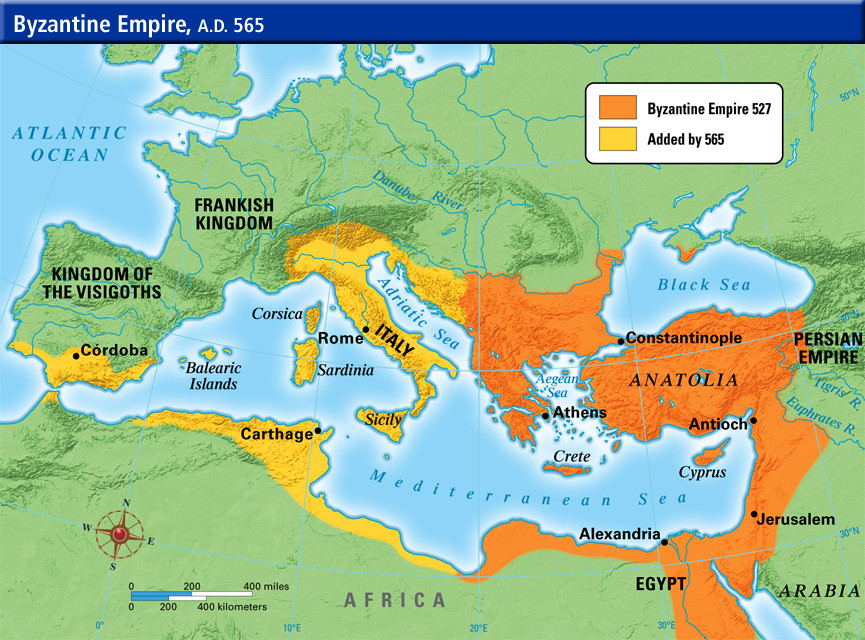
By the 6th century, the Eastern Roman Empire had stabilized after generations of pressure. Under the rule of Justinian I, it entered a new phase — one defined not by survival, but by ambition.
Justinian did not see himself as the ruler of a reduced eastern state. In his view, the Roman Empire had not disappeared in the West. It had simply been interrupted. His goal was to restore it.
This vision, often described as Restitutio Imperii, shaped the military strategy of his reign.
From Constantinople, campaigns were launched across the Mediterranean. The most remarkable of these expeditions were led by Belisarius, one of the most capable generals of the age. With relatively limited forces, he defeated the Vandal Kingdom in North Africa, bringing a crucial region of the former Western Empire back under imperial control.
Soon after, attention shifted to Italy.
The long and costly wars against the Ostrogoths gradually returned the Italian peninsula, including Rome itself, to imperial rule. These victories were later reinforced by commanders such as Narses, who completed the reconquest in the region.
At its height, the empire extended far beyond its eastern core. It controlled large parts of North Africa, Italy, and even sections of southern Spain. When viewed on a map, this expansion is striking.
For a brief moment, the Mediterranean once again resembled a Roman world.
This achievement, however, was not only the result of military success. It also reflected the deeper structure of the empire. The administrative systems, legal traditions, and military organization inherited from Rome continued to function effectively, while the intellectual and cultural life of the eastern Mediterranean — rooted in Greek language and learning — provided an additional layer of cohesion.
This combination allowed the empire to operate across vast distances, coordinating campaigns from Constantinople to the western edges of the Mediterranean.
Yet the scale of this expansion also revealed its limits.
Holding such a wide territory required constant military presence, stable finances, and uninterrupted communication. Even at the moment of its greatest extent, the empire was balancing ambition with strain.
When we look at the map of the Byzantine Empire under Justinian, we are not only seeing its largest borders. We are also seeing the peak of a project that would prove difficult to sustain.
7. Nika Revolt and Codex Justinian
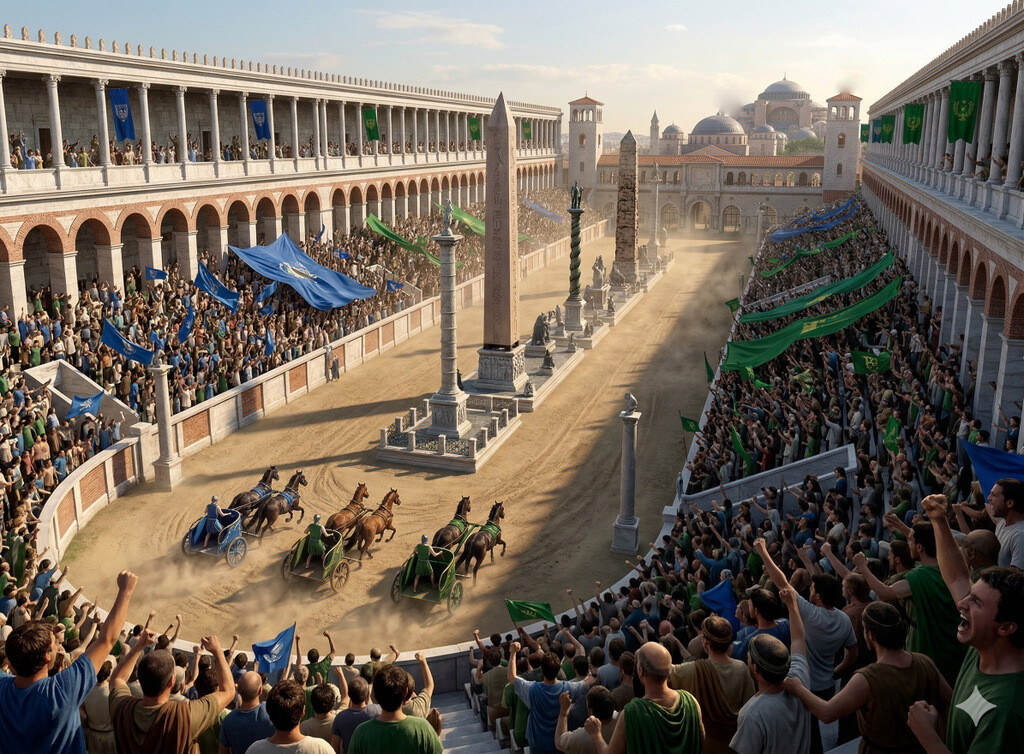
The reign of Justinian I is often remembered for its military successes and the vast territories shown on imperial maps. Yet at the very height of this expansion, the stability of the empire was tested from within.
In 532, Constantinople became the center of one of the most violent uprisings in its history.
The revolt, known as the Nika Revolt, did not begin as a simple conflict. It grew out of multiple tensions that had been building over time. Heavy taxation, administrative corruption, and dissatisfaction with imperial authority had already created a fragile atmosphere in the city. The rival factions of the Hippodrome — the Blues and the Greens — provided the structure through which this discontent could erupt.
What made this uprising different was the moment when these opposing groups acted together.
Crowds gathered in the Hippodrome of Constantinople, shouting “Nika” — meaning “Victory.” The unrest quickly spread beyond the arena. Fires broke out across the city, and large parts of Constantinople, including major public buildings, were destroyed.
For a brief period, imperial control seemed uncertain.
At the height of the crisis, Justinian is said to have considered abandoning the city. According to historical accounts, it was Theodora who persuaded him to stay. Her reported words — that imperial power was worth more than life itself — marked a turning point in the response to the revolt.
The suppression that followed was decisive and brutal.
Imperial forces under Belisarius and other commanders trapped the rebels inside the Hippodrome. Thousands were killed in a single operation, bringing the uprising to an end.
The city, however, had been transformed.
In the aftermath of destruction, Justinian initiated a program of reconstruction that would redefine Constantinople. One of the most significant results of this effort was the construction of Hagia Sophia, built on the site of an earlier church that had been destroyed during the revolt. Completed in a remarkably short period, it became the architectural and symbolic center of the empire.
At the same time, another project was taking shape — one that would have an impact far beyond the city itself.
Under the supervision of the jurist Tribonian, imperial authorities compiled and organized centuries of Roman legal tradition into what is now known as the Codex Justinianus. This work did not introduce a new legal system, but clarified, systematized, and preserved the existing one. Its influence would extend into later European legal traditions and remain visible even in modern civil law systems.
Taken together, these developments reveal the dual character of Justinian’s reign.
It was a period of expansion and ambition, but also one of crisis and reconstruction. The same ruler who extended the empire’s borders across the Mediterranean also faced a moment when control of his own capital was nearly lost.
And from that moment of instability emerged some of the most enduring achievements of the Byzantine world.
8. The Spread of Islam
At the beginning of the 7th century, the Eastern Roman Empire seemed to have overcome one of the greatest challenges in its history.
Under the leadership of Heraclius, the empire had fought a long and exhausting war against the Sasanian Persians. After years of setbacks, Heraclius managed to turn the tide. His campaigns pushed deep into Persian territory, and the imperial army even reached Ctesiphon, the heart of the enemy state.
For a brief moment, it appeared that a new period of stability was about to begin.
But this moment was deceptive.
The decades of warfare between Byzantium and Persia had come at a heavy cost. Both empires were severely weakened — financially, militarily, and demographically. Resources had been drained, armies had been exhausted, and large regions had been left vulnerable.
It was in this context that a new force emerged from the Arabian Peninsula.
Following the expansion of Islam under Muhammad, a series of campaigns began that would rapidly expand into neighboring territories. These armies were not only highly mobile but also driven by a strong sense of unity and purpose that set them apart from the fragmented political landscape they encountered.
At first, the scale of this transformation was not fully understood.
The Byzantine administration, still recovering from its conflict with Persia, did not immediately recognize the long-term implications of these early advances. But as confrontations increased, it became clear that this was not a temporary disturbance. It was a structural shift in the balance of power.
The impact was swift.
Within a relatively short period, some of the most important regions of the empire began to slip away. Provinces such as Syria, Palestine, and Egypt — areas that had long been central to the empire’s economy and administration — were no longer secure.
The reasons for this rapid change were not only military.
In several of these regions, local populations had already developed tensions with the central government. Religious differences, particularly those that had deepened in earlier centuries, played a role in shaping these reactions. In some cases, the new rulers were perceived not simply as conquerors, but as an alternative to existing pressures.
For Heraclius, this shift marked a dramatic reversal.
The emperor who had restored the empire’s position against Persia lived long enough to witness the loss of much of what he had defended. The sense of recovery that followed his victories gave way to a new reality, one in which the empire was no longer expanding, but contracting.
By the middle of the 7th century, the map of the Eastern Mediterranean had been fundamentally altered.
And the Byzantine Empire, which had once dominated these regions, was forced to redefine its place within a rapidly changing world.
9. Byzantine-Arab Wars
The initial shock of the 7th century quickly turned into a long period of confrontation.
The wars between the Byzantine Empire and the emerging Islamic states were not a single conflict, but a prolonged struggle that would shape the eastern Mediterranean for centuries. What began as a rapid series of losses gradually evolved into a sustained effort to defend what remained.
One of the decisive early moments came in 636.
At the Battle of Yarmouk, Byzantine forces faced a well-organized and highly mobile army led by Khalid ibn al-Walid. The defeat was overwhelming. Much of the imperial field army in the region was lost, and with it, the empire’s ability to maintain control over Syria.
From that point on, the strategic balance shifted permanently.
Cities that had been central to the empire for centuries — including Alexandria, Jerusalem, and Damascus — were gradually lost. The eastern Mediterranean, once dominated by Byzantine administration, was now contested terrain.
Faced with these realities, the empire adapted.
Rather than attempting to recover vast territories in open battle, Byzantine strategy began to change. Defensive lines became more important than expansion. Natural barriers, especially the mountain ranges of Anatolia, were used as shields. The empire reorganized its military and administrative system, gradually developing what would later be known as the theme structure — a network of regional forces designed for rapid local defense.
This transformation marked a turning point.
The Byzantine Empire was no longer the dominant power of the Mediterranean. It had become a state focused on survival.
Yet survival did not mean passivity.
Despite repeated losses on land, Constantinople itself remained beyond reach. The city’s fortifications, combined with its control over the surrounding waters, made it extraordinarily difficult to capture. Several large-scale attempts were made to take the capital, but none succeeded.
Naval warfare played a crucial role in this resistance.
Byzantine forces developed and deployed a weapon later known as Greek Fire, a substance capable of burning even on water. Used against attacking fleets, it became one of the most effective defensive tools available to the empire and contributed significantly to the failure of maritime assaults on the city.
Over time, the conflict settled into a pattern.
Frontiers shifted, raids continued, and both sides adjusted to a long-term balance of power. The Byzantine Empire, though reduced in size, had secured a defensible core centered on Anatolia and the Balkans.
This was no longer the empire of Justinian.
But it was an empire that had learned how to endure in a very different world.
10. Byzantine Iconoclasm
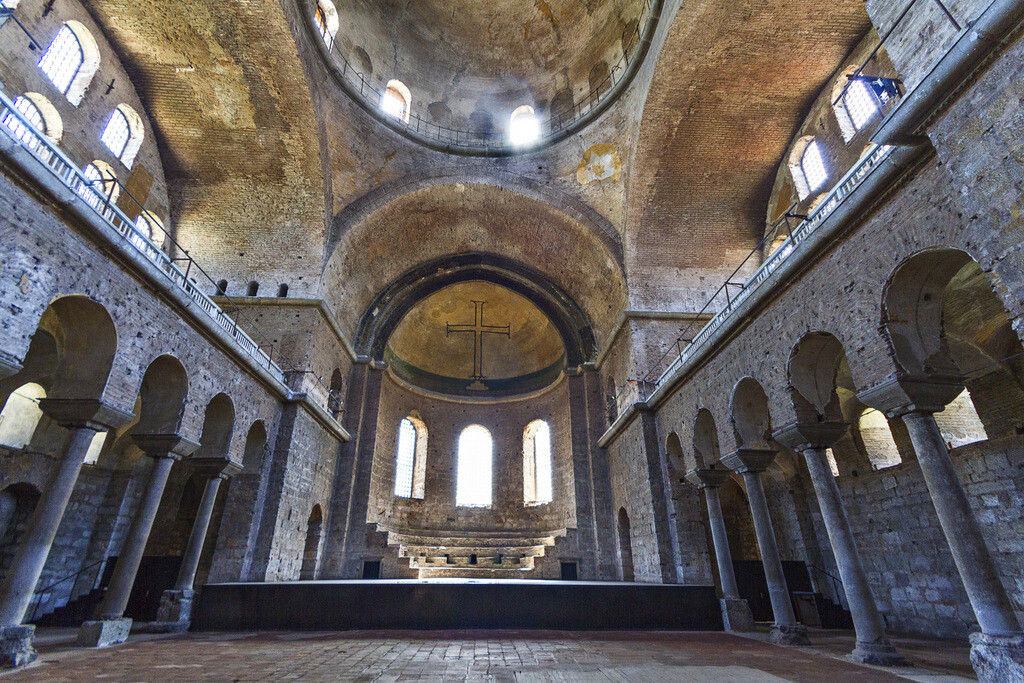
By the early 8th century, the Byzantine Empire had survived repeated external threats, but the cost of this survival was visible everywhere.
Large territories had been lost, populations had shifted, and the balance of power in the eastern Mediterranean had changed permanently. These developments were not only political or military. They also had a profound impact on how the empire understood itself.
In this atmosphere of uncertainty, a new question began to take shape.
Why had the empire suffered so many losses?
For some, the answer was not to be found on the battlefield, but in faith.
When Leo III came to power, he introduced a policy that would redefine the relationship between religion, society, and the state. This policy, later known as Iconoclasm, focused on the rejection of religious images.
Icons, mosaics, and painted representations of sacred figures had long been central to Byzantine religious life. They were not merely decorative elements, but objects of devotion. However, critics argued that these practices had moved too close to idolatry.
In a period marked by continuous setbacks, this argument gained strength.
Leo III and his supporters believed that divine favor had been lost, and that the empire’s misfortunes were a form of punishment. Removing these images, in their view, was a way to restore balance and regain protection.
The policy, however, was not only religious.
Monasteries had accumulated significant wealth and influence over time. They controlled large estates, enjoyed tax privileges, and were often outside the direct reach of imperial authority. By targeting the use of icons, the state also found a way to limit this power. Monastic properties were confiscated, and resources were redirected toward the needs of the empire, including the military.
As a result, Iconoclasm became both a spiritual reform and a political strategy.
Its effects were felt across the empire. In regions closer to the eastern frontiers, where the pressure of war was constant, the policy found more support. In contrast, areas such as Greece and parts of Italy, where artistic traditions were deeply rooted, resisted these changes.
This division extended beyond imperial borders.
Relations with the western Church deteriorated, as religious and political differences became increasingly difficult to reconcile. What had once been a shared Christian framework began to fragment into separate traditions.
Within the empire itself, the consequences were equally lasting.
Artistic production was interrupted, and many earlier works were destroyed or altered. The visual culture that had defined Byzantine religious life for centuries was temporarily replaced by a more restrained aesthetic.
Yet, like many developments in Byzantine history, this period did not represent a final break, but a transformation.
In time, the use of icons would be restored. But the debates, conflicts, and reforms of this era left a permanent mark on the structure of the empire and on its relationship with both its own people and the wider Christian world.
11. Byzantine Empire Map under Basil II
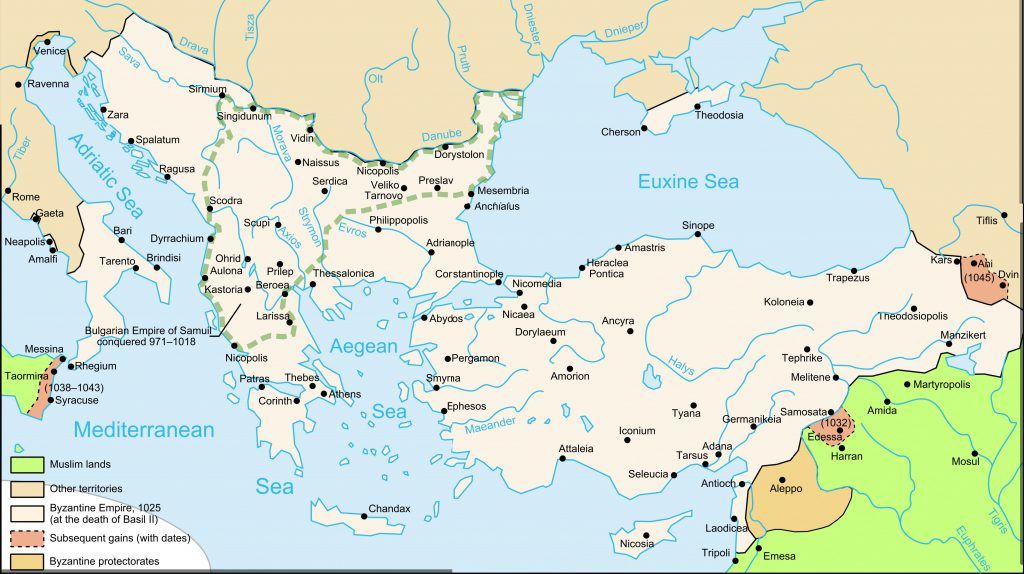
By the late 10th century, the Byzantine Empire had recovered from the crises of earlier centuries and entered a new period of strength.
Following the end of Iconoclasm, political stability gradually returned, and imperial authority was reasserted across key regions. This phase, often associated with the Macedonian dynasty, marked a revival not only in governance but also in cultural and religious life.
Under the rule of Basil II, this recovery reached its peak.
Unlike the expansive but fragile ambitions of earlier emperors, Basil’s approach was measured and deliberate. His campaigns focused on securing and stabilizing the empire’s core territories rather than extending them beyond sustainable limits. The result was a map that appeared more compact than that of Justinian, but far more resilient.
One of Basil’s most significant achievements was in the Balkans.
After years of conflict, he brought the Bulgarian state under imperial control, restoring Byzantine authority up to the Danube River. This not only expanded the empire’s territory but also established a strong and defensible northern frontier.
At the same time, the eastern borders remained stable, allowing the empire to maintain a balance between its European and Asian domains. Trade routes functioned efficiently, agricultural production was secured, and the imperial treasury accumulated substantial reserves.
Constantinople once again stood at the center of a well-organized and prosperous state.
Basil himself was known more as a soldier than a patron of the arts. He spent much of his reign on campaign, personally leading his armies and maintaining strict control over both military and administrative structures. His authority was rarely challenged, and the empire under his rule functioned with a level of discipline that had been difficult to achieve in earlier periods.
Yet this strength came with a limitation.
Basil did not establish a clear line of succession. His long reign ensured stability during his lifetime, but it also meant that the transition after his death would be abrupt. Without a strong successor, the systems he had maintained so carefully would be left vulnerable to internal competition.
When we look at the map of the Byzantine Empire under Basil II, we see a state that had regained control, secured its borders, and accumulated wealth.
But we are also looking at the last moment when this balance held together.
12. The Great Schism
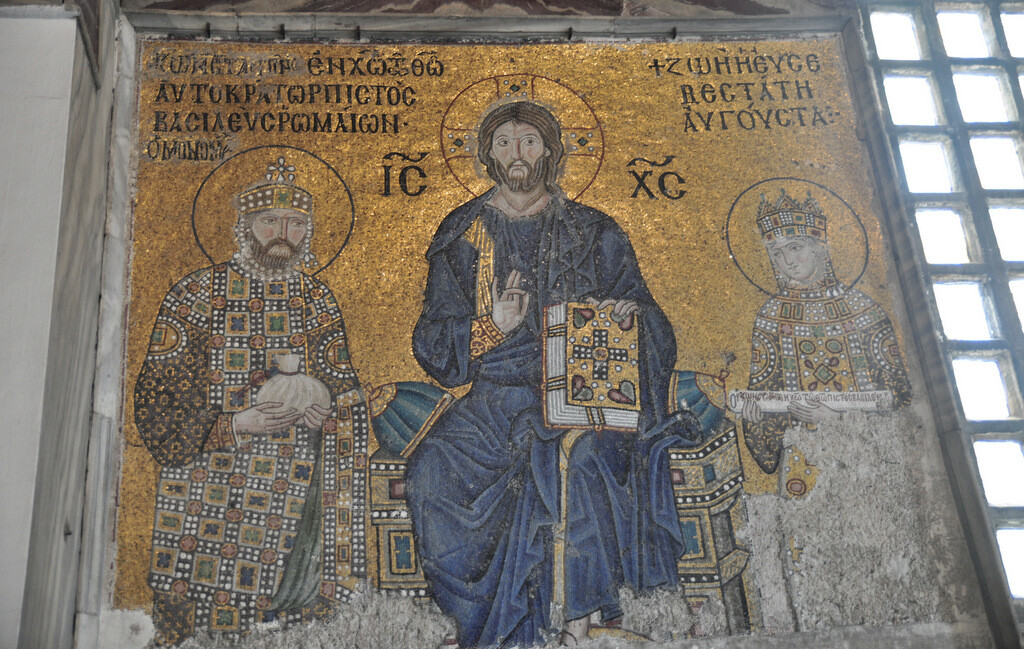
By the mid-11th century, the Byzantine Empire was still a major power, but the stability established under Basil II had begun to weaken.
After his death, imperial authority gradually shifted away from the military leadership that had defined his reign. Court officials and bureaucratic elites gained influence, often prioritizing political control over long-term stability. In this environment, the empire’s internal balance became more fragile.
At the same time, a deeper and more enduring division was reaching its final stage.
The relationship between the churches of Rome and Constantinople had been evolving for centuries. Differences in language, tradition, and practice had slowly created distance between the Latin-speaking West and the Greek-speaking East. Earlier conflicts, including those that emerged during the period of Iconoclasm, had already strained this relationship.
By the 11th century, these differences were no longer easy to contain.
Some of the disagreements appeared technical — questions about liturgy, theological formulations, and ritual practices. But beneath these issues lay a more fundamental problem: authority.
The Bishop of Rome, known as the Pope, claimed a universal leadership role over the Christian world. In Constantinople, this claim was not accepted in the same way. The Patriarch of Constantinople viewed the Church as a network of equal centers, rather than a hierarchy led by a single figure.
This disagreement created a tension that extended beyond theology.
In 1054, the situation reached a breaking point.
Representatives of Pope Leo IX arrived in Constantinople to negotiate with the local church leadership. The discussions failed. During a ceremony in Hagia Sophia, one of the papal envoys placed a document of excommunication on the altar, formally condemning the Patriarch of Constantinople.
The response was immediate.
The Patriarch and his supporters issued their own excommunication in return. What had been a long-standing tension was now formalized as a division.
This event is known as the Great Schism.
It did not create differences between East and West, but it confirmed them in a way that would be difficult to reverse. From this point onward, the Christian world was divided into two major traditions: the Roman Catholic Church in the West and the Eastern Orthodox Church in the East.
The consequences extended far beyond religious life.
For the Byzantine Empire, this division meant a weakening of ties with Western Europe at a time when external pressures were increasing. Diplomatic cooperation became more complicated, and mutual distrust deepened over time.
In the years that followed, this separation would shape not only religious identity, but also political alliances and conflicts across the region.
And for the empire itself, it marked another step toward a more isolated position in an increasingly fragmented world.
13. Byzantium and the Seljuk Empire
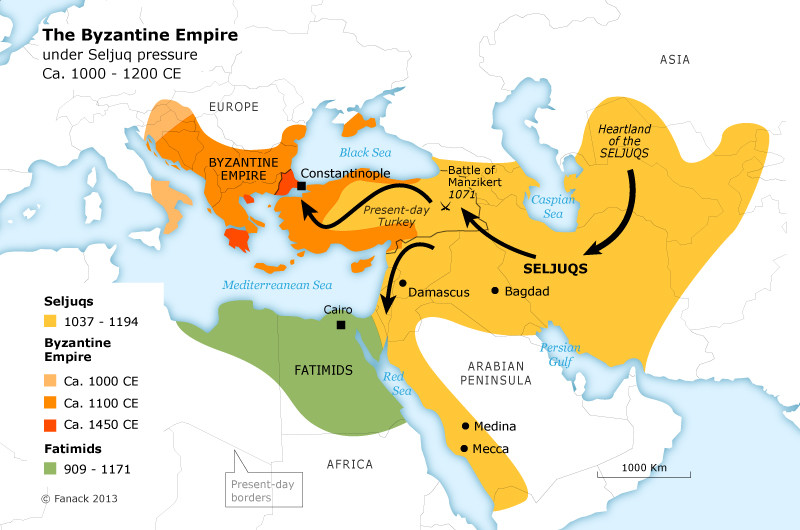
By the mid-11th century, the Byzantine Empire found itself in a very different position from the one it had held under Basil II.
While internal stability had weakened, a new power was rising in the east.
The Seljuks, a Turkic group that had moved westward from Central Asia, established themselves in the Iranian world and gradually built a large and organized empire. Centered around cities such as Isfahan, this new state combined nomadic military traditions with the administrative and cultural structures of the Islamic world.
Within a relatively short time, the Seljuks became one of the dominant forces in the region.
Their rulers gained recognition from the Abbasid Caliph, strengthening both their political legitimacy and their position within the broader Islamic world. Unlike earlier frontier groups that had interacted with Byzantium through raids and tribute, the Seljuks represented a more permanent and expansive presence.
This changed the nature of the eastern frontier.
For centuries, Byzantium had dealt with a range of smaller states and shifting alliances along its eastern borders. Now, it faced a single, coordinated power with the ability to project force across a wide area.
At the same time, population movements added another layer of pressure.
Turkic groups moved into Anatolia not only as part of military campaigns, but also in search of new lands. These migrations were not temporary incursions. They were the beginning of a gradual transformation of the region.
In Constantinople, these developments were met with concern.
The imperial court was divided, and the military system that had once secured the empire’s frontiers had weakened over time. In response, a new emperor, Romanos IV Diogenes, came to power with a clear objective: to restore control over the eastern provinces.
Romanos was a soldier by background and approached the situation as a military problem that required a decisive solution. Early campaigns brought some success and raised expectations.
But the broader situation was more complex.
The Seljuk ruler Alp Arslan was primarily focused on campaigns to the south, particularly against rival powers in the Islamic world. The Byzantine advance into eastern Anatolia was not initially the center of his attention.
This created a moment of uncertainty.
Two large powers were operating in the same region, each with different priorities, but increasingly aware of the other’s presence. The balance was unstable, and the conditions for a direct confrontation were gradually forming.
By the time the Byzantine army moved deeper into eastern Anatolia, the stage had already been set.
14. The Battle of Manzikert
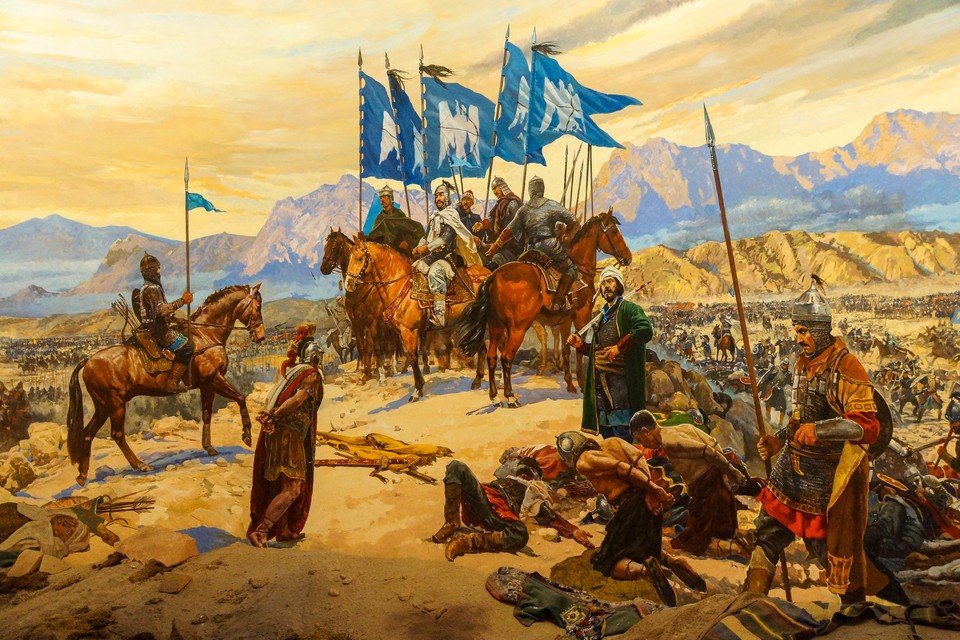
By the time the Byzantine army advanced into eastern Anatolia, the situation had already become unstable.
Emperor Romanos IV Diogenes aimed to secure the eastern frontier and push back the growing Seljuk presence. His plan was straightforward: reassert imperial control through a decisive campaign.
But from the very beginning, the operation was marked by miscalculations.
The Byzantine army was large, but it was not unified. It included a mix of professional soldiers, regional forces, and foreign mercenaries. Loyalty within the ranks was uneven, and political tensions in Constantinople had already extended into the field.
As the campaign progressed, another critical decision shaped what would follow.
Romanos divided his forces, sending a significant portion of the army to operate separately. This reduced the strength of the main force at a moment when coordination was essential.
At the same time, intelligence failures added to the uncertainty.
The emperor advanced toward the fortress of Manzikert, believing that the Seljuk ruler Alp Arslan was engaged elsewhere. Instead, he found himself facing a highly mobile and prepared Seljuk army.
The encounter that followed did not immediately favor one side.
In terms of numbers, the Byzantine army still held an advantage. But the conditions of the battlefield told a different story. The open terrain of the region favored the Seljuk forces, whose cavalry relied on speed, maneuverability, and coordinated movement.
As the battle unfolded, the Seljuks avoided direct confrontation, drawing the Byzantine forces forward and gradually wearing them down.
By the end of the day, the situation had become critical.
At the moment when the army needed cohesion, it began to break apart. Confusion spread through the ranks, and retreat orders were either misunderstood or deliberately ignored. The most decisive failure came from the rear guard, commanded by Andronikos Doukas.
Rather than supporting the main force, he withdrew from the battlefield.
This decision turned a difficult situation into a collapse.
As parts of the Byzantine army began to retreat, the Seljuk forces moved to encircle what remained. Units that had advanced too far could no longer regroup, and the structure of the army dissolved under pressure.
Despite the efforts of elite units, including the Varangian Guard, the imperial position could not be restored.
Romanos IV was captured.
The outcome of the battle was not simply a military defeat. It triggered a chain of events that would reshape the empire.
Although the Seljuk leadership treated the emperor with a degree of respect and released him after negotiations, the situation in Constantinople took a different turn. Political rivals moved quickly. Romanos was deposed, and internal conflict followed.
This internal struggle proved more damaging than the battle itself.
With the central authority weakened and the army fragmented, there was no effective force left to defend Anatolia. In the years that followed, Turkic groups moved deeper into the region, encountering little organized resistance.
The defensive system that had protected the empire for centuries had effectively collapsed.
When we look back at the Battle of Manzikert, it stands not as an isolated defeat, but as a turning point.
It was the moment when control over Anatolia — the strategic and economic heart of the empire — began to slip away.
15. The Sack of Constantinople
By the beginning of the 13th century, the Byzantine Empire had already been weakened by internal struggles and territorial losses.
Yet what followed in 1204 was not the result of a new external enemy.
It came from the West.
The Crusades, originally launched to secure Christian control over Jerusalem, had already brought large armies into the eastern Mediterranean. In earlier campaigns, Byzantine emperors had managed to cooperate with these forces when it suited their interests. But by the time of the Fourth Crusade, that balance had broken down.
What began as a military expedition toward the Holy Land gradually turned into something else.
Financial pressures, political intrigues, and shifting alliances redirected the crusading army toward Constantinople. A deposed Byzantine prince promised payment and support in exchange for help in reclaiming the throne. When these promises could not be fulfilled, the situation escalated rapidly.
At the center of these developments stood Enrico Dandolo, the leader of Venice, whose influence over the expedition played a decisive role.
The result was a direct assault on Constantinople.
For centuries, the city had resisted some of the most powerful armies in the world. Its land walls had held against Persians, Arabs, and Bulgarians. But in 1204, the attack came from a different direction.
The crusaders and their Venetian allies approached from the sea.
Using ships to breach the defenses along the Golden Horn, they were able to penetrate the city’s weaker maritime fortifications. Once inside, resistance quickly collapsed.
What followed was not a controlled occupation, but a systematic sack.
For several days, Constantinople was looted, burned, and stripped of its wealth. Churches, palaces, and public spaces were entered and emptied. Objects that had been preserved for centuries — relics, manuscripts, works of art — were destroyed or carried away.
Among the many losses were monuments taken directly from the city’s most symbolic spaces. The bronze horses that once stood in the Hippodrome were removed and transported to Venice, where they remain today as a visible reminder of this moment.
The damage was not only material.
This event marked a profound rupture within the Christian world. The division between East and West, already formalized in earlier centuries, now took on a new and irreversible form.
In the aftermath, a Latin state was established in Constantinople, while Byzantine elites retreated to other regions, including Nicaea and Trebizond, where they attempted to preserve what remained of imperial authority.
Although the city would eventually be recaptured, it never fully recovered from what had happened in 1204.
What had once been the wealthiest and most powerful city of the medieval world was left permanently diminished.
16. The Decline of the Byzantine Empire
When Constantinople was recaptured in 1261, the Byzantine Empire appeared to have regained its capital.
In reality, what remained was a very different state.
The decades of Latin rule had left the city severely damaged. Population levels had dropped, infrastructure had deteriorated, and many of the economic networks that once sustained the empire had shifted elsewhere. Rebuilding was possible in part, but the conditions that had supported Byzantine power in earlier centuries were no longer present.
The empire continued, but on a much smaller scale.
Its territories were fragmented, and its authority was limited. Regions that had once been integrated into a single imperial system now functioned with greater independence or had already broken away entirely.
At the same time, the economic balance of the eastern Mediterranean had changed.
Maritime trade, once dominated by Constantinople, was increasingly controlled by Italian city-states such as Venice and Genoa. In some cases, foreign merchants operating within Byzantine territory generated more revenue than the empire itself.
This shift further reduced imperial capacity.
Military strength also declined.
Without sufficient resources to maintain large standing armies, the empire relied more heavily on diplomacy, alliances, and, at times, foreign troops. Internal conflicts, including struggles for the throne, weakened central authority even further.
Yet this period was not defined only by decline.
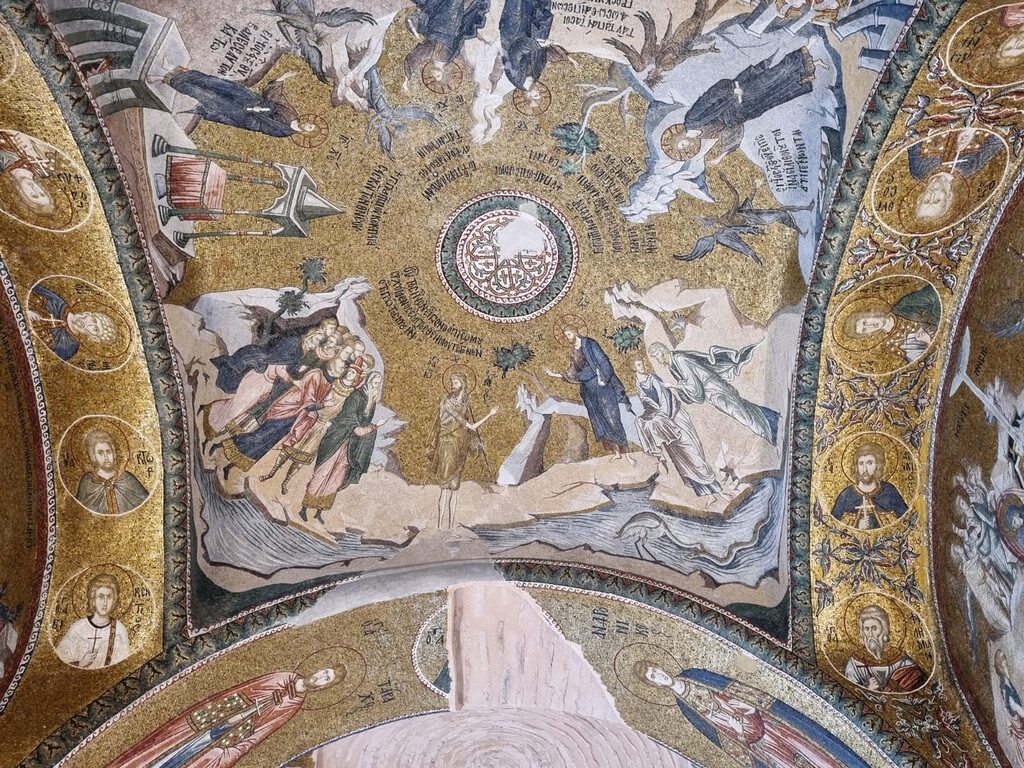
In cultural and artistic terms, the empire experienced a final phase of creativity. Churches were decorated with new mosaics and frescoes, and intellectual life continued within the reduced political framework. These developments reflected a society that, despite its material limitations, remained deeply engaged with its traditions.
Still, the broader trajectory was clear.
The Byzantine Empire had been transformed from a major imperial power into a collection of smaller, vulnerable territories centered on Constantinople and a few surrounding regions.
From this point onward, survival depended less on strength and more on circumstance.
And as new powers continued to rise in the region, the space for that survival would become increasingly narrow.
17. Byzantium and the Ottoman Empire
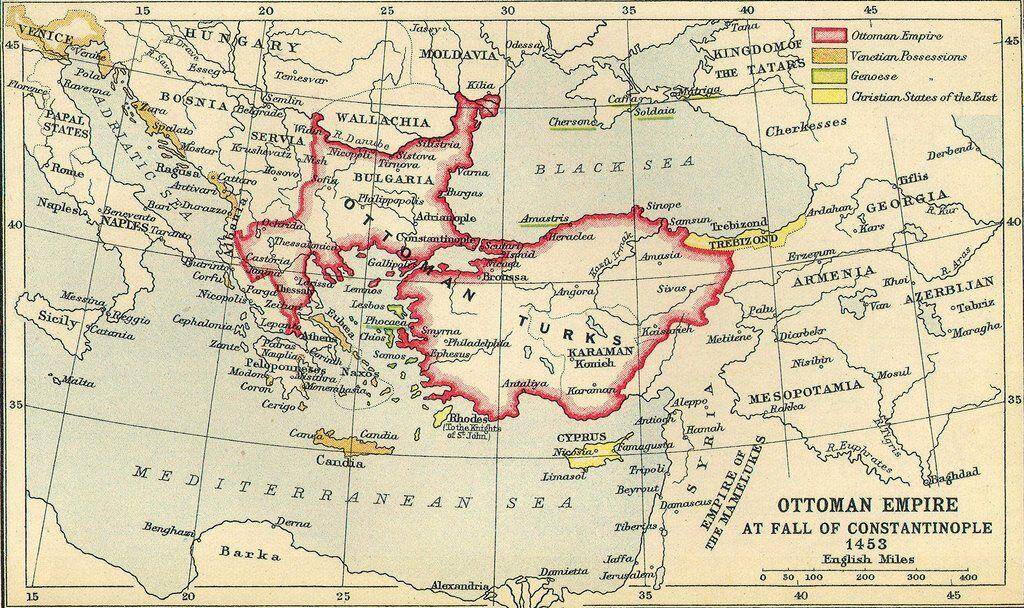
By the 14th century, the Byzantine Empire had been reduced to a shadow of its former self.
What remained was centered on Constantinople and a few scattered territories, surrounded by a rapidly expanding power.
The Ottomans.
Emerging from one of many Turkic principalities in Anatolia, the Ottoman state grew steadily through a combination of military strategy, diplomacy, and careful positioning. Unlike earlier powers that had challenged Byzantium, the Ottomans did not attempt a single decisive blow.
They advanced gradually.
The first major step came with the capture of key cities in northwestern Anatolia. Bursa fell in 1326, followed by Nicaea in 1331 and Nicomedia in 1337. With these losses, Byzantium’s last strongholds in Anatolia disappeared.
The connection between Constantinople and Asia was effectively severed.
The next phase shifted the balance even further.
In 1354, following a devastating earthquake, Ottoman forces established a permanent foothold in Gallipoli. From there, they expanded into the Balkans. Over time, cities such as Adrianople were taken and transformed into major centers of power.
With the capital moved to Edirne, the strategic picture became clear.
Constantinople was now surrounded.
To the east, Anatolia was firmly under Ottoman control. To the west, the Balkans were increasingly dominated by Ottoman forces. The Byzantine Empire, once a vast territorial state, had become an isolated enclave within a much larger system.
Yet this process was not defined by constant warfare.
There were periods of negotiation, alliances, and even cooperation. Byzantine emperors, facing limited options, sometimes aligned themselves with Ottoman rulers, accepting tributary status or providing military support in exchange for temporary stability.
These arrangements prolonged the life of the empire, but they did not change its trajectory.
Several attempts were made to capture Constantinople before the final conquest. Bayezid I laid siege to the city, but his campaign was interrupted by the arrival of Timur and the defeat at the Battle of Ankara. Later, Murad II renewed the effort, but shifting conditions in the Balkans and the intervention of Western powers prevented a decisive outcome.
Each time, Constantinople survived.
But not because it had regained its strength.
It survived because the circumstances around it had not yet aligned.
By the mid-15th century, that window was closing.
The empire now consisted of little more than the city itself, a small part of the surrounding region, and a few distant territories. On the map, it appeared as a small and isolated fragment, almost invisible within the expanding Ottoman domain.
The final confrontation was no longer a question of possibility.
It was only a matter of time.
18. The Fall of Constantinople
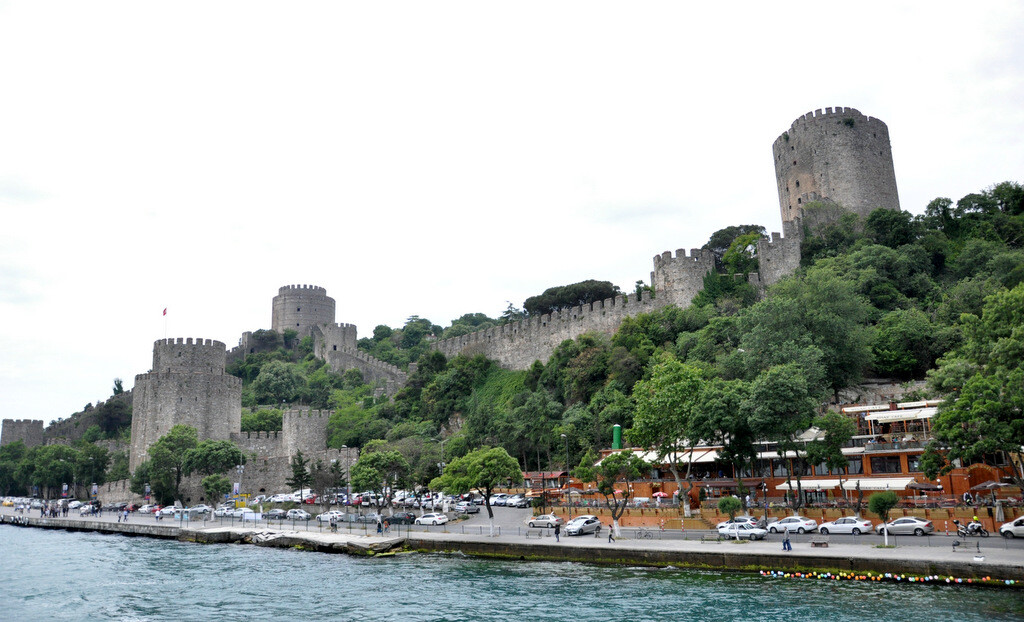
When Mehmed II ascended the Ottoman throne, he approached Constantinople not as an obstacle, but as a strategic necessity.
Previous attempts had shown that controlling the city required more than persistence. It required preparation.
One of his first actions was the construction of Rumeli Fortress on the European side of the Bosphorus. Positioned at the narrowest point of the strait, it allowed the Ottomans to control maritime traffic and effectively block aid coming from the Black Sea.
The city was being isolated.
Inside Constantinople, the situation was increasingly difficult. Emperor Constantine XI Palaiologos sought support from Western Europe, but the response was limited. Religious divisions, political concerns, and the memory of earlier conflicts reduced the possibility of large-scale assistance.
Those who did arrive were few.
Among them was the Genoese commander Giovanni Giustiniani, who took charge of key defensive positions along the land walls. The defenders, though determined, were limited in number.
The Ottomans, by contrast, were well prepared.
Their forces included a large and disciplined infantry, supported by artillery that represented a new phase in siege warfare. Massive cannons were used to target sections of the Theodosian Walls, structures that had protected the city for centuries but were not designed to withstand sustained bombardment.
The geography of the city also played a decisive role.
The chain that blocked access to the Golden Horn prevented a direct naval assault, but this barrier was eventually bypassed. Ottoman ships were transported over land and launched into the inlet, placing additional pressure on the city’s defenses.
After weeks of continuous siege, the situation reached its final stage.
On May 29, 1453, Ottoman forces launched a full-scale assault. The defenders resisted as long as they could, but the combination of sustained artillery damage, numerical superiority, and coordinated attacks eventually broke through the defenses.
During the final moments, Emperor Constantine XI is believed to have joined the fighting as an ordinary soldier, choosing to remain within the city rather than retreat.
With the fall of the walls, Constantinople was taken.
This event marked the end of the Byzantine Empire.
But it also marked a beginning.
Shortly after the conquest, Mehmed II entered the city and established it as the capital of the Ottoman Empire. Constantinople, which had served as the center of Roman and Byzantine power for over a thousand years, became the political and cultural heart of a new imperial system.
Despite the change in rule, the city’s past did not disappear.
Structures such as Hagia Sophia remained central to the urban landscape, carrying forward layers of history into a different era.
And in this way, the legacy of Byzantium continued — not as a political entity, but as a foundation within the city that had always defined it.
Conclusion
The history of the Byzantine Empire is not just the story of a lost state. It is the story of how a political system, a cultural identity, and a city managed to endure for more than a millennium under constantly changing conditions.
In preparing this guide, I drew on a combination of academic works and long-form historical narratives. Among the most influential were the multi-volume studies of John Julius Norwich, as well as the research of Stefanos Yerasimos and Doğan Kuban. In addition, narrative-driven sources such as Mike Duncan’s The History of Rome and Robin Pierson’s The History of Byzantium helped shape the storytelling approach used throughout the article.
However, bringing these elements together into a clear and accessible structure is largely the result of practical experience.
For more than 20 years, I have worked as a licensed tour guide in Istanbul, focusing especially on the Byzantine period. Explaining this history on-site — in places such as Hagia Sophia, the Hippodrome, and the surviving city walls — has played a major role in shaping how this story is presented here.
This article was also supported by modern tools where appropriate. Artificial intelligence was used at the editorial level to refine the text and eliminate inconsistencies in a long-form structure. In addition, some of the visual reconstructions were created using AI prompts based on academic references, allowing historical environments to be represented more clearly.
If you are interested in exploring this period further, you can find related articles in the Old City and History sections of the site. For those planning a visit to Istanbul, a private Byzantine history tour can also provide a more direct experience of the places discussed here.
📌 Note on Maps
Some of the maps used in this article come from historical archives and widely circulated visual sources. While they have been carefully selected to reflect the historical context as accurately as possible, their original authorship may not always be clearly identifiable.
If you are the owner of any of these images, please feel free to get in touch for proper attribution or removal.

This was very fun to read and thx for putting this out for us to see this amazing article.
Hi Kylan, thank you for the feedback on the article. I am happy to see that you have enjoyed reading it.
This was very helpful.
Hi Elena, I’m so glad my post was helpful to you.
If I ever make it to Istanbul- I’m definitely looking for you! Great article!
Hi Nan, thanks for your great feedback.
I have read many articles on Byzantine Empire. Your article is very clear and simple. I like that a lot. Thanks for all the hours of labor.
Hi Sam, I’m so glad you liked the article. I wanted to create an article on Byzantine history in the simplest and most explanatory way. It seems that I have achieved my goal. Thanks again for the feedback.
I have read many books about Byzantine history and this article presents a wonderful and accurate overview. The maps makes this overview even richer. It makes me come and visit the City once more. Very respectfully , I think that the English can be improved in a limited number of sentences but the meaning is always clear.
Hello Theo, I am glad that someone who knows about Byzantine history finds the article objective and accurate. I wrote this article when I just opened my blog. And to be honest, my English wasn’t mature enough to write a history article in 2015.
Over time I improved myself and now I am reorganizing old articles. There was no time to rewrite this article yet. I care about your opinion and will try to prioritize this post for re-editing.
I love this article it helped a lot with my work
Hi Bob, that’s great. I tried to fit what I know about Byzantine history into the shortest possible article, and it makes me happy that this summary works for people.
Well done Serhat, got enough knowledge about Byzantine.
Hi Zeeshan, thank you for the review. I am glad to see that it’s been useful for you.
Very objective and historically accurate narrative. Non biased at all.
Well done!
Thank you for the feedback. I am happy to see that you enjoyed reading it.
This is really educating and we will need more of this there later, thanks a lot.
Hello Sani, thank you for the review. I intend to provide more article about “Byzantine History” in the near future.